






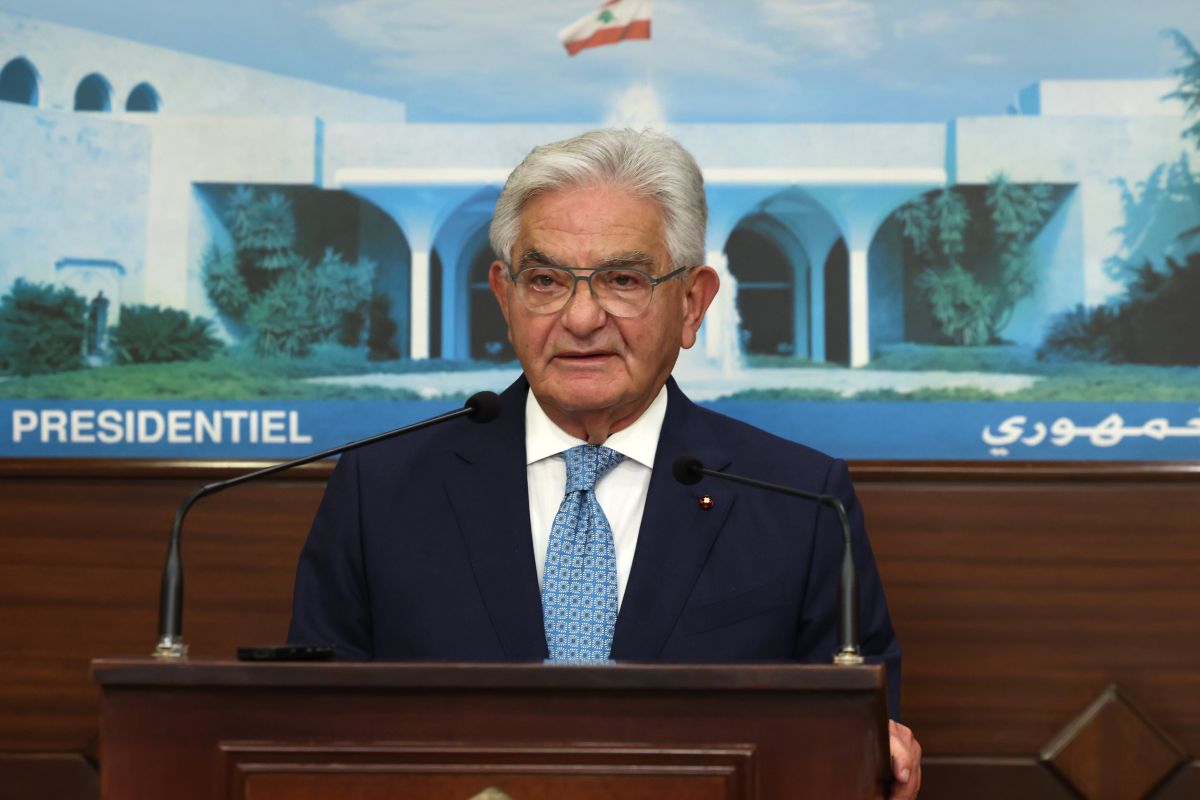
The president of the Association of Banks in Lebanon, Salim Sfeir, in Baabda, on May 14, 2026. (Credit: Photo published on the presidency's X account)






BEIRUT — The Association of Banks in Lebanon (ABL) reappointed Bank of Beirut CEO Salim Sfeir for a fourth consecutive term as its chairman Wednesday. At an extraordinary general assembly held earlier in the day, ABL members approved two exceptional amendments to its bylaws, once again increasing the number of board members from 12 to 14 and granting the incumbent chairman another exemption from the two-consecutive-term limit.
Sfeir first took the helm of the ABL in June 2019 and was re-elected in 2021. His third term had already been made possible in January 2025 by an "exceptional" amendment to the same provisions. Since taking office, the Bank of Beirut CEO has been one of the leading proponents of the banking lobby’s "hard-line" position on issues related to loss allocation and the restructuring of the sector.
While the renewal of Sfeir’s term was, according to our information, already virtually assured among the association’s members, Lebanese Swiss Bank Chairman Tanal Sabbah was the only person to run against him, under the slogan "Strengthening democracy and fighting sectarianism." A Shiite who describes himself as "anti-sectarian," Sabbah is among the members who have notably denounced the fact that the position is traditionally assigned to a specific religious community — in this case, the Maronite community.
An ordinary general assembly held immediately afterward approved the association’s reports and financial statements for 2025, elected its new board of directors and adopted its draft budget for 2027.
All 14 outgoing board members were re-elected: Salim Sfeir of Bank of Beirut, Nadim Kassar of Fransabank, Ghassan Assaf of BBAC, Walid Raphaël of Banque Libano-Française, Saad Azhari of BLOM Bank, Antoun Sehnaoui of SGBL, Raya Haffar al-Hassan of BankMed, Abdel Razak Achour of Fenicia Bank, Joseph Torbey of Crédit Libanais, Khalil Debs of Bank Audi, Tanal Sabbah of Lebanese Swiss Bank, Semaan Bassil of Byblos Bank, Raed Khoury of Cedrus Bank and Marwan Kheireddine of AM Bank.
Nadim Kassar retained the vice-chairmanship, Walid Raphaël remained secretary-general and Abdel Razak Achour remained treasurer.
Among the expenditures approved under ABL’s 2027 budget is a $2 million public-relations allocation for Lebanese media outlets, primarily television channels.

A banker familiar with the expenditure, speaking on condition of anonymity, said the funds had previously been used to finance "advertisements, donations to television channels and airtime for ABL representatives and members." According to the banker, the funds had been distributed "haphazardly" in previous years, without a structured communications program or formal terms of reference. He added that no clearly defined plan had yet been drawn up for this year’s spending.
While the expenditure was previously financed mainly by a handful of banks — particularly the 14 board members last year — its cost will now be distributed among ABL’s roughly 50 members through their membership fees.
A seat at the negotiation table
Discussions also addressed the banking sector’s exclusion from the ongoing negotiations between the International Monetary Fund (IMF), Banque du Liban (Central Bank, BDL) and the state over the allocation of tens of billions of dollars in financial-sector losses and the repayment of deposits unlawfully frozen since 2019.
"The general assembly requested that the banks be represented in the negotiations, either through the board or through a designated committee," the banker added.
According to the banker, Lebanese banks currently have no external firm representing them in the negotiations. Their collaboration with international consulting firm Ankura, which began in Aug. 2025 for that purpose, reportedly ended "around six months ago."
At the time, two banking sources told L’Orient-Le Jour that the proposed contract was expected to run for 18 months at a cost of $4 million — approximately $220,000 per month. According to the banker, Ankura’s role ultimately consisted mainly of "crunching the numbers."
The resolution of the crisis and the allocation of losses have been the subject of an intense political battle for years. Following Parliament’s repeated failure to approve plans submitted by previous governments, the Cabinet approved the draft Financial Stabilization and Deposit Recovery Law (FSDR, commonly known as the gap law) on Dec. 26, 2025. The bill remains under consideration in a parliamentary committee.
The legislation seeks to allocate losses among the state, BDL, commercial banks and depositors while establishing mechanisms for deposit repayment. The Bank Resolution Law, which sets the framework for future bank restructurings, was amended at the IMF’s request in August 2026, barely a year after its adoption.