






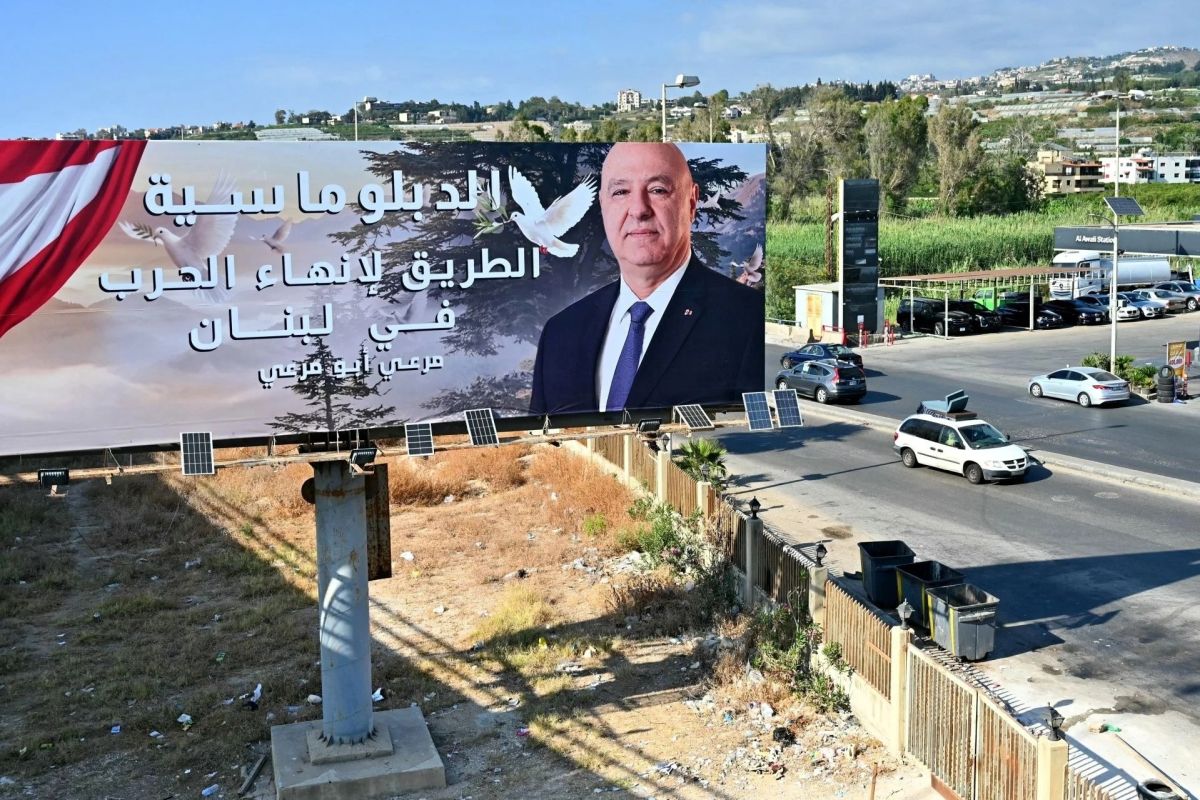
A billboard featuring a portrait of Lebanese president Joseph Aoun and the inscription: "Diplomacy is the means to end the war in Lebanon," along the Saida highway, as displaced families return to their villages in southern Lebanon, June 15, 2026. (Credit: Fadel Itani/AFP)






BEIRUT — President Joseph Aoun called on Greece to assist in the implementation of the Lebanon-Israel framework agreement signed in June, during his meeting in Athens on Monday with Greek President Konstantinos Tasoulas.
Aoun said that "the goal of negotiations with Israel is to put an end to the state of hostility."
"We reached an agreement to sign a framework agreement under U.S. auspices, and it must be fully implemented by both sides, without selectivity. We ask Greece to assist, to the extent possible, in ensuring the implementation of the agreement," Aoun said, according to a post released by the Lebanese Presidency on X.
The ultimate objective of the framework agreement between Lebanon and Israel is for the latter to withdraw from southern Lebanon, in exchange for Hezbollah's disarmament. The last round of direct negotiations between Lebanon and Israel, held this month in Rome, failed to achieve progress on future pilot zones and a halt to Israeli attacks on Lebanon. No date has yet been set for the next round, as talks stall notably over which countries would take part in an international force tasked with overseeing the disarmament process.
Aoun thanked Greece for its "warm reception and its continued support for Lebanon politically, humanitarianly and militarily." He affirmed his commitment to "developing relations between the two countries at various levels, in a manner that serves their shared interests."
"Lebanon’s stability is essential to the stability of the region and Europe, and any turmoil in Lebanon would have broad negative repercussions," he added.
Lebanese officials regularly raise, in their discussions with European countries, the fear of negative repercussions for these countries should a conflict erupt in Lebanon, particularly in the form of a potential influx of refugees from the region.
"Lebanon and its people are tired of wars ... It is time for Lebanon to have respite, and we are determined to put an end to the state of hostility. The solution lies in diplomacy, not war," he said.
Aoun met with Greek Prime Minister Kyriakos Mitsotakis, during which he said that he looks forward to Greece's continued support for the Lebanese Army.
On Saturday, the Lebanese Army announced that it received a second batch of Greek military aid, consisting of 13 M113 armored personnel carriers and 10 trucks, seven months after it received the first batch. The Lebanese Army is responsible for disarmament in the "pilot zones" agreed upon in the agreement. The first three zones, which included two villages not occupied by Israel, were announced last month.
"I look forward to your continued support for the Lebanese Army and our official armed forces, which we have tasked with rescuing Lebanon from its two interconnected, longstanding crises: the crisis of an occupation existing on our land, and the crisis of weapons existing outside the authority of our state, which has persisted for decades," Aoun said. "We have now determined that the only possible solution is to address both problems simultaneously, concurrently and in parallel: a complete withdrawal of the occupying forces, and full control by our armed forces alone over all of our territory."
In parallel with the lack of progress in the negotiations, the Israeli army's demolitions and attacks have been intensifying in southern Lebanon. Fears of further escalation are on the rise, especially as Israel is reportedly awaiting a green light from the United States to launch an offensive against the strategic hills of Ali Taher, where Hezbollah fighters are believed to be operating.