






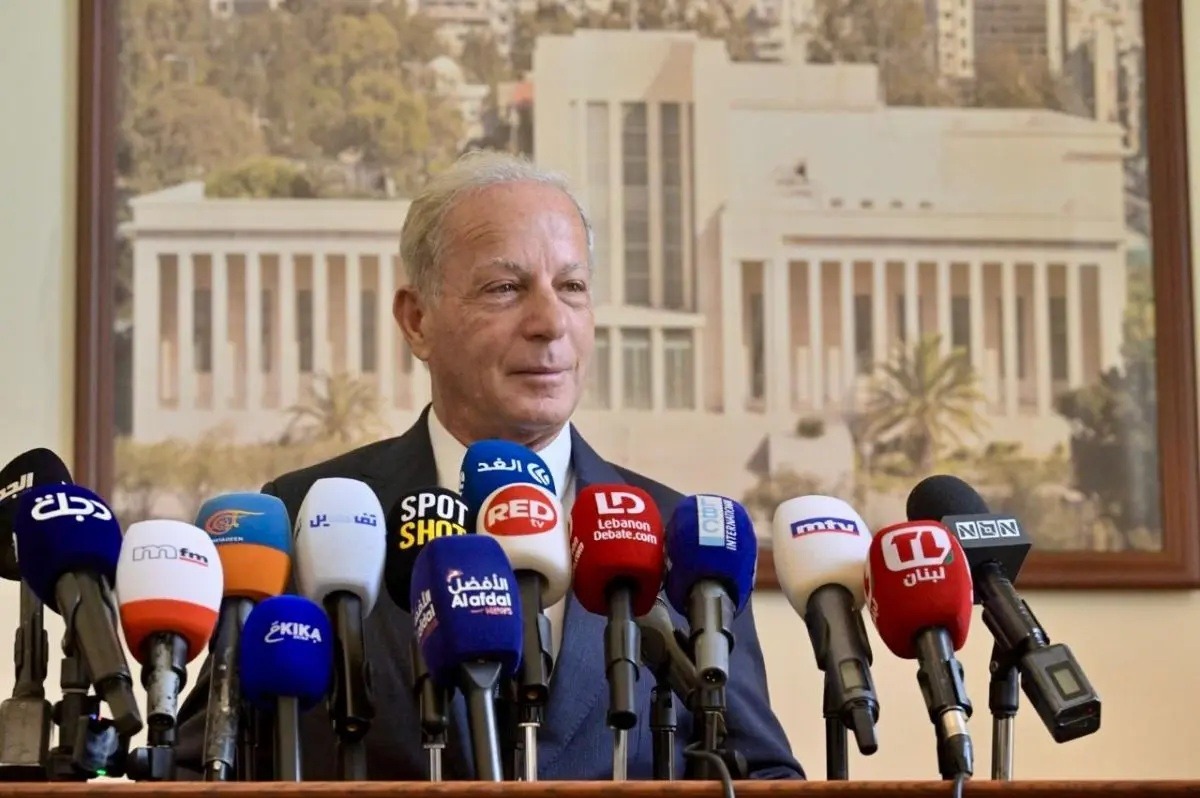
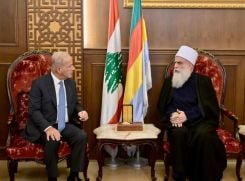
American ambassador Michel Issa, speaking after a meeting with Druze Sheikh Akl Sami Abi al-Mona, on Aug. 27, 2026. (Credit: NNA)






BEIRUT — A day after criticizing Hezbollah’s lack of progress on disarmament, U.S. Ambassador to Lebanon Michel Issa raised the issue again Thursday during a meeting with Druze Sheikh Akl Sami Abi al-Mona in Beirut.
“We are constantly asking Israel to stop or reduce its strikes, but, in return, Hezbollah is not making any steps,” Issa said, adding that Lebanon’s population agrees that the group should hand over its weapons.
He also indicated that he "thought there are contacts between President Joseph Aoun and Hezbollah, whether directly or indirectly," to move the issue forward.
The previous day, President Aoun had reiterated his conviction that negotiations with the Israeli state remained the most viable solution for Lebanon, even if they are "neither easy nor fast." The Lebanon-Israel framework agreement, reached on June 26, 2026 in Washington under American mediation, calls for the deployment of the Lebanese Army and the dismantling of Hezbollah’s infrastructure in “pilot zones” where Israel agrees not to intervene.
This agreement was rejected by Hezbollah and its ally Amal, as well as by Druze leader and former Progressive Socialist Party chief Walid Joumblatt, who called it a "misstep" for the Lebanese state in an interview with L’Orient-Le Jour on July 1.
Asked about those criticisms during his press briefing after the meeting with Sheikh Mona, Issa replied, "Joumblatt, one day he wants it, one day he doesn’t. We will contact him soon." Joumblatt quickly responded to him on X, in English: "It appears that Ambassador Issa, despite his various cultural and political activities, could not read my comments on the document called the ‘framework agreement,’ which I reject and which should be replaced by the armistice agreement mentioned in the Taif agreement and Resolution 1701."
On July 1, Joumblatt had argued that Lebanese negotiators "should have insisted on maintaining the armistice, which has governed relations between Lebanon and Israel since 1949," adding that there had been "American pressure, as well as a Lebanese lobby in Washington that wanted this piecemeal deal, knowing that it goes against Lebanon’s interests."
On Aug. 21, on X, the former PSP chief reiterated. "It also appears that mentioning the armistice is now forbidden, after some parts of this state have adopted the ‘roadmap’ which is not based on any legal foundation," he wrote.
Talks 'in September' in Rome
Despite the framework agreement, Israel has completely leveled more than 20 Lebanese villages in the areas it occupies. The Israeli withdrawal from south Lebanon, conditioned on Hezbollah’s disarmament, is at the heart of negotiations launched between Beirut and Tel Aviv.
The last round of talks, held in Rome, nevertheless failed to achieve progress on the issue of future pilot zones and a halt to Israeli attacks on Lebanon. While some fear diplomacy will remain stalled, Italian Foreign Minister Antonio Tajani said Wednesday evening from Rimini that talks would resume "in September" in the Italian capital to "build peace" in Lebanon. No date has yet been set. A few hours earlier, Aoun, who was in Italy late last week, had stated that diplomacy, despite obstacles, was "preferable to the disasters of war."
“The issue is no longer solely about Lebanon,” Issa also said. “There is Iran and the United States, and these developments have repercussions on the negotiations here. In other words, we cannot move forward without knowing what will happen in the region.”
The U.S. ambassador later qualified his remarks, saying: “The Lebanese-Israeli issue is not directly linked to what is happening between Iran and the United States, but events there affect the situation in Lebanon because Hezbollah remains tied to Iranian decisions.”