






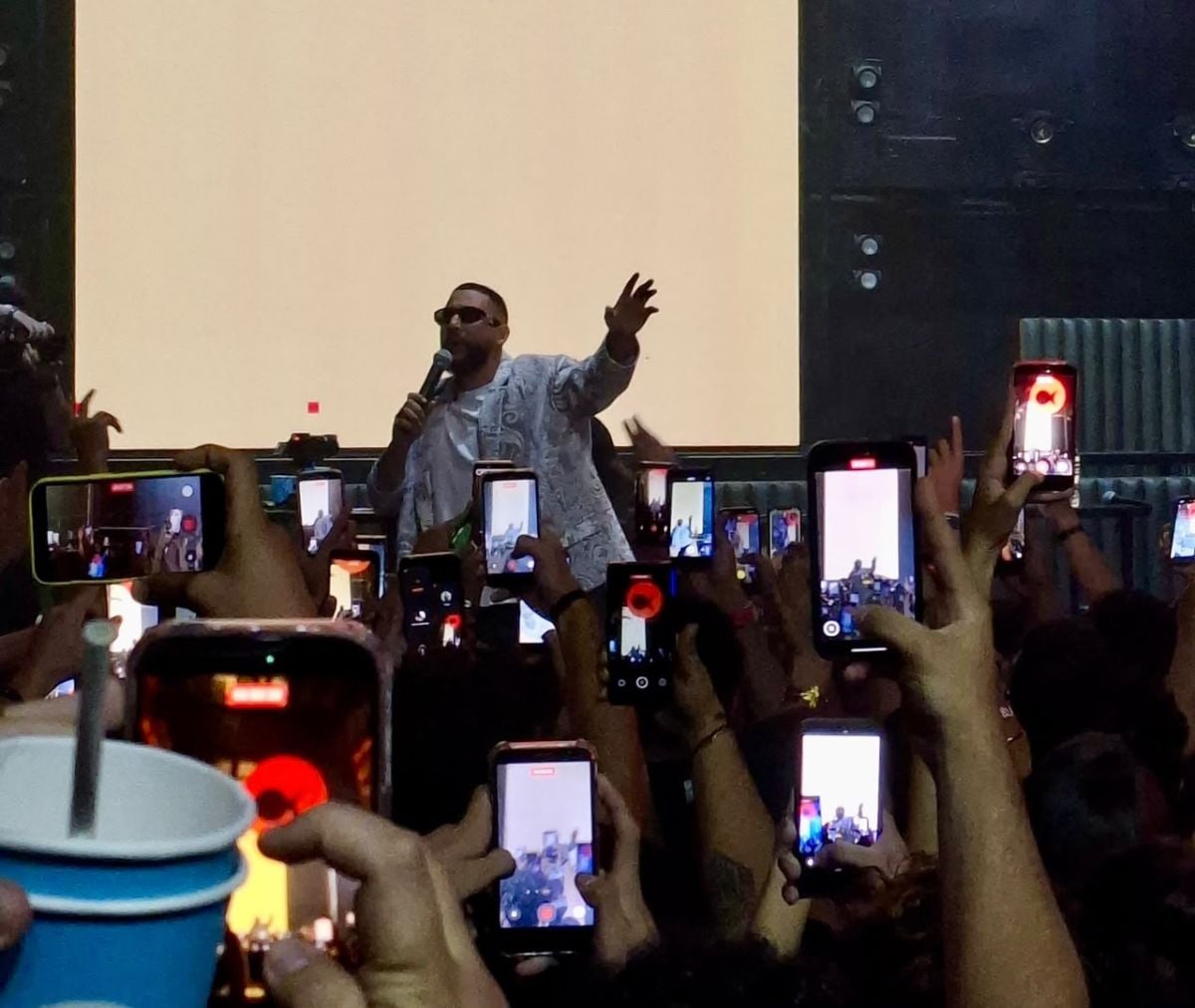
Palestinian rapper Shabjdeed during his concert in Beirut on Aug. 19, 2026 (Credit: Nima Salha/ L'Orient Today)






My cousin asked me what I thought of Shabjdeed’s Saint Levant diss track a few weeks ago. Without thinking, I found myself saying, “It's entertaining, but a little pathetic if he’s taking it seriously.”
Before the release of "SLV," for “Saint Levant,” Shabjdeed had created an image in his music and interviews built on cynicism and indifference. Saint Levant built himself inside a bubble of idealistic enthusiasm. The contrast between the two made the track seem like a step-down from Shabjdeed’s usual moral high ground.
My introduction to poetic invective was through Mansour Rahbani’s musical about Al Mutanabbi when I was 14. I asked my mother about the meaning of a word the poet used to describe his rival’s mother. “It means donkey,” she had said. It did not mean donkey. It was way worse, and I just discovered that.
That play is carefully sealed in my brain, and I distinctly remember finding the idea of writing a Fush’a poem for the sole purpose of attacking someone extremely fun. What a productive and healthy way to utilize pent-up anger.
Isn't it also interesting that one of Al Mutanabbi’s most famous insults attacks a mother, when he himself lost his mother at a very young age? In Steven Pinker’s The Stuff of Thought, the author explains that insults are mainly centered around what the insulter holds dear and precious, to convince themselves of the effectiveness of it. Maybe that is why Shabjdeed starts his diss track by telling Saint Levant that he respects how focused he is on women, and then proceeds to shame him for his collaborations with Mia Khalifa and Haifa.
Even the very essence of his attack on Saint Levant for not conforming to what a Palestinian artist should look like is precisely the kind of thinking he rejected when he started his music record BLTNM.
My editor said you can trace everything back to gender if you want to, but there is more to consider for this one. So, I will not dwell on virtue signalling and the use of women as objects of insult to shame men. I will try to put my feminist lens down for now, and pick up a historic one. Phew, dusty.
Politics in general, but especially in Lebanon and the region, have always relied on alliances, some more bizarre or striking than others: the United States’ support of Saddam Hussein’s war against Iran, the Lebanese Forces’ alliance with the Syrian Socialist Nationalist Party in the 2025 municipal elections, Walid Joumblatt’s alliance with Hafez al-Assad despite him being the main suspect in the assasination of his father, Kamal Joumblatt.
There are solid, logical, and convincing arguments as to why each of these alliances made sense at the time. Yet, it is extremely easy to find a pre-1984 U.S. terrorist list that includes Saddam Hussein’s name. It is probable to hear an SSNP member cursing out Samir Geagea within 15 minutes of sitting with them, and it is highly likely that Joumblatt’s Feb. 14, 2007 speech is still logged in your brain.
These public attacks are directed more towards the general audience than they are towards the “enemy.” When Joumblatt called Assad “an ape unknown to nature” and “a creature made of half-men,” he said it in front of 300,000 people. The performative element of political feuds, a term that also applies to the Shabjdeed-Saint Levant so-far-one-sided beef, is more than half the game. The public nature of these attacks serves as an invitation for the other side to join the performance and capitalize on the drama. What Shabjdeed was able to achieve through “SLV” is bringing together two names and even worlds that otherwise wouldn’t have necessarily crossed paths.
Choosing which enemy is worth publicly attacking has less to do with politics than with precedence, power, and self-worth. Shabjdeed started making music in 2015, released his first album in 2019, and has racked up 37.6M plays on Anghami since. Saint Levant started in 2020 — five years later — and already has 95.7M plays on Anghami. I understand the resentment. Not toward Saint Levant personally, but toward the idea of someone doing the same work you’ve spent a decade on, in a fraction of the time, and appearing to do it better, at least by the only metric anyone seems to count: reach.
The context, of course, does not negate the validity of the speaker's argument. In a nutshell, Shabjdeed is accusing Saint Levant of capitalizing on the Palestinian issue and attempting to merge his Arab cultural background with a Western-infused approach to pop music, an argument that is worth weighing.
Although Shabjdeed is not the first rapper to diss Saint Levant (have you heard Carnaval?), he is the first to dedicate an entire track to that specific purpose, and he seems to be giving this track a lot of attention in his concerts too. So what is he really trying to tell his listeners and Saint Levants’?
I was taught in school that things are distinguished by their opposites. There are a lot of similar words in the Arabic language that are more easily understood through their antonyms. As I got older, I learned, like all teenagers do, that it is easier to define myself by what I don’t like than it is to decide who I really am.
In the same way, what Shabjdeed is doing through “SLV” is telling us that he did not sell out. He is struggling to bear the cost of the “alternative” path he has chosen for his music, especially in comparison to the success he sees adopting the mainstream bring to other artists.
Shabjdeed is telling us who he is by attacking what he thinks he is not; a classic political move that relies on our instinct to pick sides and our tendency to forget all about it shortly after.

 Evening recap: Netanyahu announces West Bank offensive; 7 killed in Jordan church shooting; tents burned in south Lebanon
 US strike on Iran this weekend? ‘Absolutely,’ says Barrack; ‘I have no idea,’ says Trump