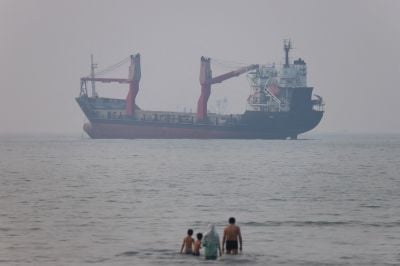
A ship in the Strait of Hormuz, near the beach of Bandar Abbas, Iran, on June 30, 2026. (Credit: Amirhosein Khorgooi/ISNA/WANA/Reuters)






According to the Financial Times (FT), Iran is no longer simply limiting its response to the Middle East but is reportedly considering striking U.S. targets in Europe in the event of another escalation of U.S. military action, meaning that Tehran now considers the resumption of war inevitable.
According to two sources close to the regime cited by the FT, Iranian forces have assessed the possibility of targeting American facilities in the Balkans and around the Mediterranean. Bulgaria, where the Bezmer Air Base has authorized its use for refueling American aircraft between July and October 2026, and Cyprus, where a British base was already targeted by a drone in March, are specifically mentioned. The same source also added that Iran is separately considering targeting undersea fiber-optic cables in the Strait of Hormuz in the event of an escalation.
The FT does not mention Ukraine as one of the potential targets, despite a threat made by Tehran last July. Iran had threatened Ukraine with retaliation after Ukrainian drones attacked an Iranian cargo ship in the Caspian Sea, suspected of carrying military equipment for Russia.
In the course of its investigation, the FT suggests there is a growing Iranian desire to strike more distant targets.
In the weeks following the outbreak of war by the United States and Israel last February, Washington accused Tehran of firing several missiles — none of which hit their targets — at the U.S.-British Diego Garcia base in the Indian Ocean, about 4,000 kilometers from Iran. "It was also a message to Europe: it can be targeted by missiles, and must therefore decide what position to take in this war," the source close to the Islamic regime told the FT. "A very serious mistake, such as striking our infrastructure, could drag the war outside the region and extend it into Europe."
For this attack, Iran used Khorramshahr-4 medium-range ballistic missiles, with a maximum range of 2,000 kilometers.
The same source also reports that the attack carried out last month on a U.S. base in Jordan, which killed three Americans, was "the most precise long-range strike ever carried out by the Islamic Republic, demonstrating its ability to hit targets at longer distances."
Targets in southern Europe
Sidhart Kaushal, a researcher at the Royal United Services Institute, a London-based think tank, told the FT that the Shahab series of ballistic missiles, with ranges from 300 km to approximately 2,000 km, could pose a "real but limited" threat to targets in southern and southeastern Europe. According to him, however, these missiles would have difficulty causing damage at longer distances.
Douglas Barrie, of the International Institute for Strategic Studies, questions Iran’s actual capabilities and willingness to use its missiles for symbolic purposes. "The number [of medium-range ballistic missiles] they actually have is another question, and whether they would be willing to use even a handful to make a grand statement remains open," he said.
These threats are taking place in a context where some within the Iranian regime now see the resumption of war as a matter of time, rather than possibility. Several recent signals feed this dynamic: the memorandum of understanding concluded in June between Washington and Tehran collapsed last month; Supreme Leader Mojtaba Khamenei last week promoted several hardliners to key security and military posts; and Donald Trump said Tuesday there were "no ongoing, or planned, discussions or conversations" with Tehran. Weeks of diplomatic efforts have failed to break this impasse or revive broader negotiations to end the war.
The Iranian threats add a new dimension to the regional conflict, challenging its direct boundaries and potentially involving new state actors in the conflict, which has lasted for six months.
On Wednesday, a NATO official, when asked about the information reported by the FT, said the organization was "ready to face any threat" and that it "will always do whatever is necessary to defend all its allies."