


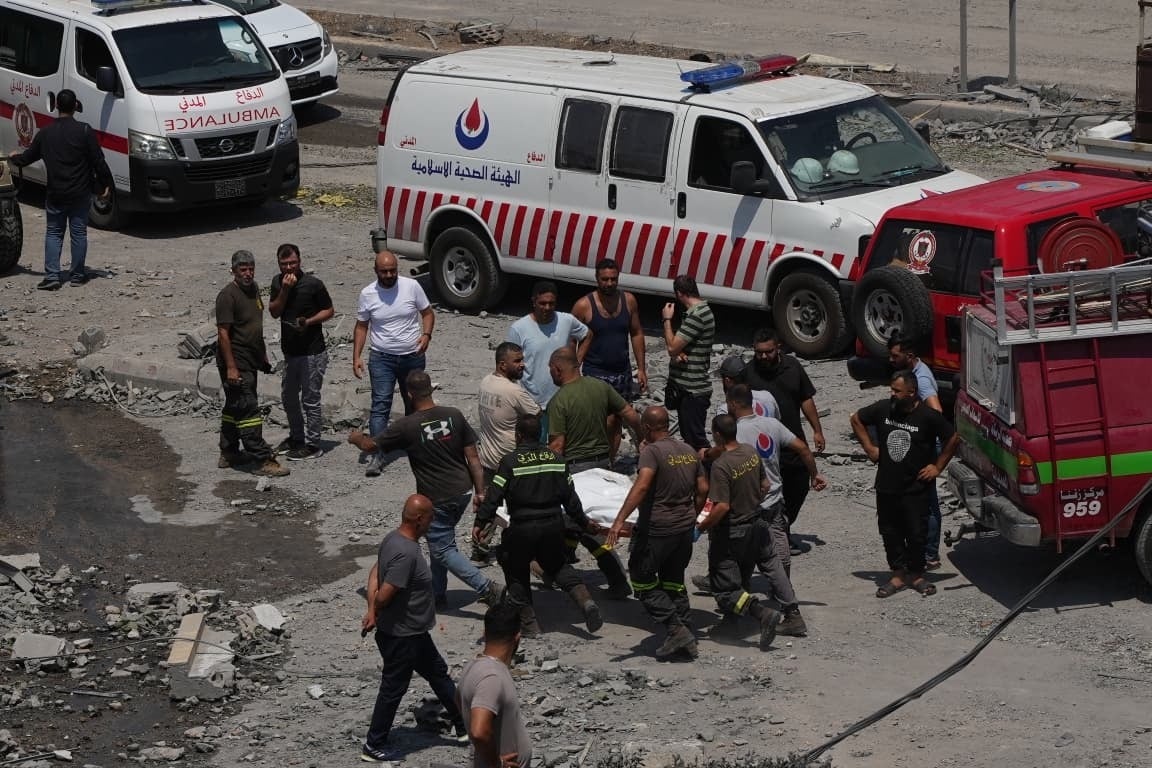
In Deir Zahrani, where Israeli strikes killed 4 people, rescue workers transport the bodies of the victims, August 15, 2026. Photo Mohammad Yassine/ L'Orient-Le Jour






BEIRUT — The three branches of Lebanon’s government on Saturday strongly condemned Israeli strikes that killed at least 11 people and wounded several others in the southern towns of Ansar and Deir Zahrani, as direct negotiations between Lebanon and Israel remain stalled and no date has been set for their next meeting.
Aoun denounces a 'clear message against negotiations, U.S. efforts to implement the agreement'
President Joseph Aoun denounced “the ongoing Israeli attacks in south Lebanon, especially in the Nabatieh area and its surroundings.” In a message posted on the Lebanese presidency's X account, he lamented “the repeated violations of the framework agreement, the work of the military coordination group and international laws that are supposed to protect civilians,” citing “the tragic death of an entire family in the village of Ansar.”
For Aoun, “these violations are a clear message against the negotiation process and U.S. efforts to implement the agreement.”
Direct Lebanese-Israeli negotiations have been ongoing since April under U.S. sponsorship, and the framework agreement for a gradual Israeli withdrawal from south Lebanon and the deployment of the Lebanese Army was signed in June.
Still Israel has continued to demolish, advance its occupying troops, and conduct attacks in violation of the cease-fire and the framework agreement.
The Israeli escalation comes a day after a speech by Hezbollah Secretary-General Naim Qassem, who once again criticized the framework agreement signed between Beirut and Tel Aviv on June 26, under U.S. mediation. He also criticized the “pilot zones,” which are intended to enable a gradual withdrawal of the Israeli army in exchange for Hezbollah's disarmament in specific regions. He also once again threatened the state with popular “wrath.” The pro-Iran militia party refuses to disarm and continues to warn the government.
For Berri, this is a 'war of extermination' against the South
Parliament Speaker Nabih Berri, for his part, said that “the two massacres carried out by the Israeli air force in the villages of Ansar and Deir Zahrani, which claimed the lives of an entire family, women and children included, are part of a war of extermination that the Israeli machine of death and destruction continues to wage” in southern Lebanon.
For the Parliament speaker, an ally of Hezbollah, “these attacks are proof that Israel, on both political and military levels, does not care about agreements, laws, or efforts to end the war and tensions in Lebanon and in the region.”
In a statement published by the state-run National News Agency (NNA), Berri called for a new response to the Israeli escalation, “based on national unity, far from all regional, sectarian or partisan considerations.” He addressed “the sponsors of negotiations and agreements,” saying they “must assume their responsibilities to put an end to the war,” a clear reference to the Americans who are sponsoring the Lebanese-Israeli negotiations and the framework agreement signed by both parties in June.
Berri, leader of the Amal Movement, has rejected direct negotiations since their launch in April.
Israel must stop this escalation, Salam insists
Responding in turn, Prime Minister Nawaf Salam wrote on his X account, saying that the attacks “on the city of Nabatieh, the villages of Ansar, Deir Zahrani and others … are extremely serious and hinder efforts to stabilize the situation in the South.”
“The seven killed in the Israeli strike on the village of Ansar are not ‘military infrastructure;’ the children and women who fell are not military targets,” he stressed.
Salam continued: “The management of any military infrastructure, if it is on Lebanese territory, is the exclusive responsibility of the Lebanese state, through the Lebanese Army and its legitimate institutions, and the presence [of such infrastructure] does not entitle Israel to violate Lebanese territory or endanger the civilian population.”
“Israel must stop this escalation; the safety of our people and their right to live on their land are neither negotiable nor subject to compromise,” concluded the prime minister.
Presidents Aoun and Salam regularly denounce Israeli violations and demolitions in southern Lebanon, and, more broadly, the occupation of nearly 700 square kilometers in the region. On Friday, Salam insisted on this point before Lieutenant General Joseph Clearfield, who leads the U.S.-run cease-fire monitoring, also known as the 'Mechanism'.


