






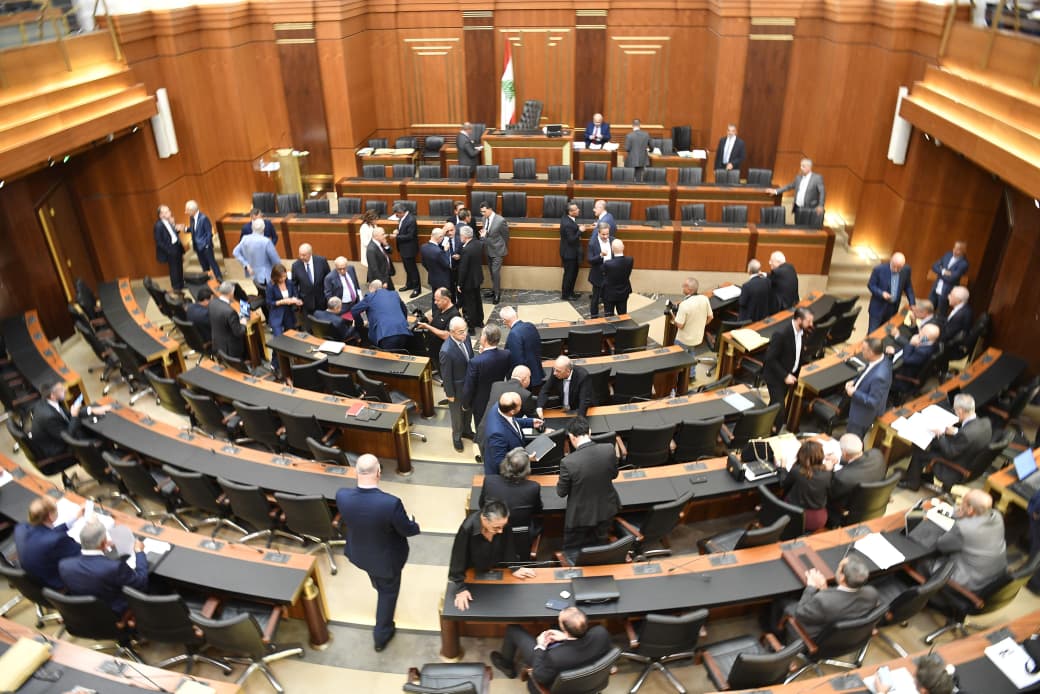
Members of parliament in the chamber, Sep. 29, 2025. (Credit: Archive photo Mohammad Yassine / L'Orient-Le Jour)






BEIRUT — Defense Minister Michel Menassah on Monday submitted the Lebanese Army’s written observations on the proposed amendments to the general amnesty bill to Deputy Speaker Elias Bou Saab, according to the National News Agency (NNA). Menassah had earlier met with Speaker Nabih Berri.
The Chamber’s bureau has summoned deputies to two plenary sessions next Tuesday and Wednesday, starting at 11 a.m., to examine several key bills on the agenda. Two sessions are scheduled for each day, one in the morning and one in the afternoon. L’Orient-Le Jour has learned that the agenda for the plenary sessions was established in accordance with an agreement reached earlier this week between Speaker Nabih Berri and the majority of Sunni MPs.
The bill concerning the abolition of the death penalty appears at the top of the agenda, followed by the bill concerning the media sector, and then the general amnesty bill. "It is a way to enable detainees, several of whom are Islamists, to benefit from the amendment to the law on the death penalty, which should be replaced by aggravated life imprisonment with forced labor," Nabil Badr, a Sunni MP from Beirut, told L’OLJ. According to him, the amnesty bill should be easily adopted on Tuesday, especially since its final version has the support of the main Sunni groups. For their part, the Lebanese Forces, whose withdrawal derailed a session held in July, say they are standing behind the Sunni MPs on the amnesty issue. The party’s deputies are therefore expected to vote for the bill, paving the way for its adoption.
Meanwhile, also on Monday, the Lebanese Observatory for Detainees’ Rights called on deputies to "show solidarity and reach a consensus" during Tuesday’s parliamentary session by voting in favor of the general amnesty law. In a statement, the Observatory stressed that "the eyes of thousands of Lebanese families will remain fixed on them, awaiting a gesture of humanity and conscience" through their vote in favor of the law. According to the Observatory, it has become "an urgent and imperative humanitarian necessity, which will help save many lives, turn the page on a dark period experienced by the country, open the way to a future in which the Lebanese will reconcile with one another, and restore hope to many citizens who are on the verge of losing it."

 8 p.m. recap: Israel again threatens Beirut’s south suburbs; 2 ships hit near Hormuz; Riyadh football matches canceled