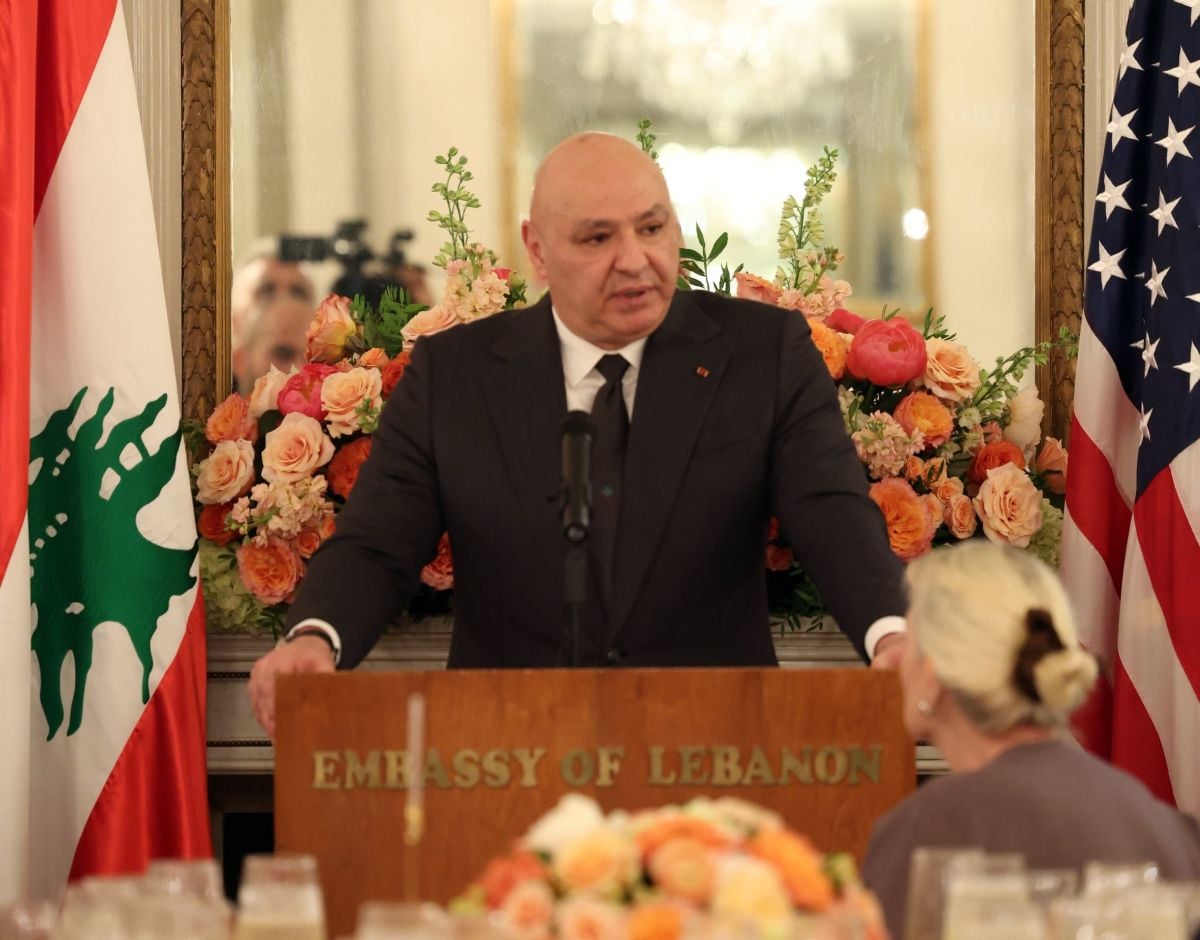
President Joseph Aoun delivers a speech at the Lebanese embassy in Washington. (Photo: X/Lebanese Presidency)






BEIRUT — As President Joseph Aoun and First Lady Neemat Aoun returned Wednesday evening from the United States — where the president met with his U.S. counterpart, Donald Trump, to strengthen the framework agreement between Beirut and Tel Aviv and to secure an Israeli withdrawal from occupied territories — several high-ranking officials and lawmakers applauded his initiative and its potential repercussions. Hezbollah, for its part, called the visit a "failure," simultaneously accusing the authorities of steering Lebanon "down a dead-end path marked by successive concessions" that harm "the state's sovereignty" and reflect "its dependence on and submission to foreign tutelage."
In a message posted on X, Sunni MP of Tripoli Ashraf Rifi welcomed Aoun's visit to Washington and the one by Prime Minister Nawaf Salam, Wednesday, in southern Lebanon — where he planted a Lebanese flag in one of the "pilot zones" where the Lebanese Army is expected to begin disarming Hezbollah, as stipulated by the framework agreement — calling them "the starting point of a national effort to restore Lebanon's sovereignty and its role among the nations."
Rifi emphasized that the goal must be "the total withdrawal of Israel from the entire Lebanese territory, the dismantling of the Iranian arsenal in Lebanon, and the deployment of the Lebanese army along the Blue Line, so that it is the only guarantor of sovereignty and security."
Parliament Speaker Nabih Berri called Aoun to wish him a safe return from his visit to Washington, before receiving former Free Patriotic Movement MP and chairman of the Finance Committee Ibrahim Kanaan. Kanaan said all political forces should work to achieve the objectives of the president’s visit, namely "ending the war, securing the withdrawal of Israeli forces, reaffirming Lebanon’s sovereignty, and supporting the Lebanese Army."
Berri in line with Aoun, says Hajjar
Several ministers of the Salam government also spoke out.
Interior Minister Ahmad Hajjar said in an interview with Télé Liban Wednesday evening that the visit to Washington was part of coordinated efforts between Aoun, Salam, and Berri to help Lebanon recover from the war.
"Meetings in Washington should lead to real American pressure on Israel to achieve this goal," Hajjar said, referring to efforts to secure an Israeli withdrawal from South Lebanon. Hajjar also indicated that Berri supported efforts to obtain the Israeli withdrawal and Lebanese Army deployment in the South, specifying that his stance was aligned with President Aoun’s. Until now, the Parliament Speaker and Hezbollah ally had displayed resistance to direct negotiations with Israel.
For his part, Agriculture Minister Nizar Hani described President Aoun’s visit to Washington as a "positive" step. "We have noted the considerable attention given to the Lebanese president as well as the positive atmosphere that prevailed," Hani said. The minister added that Lebanon is starting to see results on the ground, noting that "everyone is waiting for a major Israeli withdrawal and a halt to destructive actions in the South," while hoping the process would accelerate in the coming days and weeks.
In comments reported Thursday by the NNA, Information Minister Paul Morcos stated that Aoun’s visit had bolstered the authority of the Lebanese state and strengthened international recognition of its role in the country's decision-making — and could pave the way for increased U.S. engagement in Lebanon, notably through a possible aid conference for the country and greater American investment.