






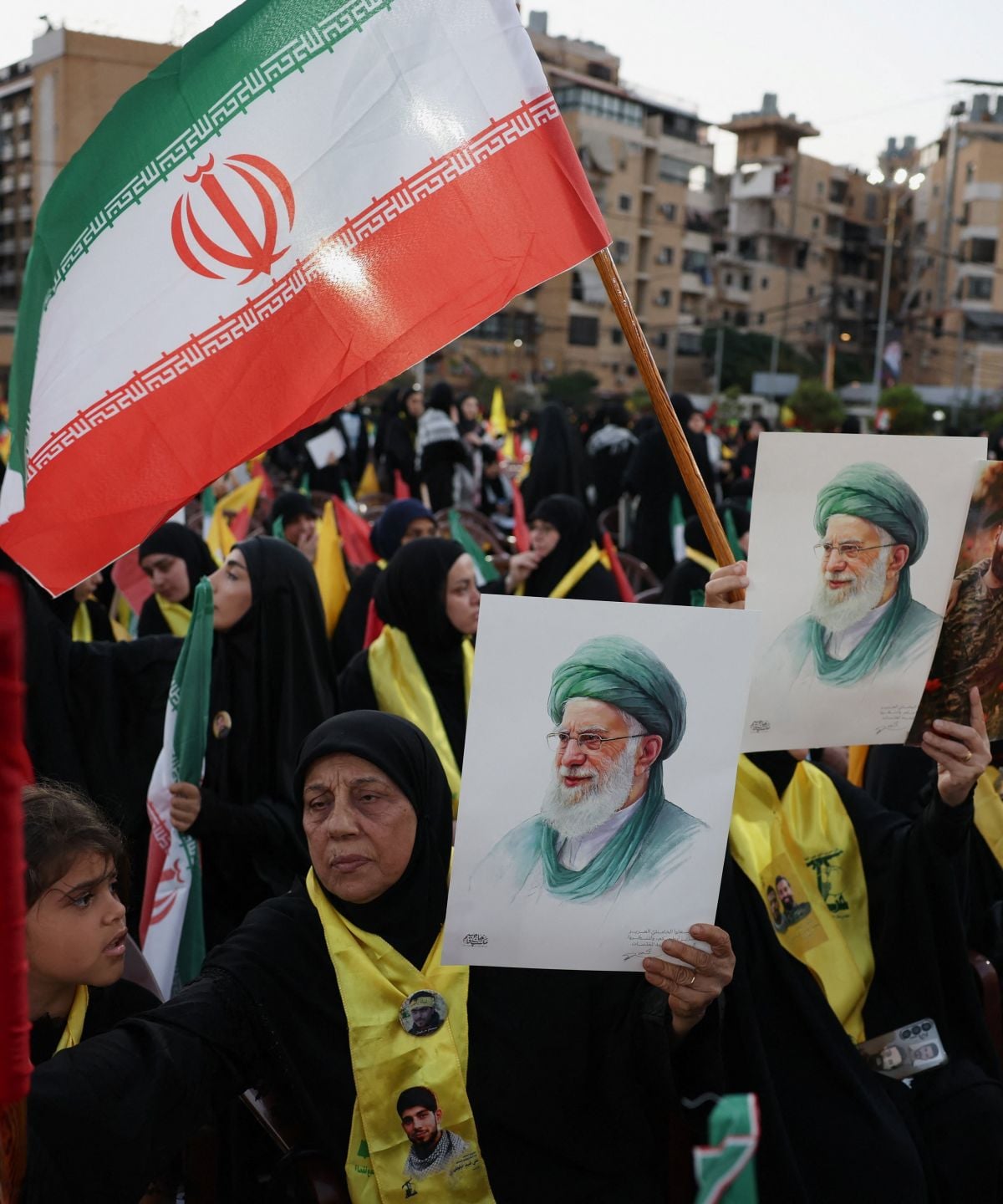
People hold posters depicting Iran's late Supreme Leader Ayatollah Ali Khamenei, who was killed on Feb. 28 in Israeli and U.S. airstrikes, as people gather to mourn him, in the southern suburbs of Beirut, Lebanon, July 8, 2026. (Credit: Mohamed Azakir/ Reuters)






BEIRUT — “No more planes will land in Beirut, and no more ambassadors will remain in Lebanon.” The threat, issued by Hezbollah political bureau deputy head Mahmoud Qomati during a televised interview criticizing Lebanon’s measures against Iran, sparked reactions from the party's opponents.
Tensions between Beirut and Tehran have risen since 2025, following the election of President Joseph Aoun and the formation of Prime Minister Nawaf Salam’s government. Lebanese diplomacy has repeatedly accused Iran of interference, particularly over its refusal to accept the disarmament of Hezbollah. Tighter measures were introduced in March 2026 after the party resumed fighting and Israeli strikes targeted Revolutionary Guard representatives present in Lebanon.
During a program on Hezbollah-affiliated al-Manar television, Qomati criticized Lebanon’s ban, imposed in February 2025, on Iranian aircraft flying over Lebanese airspace, as well as a March 2026 decision requiring Iranian citizens to obtain visas to enter the country. He described the measures as “unacceptable” and called on the Lebanese government to reverse them quickly. He also criticized the Foreign Ministry’s decision to declare Iran’s ambassador persona non grata.
“The authorities must understand: we can wait until a solution is found,” the Hezbollah official said.
'Peaceful' measures
Otherwise, “there are many means, peaceful means at our disposal, and no more planes will land in Beirut and no more ambassadors will remain in Lebanon,” he said, while stressing the “peaceful nature” of any measures Hezbollah might consider.
“Let them reconcile with Iran and restore relations, and as with any other country, inspect planes coming from Iran,” he said, calling on General Security to take the necessary steps.
“When people said we controlled the state, did we use the Foreign Ministry or mobilize the state against another country? We never did that, because we respect others. They, however, respect no one,” Qomati said.
In response, Charles Jabbour, spokesperson for the Lebanese Forces, which is firmly opposed to Hezbollah, wrote on X that “what is expected from the Lebanese authorities is to seal the Iranian embassy.”
“Iran, through its support and arming of Hezbollah in Lebanon, undermines the country’s sovereignty. Iran is an enemy state,” he added.
MP Mark Daou, a member of the protest movement and another prominent opponent of the Iran-backed party, mocked the threat, saying Hezbollah no longer holds the same influence it once did and noting that “the banners put up on the airport road lasted only a few hours.”
Hezbollah has repeatedly threatened the Lebanese government in recent weeks after Beirut signed a “framework agreement” with Israel aimed at ending Israeli attacks and securing the withdrawal of Israeli forces from southern Lebanon.
After hinting that it could mobilize supporters in the streets and threatening the Salam government, Hezbollah later toned down its rhetoric, likely under pressure from Parliament Speaker Nabih Berri. It said it considered the agreement “null and void” but not worth provoking further internal tensions over.
The agreement notably provides for an Israeli withdrawal from “pilot zones” in southern Lebanon, where the Lebanese Army would gradually deploy with the aim of dismantling Hezbollah’s local military infrastructure, a process that began on Monday.