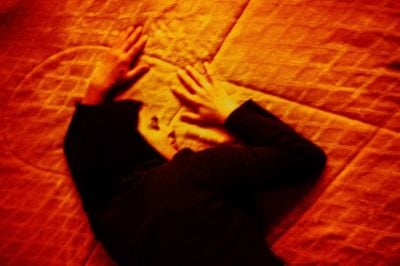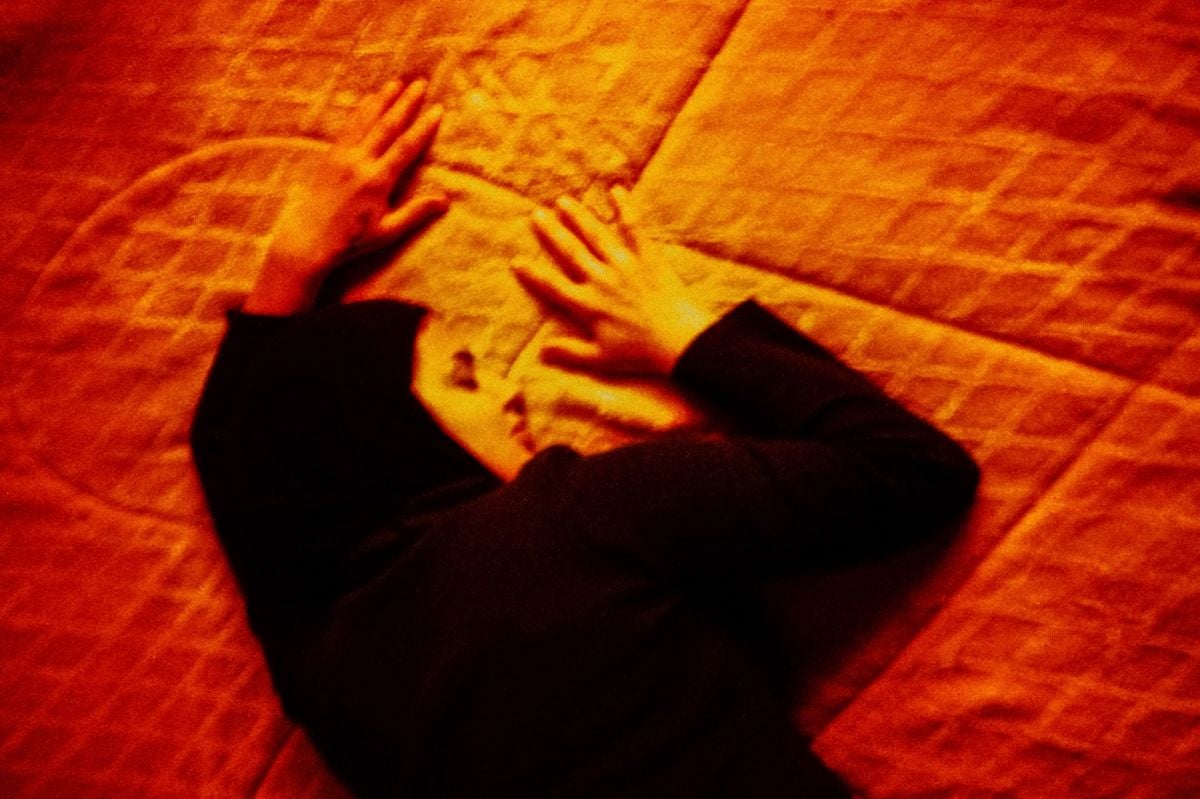
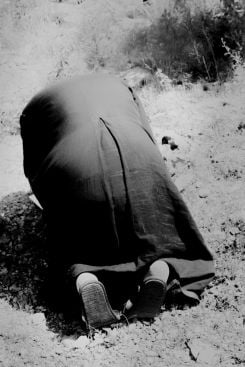
Orianne Ciantar Olive's "Hiba," 2023. (Credit: Courtesy of the artist)






Oriane Ciantar Olive's story moves freely in a region where the absurdity of borders prevails: The former journalist who changed careers and found herself stranded in Lebanon in 2019 while trying to reach Damascus by following the old railway line from Beirut.
That first setback prompted her to trace what she calls “the road of disaster” (she recalls the word’s etymology, which refers to dis astro, the “bad star”) to the separation wall at Kfar Kila, on the Lebanese-Israeli border. This journey to the edges of absurdity, composed of several trips through 2023, became an intimate exhibition of photographs and poetic texts.
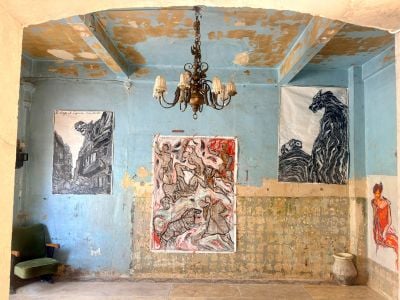
Inspired by Jorge Luis Borges’ famous story of the dreamer caught in an infinite tangle of dreams, the exhibition’s title, “Circular Ruins,” signals the artist’s desire to go beyond simply documenting reality by searching for deeper, more exploratory forms.
“As a former journalist and editor-in-chief, I work a lot as a reaction to that profession, especially regarding the live coverage of conflict zones," Olive explains, questioning the ways we can “bring a viewer to look at a conflict head on, without triggering their own trauma, and also without letting them get too used to it.”
In other words, how can we avoid falling into avoidance and denial of conflict when, on one hand, witnessing it causes too much suffering and, on the other, looking at it without emotion normalizes its images, draining them of substance?
To address this pitfall, the Franco-Maltese-Swiss artist, who holds degrees in cinematography, criminology and journalism, offers a radical solution: change the format. "So far, journalism has barely reinvented its formats. We’re still working in a model that always looks the same: headline, dek, body text, with an image or two accompanying the text. Can we do the work of a journalist by completely changing the format to address this readership crisis?" she asks.
A poetic inversion
An artistic choice thus emerges: flipping words, compass points and even film negatives. “I turned everything around to disorient the viewer and allow them to enter this conflict by setting aside any preconceptions or visible markers that might keep them stuck in their opinions. My work isn’t about preaching to the choir,” says the former journalist.
In Arles, Olive opens her exhibition with an inverted map of Lebanon, developed with artist Leo Runp. Named "Nabil" — an anagram of "Liban" ["Lebanon"] spelled backward — the map places the sea to the North and the South to the West.
Built using data from the Lebanese platform Public Works Studio, which documented Israeli strikes in Lebanon during recent wars, the map shows residential areas “bombed, razed or attacked” by Israel through last June, in a project constructed in real time.
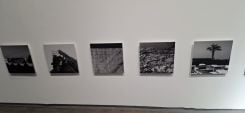
You then enter the exhibition, where a scenography built around circularity, with central mirrors, guides visitors through black-and-white images of ruins and destruction, alongside series of moving suns — explosions of orange and red — hands, and men and women shown in the humble dignity of their suffering. These are the “prostrates,” as she aptly names them.
Then come Olive’s deeply sensitive poetic texts. “Poetry completes and enriches a methodological journalistic approach. I refuse to stick to what is merely visible,” she explains. “I’ve worked extensively with poetry because it represents, for me, a different perception of reality.”
While composing the exhibition, she returned to Etel Adnan’s poem "The Arab Apocalypse," in which Adnan describes red, yellow and blue suns. It became a central inspiration for the artist’s work.
The presence of writing is inseparable from the photographs: It embraces and frames them like a conceptual structure — so much so that a book based on the exhibition was published by Éditions Dune in 2023, with a preface by Franco-Lebanese writer Sabyl Ghoussoub.
“When the events of Oct. 7 set the region ablaze, I was right in the middle of editing with Dune, and the images were becoming archival in real time because the places I’d photographed were disappearing in real time,” Olive says. “I watched the destruction of the Kfar Kila wall live.”
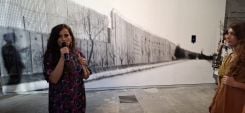
A screen showing footage of the wall’s destruction stands opposite a six-meter-by-three-meter photograph of the wall itself.
Through this process of inversion in "Circular Ruins," Olive moves from raw reality to poetic dreaminess, escaping the reductive logic of a Western worldview. The result is an intimate and deeply moving portrayal of a sensitive subject, rendered with remarkable precision and intelligence.
This article was translated from L'Orient-Le Jour.