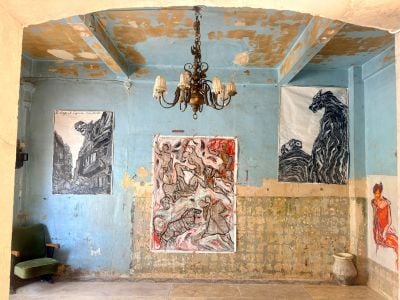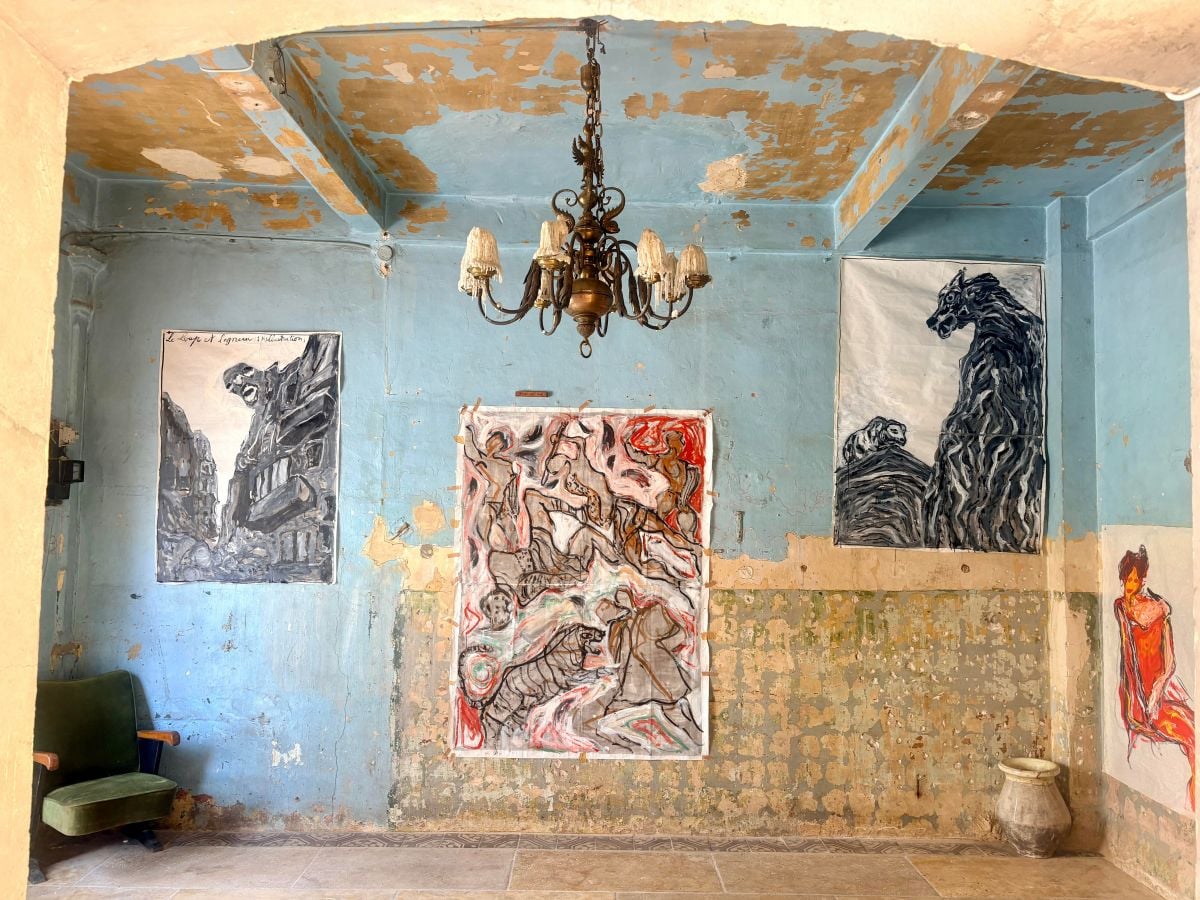
“Le monde tombe” by Samir Khaddaje: an in situ installation, conceived in close resonance with the memory of the site. (Credit: ZZ/ L'Orient-Le Jour)






How does one paint a world that is collapsing? How can one express the feeling that it is becoming a collective tomb? From the very first steps into “The World is Falling,” by Samir Khaddaje, presented by Difaf gallery*, in Beirut, visitors are immersed in the artist’s deeply disenchanted universe. Through tumultuous brushstrokes and raw sensitivity, he conjures, canvas after canvas, a vision of a world in the grips of annihilation.
Indeed, the works displayed by this Lebanese expressionist painter on the gallery walls — housed in a former pink building in the Mar Mikhael neighborhood — as well as in the bare rooms of an adjoining abandoned house, come together as fragments of a single inner landscape: one tormented and haunted both by the apocalyptic fracture of civilization and by memories of the Lebanese civil war.
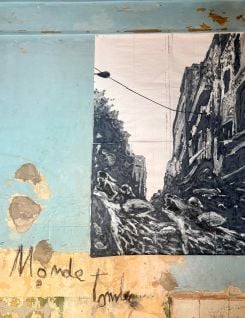
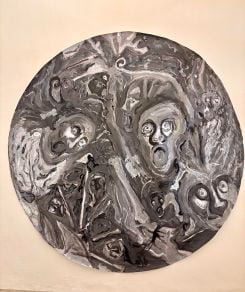
Populated by monsters, grotesque figures, convulsive faces, hybrid beings —sometimes even anthropo-architectural figures, such as a collapsed building that, in some ways, evokes a threatening masked face — his paintings cry out against the state of a broken contemporary world, abandoned to violence, chaos and infernal decline.
Metaphorical paintings around the theme of The Wolf and the Lamb, depicting buildings with monster-like heads, or tondi (Renaissance-era circular canvases) showing whirlwinds of hallucinatory, distorted faces: some of these works, through subtle touches, even evoke the dreamlike and Dantean visions of Bosch and Bruegel.
Biblical myth and the symbolism of disintegration
This new body of work is an extension of Babel, a book conceived by Samir Khaddaje in 2025 and presented at his previous exhibition, “Fragmentation.” Drawing on the famous myth of the Tower of Babel, this project explored themes of downfall, destruction and chaos, while questioning humanity’s boundless ambitions.
Reusing pages from this book in The World is Falling, the artist tore them out, reproduced them, and scattered them across the walls and floors of the exhibition space, in a deliberately chaotic installation that echoes the symbolism of confusion and disintegration associated with the biblical narrative.
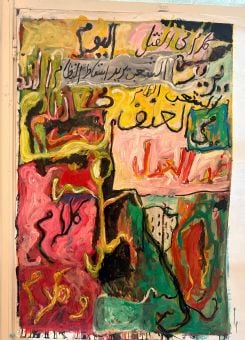
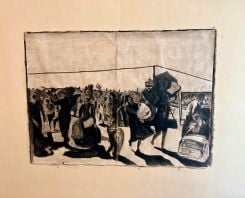
Placed alongside his new series of paintings, collages and drawings — created on site during a two-week residency — these works also enter into dialogue with earlier pieces by the artist. Some of them, dating back to the first years of the civil war, depict scenes of exile and destruction that feel strikingly contemporary.
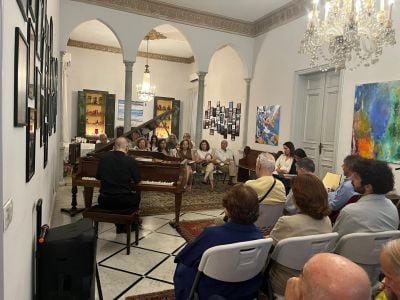
The exhibition also brings together artists, both professional and amateur, whom Khaddaje invited to participate. Their contributions — whether drawings or projections — mingle with his own works to form a symbolic Babel: a constellation of perspectives and approaches united by the universal language of art.
Connecting these different elements, and serving as a common thread, are textual fragments written in Arabic and French directly onto the walls of the various rooms. Among them are the words that open the Babel narrative in Genesis: “The people gathered together and decided to build a tower that would reach the sky, then…” as well as the phrases “The world is falling” and “fragmentation,” each repeated several times like dark refrains.
A painting that shakes
After the initial surprise, visitors gradually allow themselves to be drawn in as they wander through this installation of frameless canvases attached directly to the walls, conceived in close dialogue with the memory of the location.
The sensory impact — difficult to define and even harder to put into words — comes from this artistic immersion in a dilapidated apartment, whose peeling walls are marked by a paradoxical atmosphere where the gentleness of pre-war layers blends with traces of violence, abandonment and decay.
One must go there to fully grasp the powerful emotional charge of Khaddaje’s dystopian vision. To look closely, beneath the dense and impetuous brushstrokes, at the wolves and demons of our time, and to feel all the artist’s fury in the face of humanity’s collapse.
Make no mistake: for Khaddaje, painting does not seek to seduce or reassure, but to shake. Those looking for decorative canvases should look elsewhere.
*Difaf gallery, Mar Mikhael, Beirut, Jacaranda building. Until July 27, from 11 a.m. to 9 p.m. Tel: 78 711 433
An artist marked by war
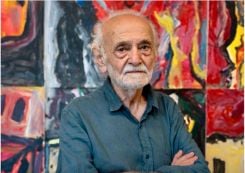
A leading figure of Lebanese expressionism, Samir Khaddaje, born in Lebanon in 1939 and based in France for several decades, has developed a body of work that blends painting, drawing, writing, and installation to probe the fractures of the contemporary world. Marked by the experience of the Lebanese civil war, his practice explores themes of memory, exile, fragmentation, and collapse, making each exhibition a space of resonance where the ruins of the past converse with the upheavals of the present.
Difaf and guest artists
Based in Beirut and Cairo, Difaf curates exhibitions of original works while publishing limited edition art prints and publications produced in close collaboration with artists. True to its name—difaf (“shores” in Arabic)— the gallery encourages dialogue between the artistic scenes of the two cities, linked by a shared cultural history.
For “The World is Falling” by Samir Khaddaje, the artist and Difaf gallery, located in Mar Mikhael, have invited 10 Lebanese, Syrian, and Egyptian artists to take part in the exhibition. They are Ali Faour, Karima Gelany, Lynne Jaber, Mahmoud Korek, Alaa Mansour, Hussein Nakhal, Fady Salloum, Antoine Sfeir, Karma Tohme, and Rebecca Wakim.