





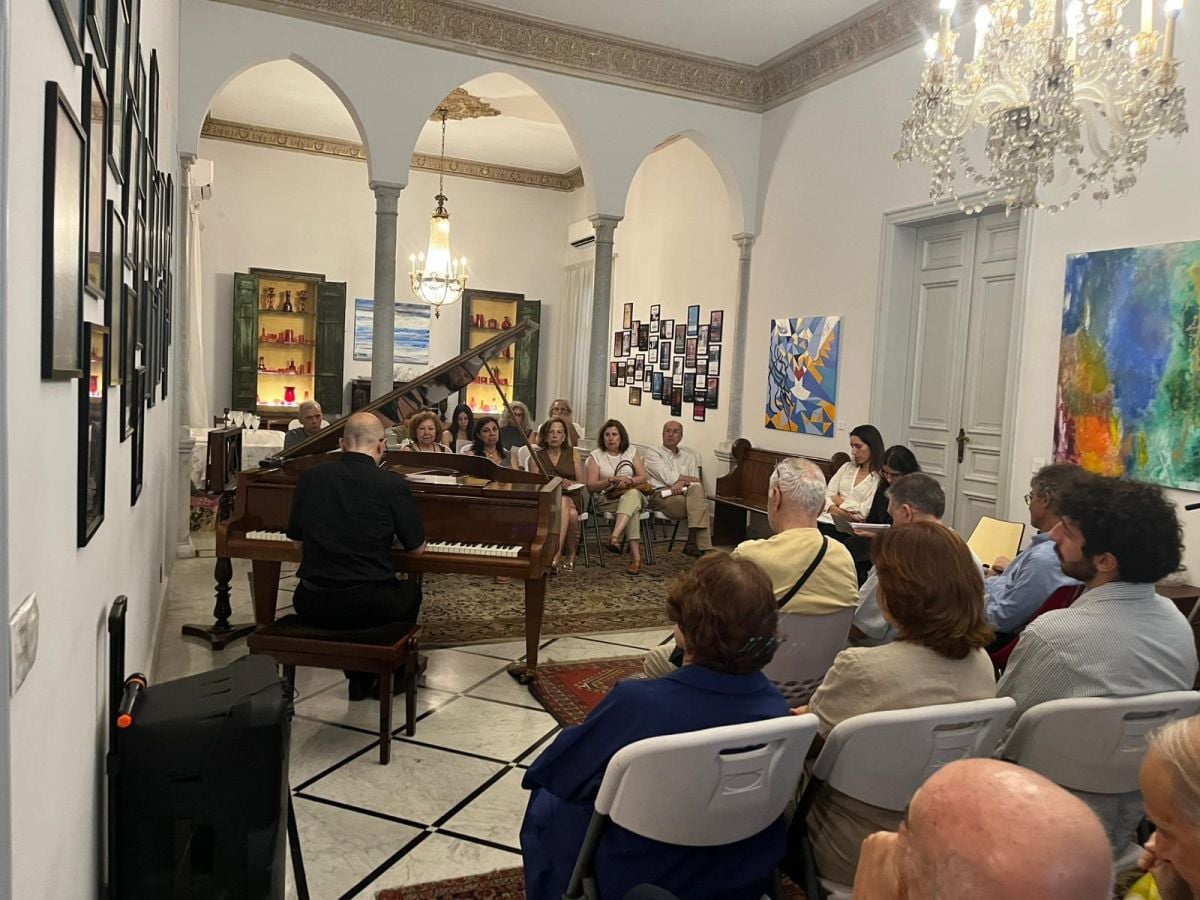
Lebanese pianist and composer Elia Koussa performs during a recital at Beit Tabaris featuring five centuries of keyboard music. (Credit: Courtesy of Beit Tabaris)






Lebanese pianist, composer, and musicologist Elia Koussa gave a piano recital on July 7 at Beit Tabaris, performing works by Scarlatti, Gibbons, Debussy, Rameau, and Chopin.
Some programs seek neither spectacular effects nor displays of virtuosity. They simply invite listeners to journey across several centuries of music. Such was the spirit of this intimate recital.
Scarlatti's sonatas opened the evening with liveliness and elegance. Beneath their unassuming appearance lies a refined art in which each note seems to dance naturally.
It was Glenn Gould who helped bring about the rediscovery of Orlando Gibbons, whose rarely performed works transport listeners to Renaissance England. Their clear, almost austere writing reveals an inner poetry that moves through simplicity. With Claude Debussy, the landscape changes. The harmonies become colors, and the sounds evoke light, water, and wind. The music suggests fleeting impressions that disappear as swiftly as they are born.
The ear no longer just listens to the notes; it contemplates the landscapes. The inclusion of Rameau further reinforces the coherence of the program. Gibbons represents the origins of English keyboard music, while Scarlatti and Rameau embody two great pinnacles of the Baroque era. Debussy, for his part, opens the path to modernity. Finally, the recital concludes with Chopin's Fourth Ballade, the height of Romanticism. The recital was thus the opposite of trivial entertainment, offering instead a genuine lesson in the history of music.
This article was translated from L'Orient-Le Jour.

 Evening recap: Netanyahu announces West Bank offensive; 7 killed in Jordan church shooting; tents burned in south Lebanon
 US strike on Iran this weekend? ‘Absolutely,’ says Barrack; ‘I have no idea,’ says Trump