

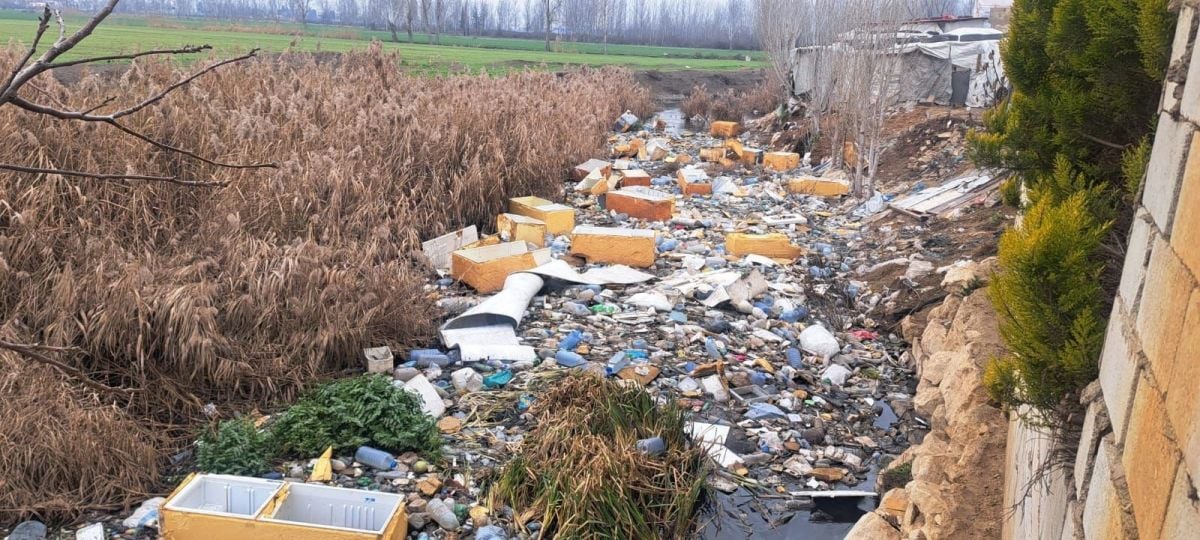
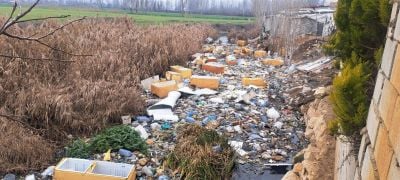
The Ghozayel stream, a tributary of the Litani in central Bekaa, completely covered with plastic and electronic waste from an illegal recycling operation. (Archive photo released by the Litani Authority)






The Cabinet on Monday suspended Decree 3214, which sets environmental fees on 98 categories of products. Signed on June 15 and published in the Official Journal three days later, the text, drafted by the Environment and Finance Ministries, had sparked a wave of objections. Political parties, unions, business circles, and civil society had called for its withdrawal, citing its impact on purchasing power and prices in a Lebanon grappling with a severe economic crisis since 2019 and still recovering from the latest devastating war with Israel.
Meeting Monday morning under the chairmanship of Prime Minister Nawaf Salam, the Cabinet devoted an extraordinary session solely to Decree 3214. According to Information Minister Paul Morcos, the government first reaffirmed the need to implement Law 38/2026, presented as a reform of governance in the waste management sector. It then announced the suspension of Decree 3214, considering living conditions, the economic situation, and the repercussions of war. In a statement, Energy Minister Joe Saddi called the decision a "responsible step" and noted that it would affect fuel prices.
A law passed in December, validated in February
The decree, issued by the Cabinet and signed by President Joseph Aoun, Prime Minister Nawaf Salam, Environment Minister Tamara Elzein, and Finance Minister Yassine Jaber, is based on Law 38 of Jan. 5, 2026, which amends Article 28 of Law 80 of 2018 on integrated solid waste management. The law adds two new funding mechanisms to Article 28: municipal collection fees and fees on imported products, based on the principle of extended producer responsibility, delegating to the Cabinet the authority to set and modify the rates by decree. The law also specifies that customs will collect these fees.
This delegation by Parliament of its taxation prerogative to the government had been contested beforehand. As early as September 2025, Legal Agenda recommended removing the Cabinet's authority to amend the fees, seeing in it a violation of the principle of tax legality enshrined in Article 83 of the Constitution. An appeal filed by MPs from the popular protest movement was rejected by the Constitutional Council on Feb. 26, 2026, with the body deeming the law consistent with the Constitution.
'Risk of social explosion'
Decree 3214 replaced the table annexed to Law 38, whose initial rates ranged from 0.10 to 0.50% depending on category, with a new list setting rates from 1 to 3% — a two- to tenfold increase, depending on the product, ranging from foodstuffs and hydrocarbons to chemicals and weapons. In its statement of reasons, the text invoked the polluter-pays principle and the need to stop financing the sector with Treasury advances and the autonomous municipal fund, shifting costs onto producers and importers.
Objections to the decree focused, from its publication, on the expected impact on the prices of the targeted products. The Progressive Socialist Party (PSP) called for the withdrawal of the text, accusing it of worsening inflation. The Lebanese Union of Labor Unions called for the decree’s cancellation, while public sector groups cited a risk of a "social explosion." The head of the union of gas station owners, Georges Brax, highlighted the impact on fuels, taxed at 2% under the decree. The chairman of Parliament’s Economy Committee, Farid Boustani, suggested prioritizing improved customs collection and fighting fraud, which he estimated at nearly $1billion in 2025.
The suspension decided Monday does not end the system. Law 38 remains in force and the fee structure is subject to further review, with no timetable or criteria yet specified.
This article originally appeared in French on L'Orient-Le Jour.

 7 p.m. recap: Houthis strike Riyadh airport again; Yemeni forces claim Bab al-Mandeb gains; Abbas postpones Palestinian polls