






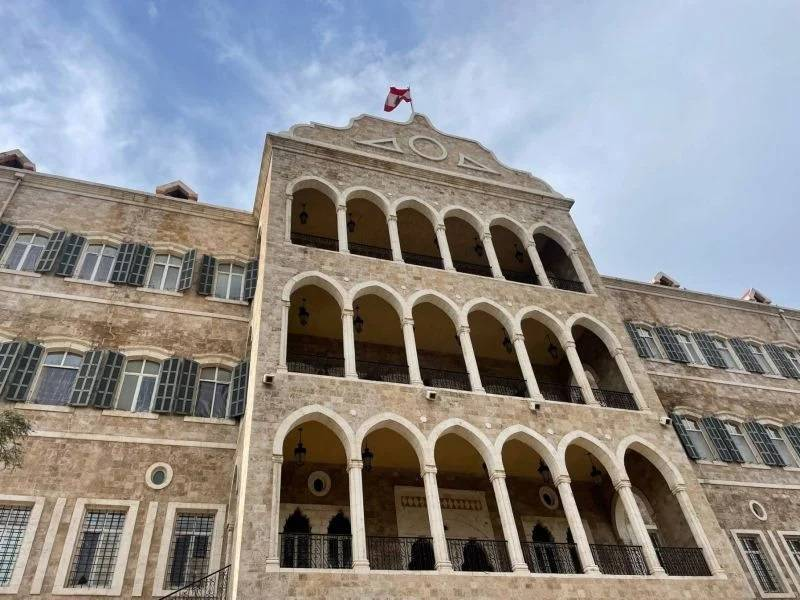
The Grand Serail in Beirut, Feb. 13, 2024. Illustrative photo by Philippe Hage Boutros






The Gathering of Arab Tribes warned on Saturday against any attack on the Grand Serail, on the prestige of the state, or on the office of Prime Minister Nawaf Salam, following nighttime demonstrations by Hezbollah supporters, particularly in downtown Beirut, against the signing of a framework agreement between Lebanon and Israel.
In a statement, the tribes gathering warned against any attack on the Grand Serail, stating that such an act, as well as any challenge to the "prestige" of the state or the "function" of the prime minister, would constitute "an attack on the state institutions and their symbolism" and would open the door to "chaos and division." It also said it is following "with deep concern" the tensions and demonstrations around the government headquarters, reaffirming its support for the Lebanese state, its constitutional institutions, and all decisions taken "within the framework of the Constitution and the law."
Lebanon is home to many Arab tribes, particularly in the Bekaa, Akkar, and the Khaldeh area near Beirut. Sunni Arab tribes have been present since before the proclamation of Greater Lebanon in 1920, explained Sheikh Haytham Tohaymi, a member of the Hourouk tribe of Faour (Bekaa) and president of the humanitarian association Al-Inma’ wal tajaddod (Development and Renewal), to our publication in 2021.
During the night from Friday to Saturday, supporters of the party demonstrated in Beirut against the framework agreement concluded between Lebanon and Israel, after the fifth round of negotiations in Washington, roaming the streets of the Lebanese capital on motorcycles, especially in central neighborhoods near Parliament and along a road leading to the airport, and blocking at least one road with burning tires.
Stating that national differences can only be resolved "through dialogue and institutions, and not by the logic of the street or by imposing a fait accompli by force," the tribes gathering reiterated its respect for the Lebanese people's right to peaceful protest, while calling on military and security authorities to protect the Grand Serail, legitimate institutions, as well as security and public order in the capital. Finally, it affirmed that "the dignity of Beirut, the prestige of the state, and the office of the president of the Council of Ministers are national red lines" that must not be crossed.
Just no violence, please !!!
27 June 2026 19:24