


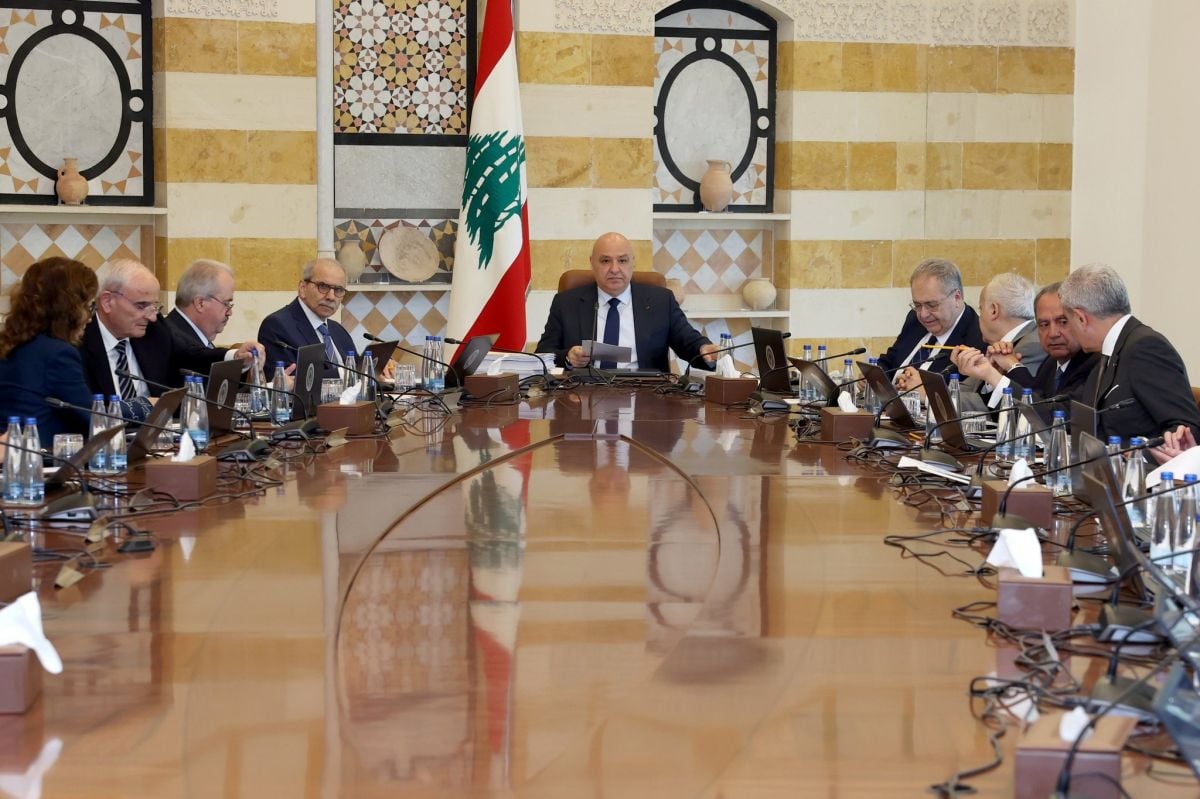
Lebanese President Joseph Aoun at the Baabda Presidential Palace during a Cabinet meeting on June 25, 2026. (Credit: Lebanese presidency/X)






On the eve of Ashura commemorations, President Joseph Aoun addressed the Lebanese on Thursday, saying unity in the ranks is "the most powerful weapon," noting that the event is one of the most important in the Shiite faith.
He added that Hezbollah has been sharply criticizing the authorities for the direct negotiations they are conducting with Israel under U.S. auspices.
Hezbollah leader Naim Qassem has repeatedly warned Lebanese leaders against direct negotiations with Israel and against the government's decision to disarm the militia party, frequently brandishing the threat of internal discord.
The head of state made the remarks during a Cabinet meeting in which the government decided to cancel the Lebanese baccalaureate for this academic year but did not resolve the controversial issue of appointing a new president of the electricity sector's regulatory authority.
Aoun quotes Moussa Sadr
During his speech, Aoun reaffirmed his commitment to "the law, as well as his commitment to the unity of Lebanon and solidarity among its citizens," calling it "the most powerful weapon we have," and saying that it rests on "the unity of the ranks of the Lebanese."
Ashura commemorates the massacre of Imam Hussein, the grandson of the Prophet Mohammad, and 72 members of his family and followers by the Umayyad Caliphate during the Battle of Karbala in 680.
On the occasion, the president recalled the words of Imam Moussa Sadr, an eminent figure for the Shiite community, for whom "Ashura is a permanent school" embodying "sacrifice, devotion, and the refusal of injustice."
The head of state also called for follow-up measures linked to the war, including the issue of displaced people and the start of a census of damage to housing, infrastructure, especially electricity and telecommunications, and farmland, in anticipation of possible international conferences in support of reconstruction.
According to a study conducted by the United Nations Development Programme (UNDP) and the National Council for Scientific Research (CNRS), Lebanon — ravaged since the beginning of March by a new war between Israel and Hezbollah — had suffered, as of April 29, 2026, damages estimated at more than $1 billion, with more than 11,000 buildings completely destroyed in the South.
Aoun also requested that ministries and administrations prepare for a potential influx of tourists and returning expatriates "if the cease-fire holds."
Ebola, electricity and fire in Dikwaneh
At the end of the Cabinet meeting, Information Minister Paul Morcos said the health minister had presented preventive measures to prevent the entry of the Ebola virus into Lebanon, while specifying that "no cases have been reported in the country." The concern comes as the Democratic Republic of Congo is experiencing a major Ebola outbreak, which has already caused more than 260 deaths, according to official figures.
Morcos also said the telecommunications minister had stressed the need to "not speculate on the conclusions of the judicial investigation" into the fire at a warehouse in the Dikwaneh suburb on Tuesday, assuring that the results would be made public as soon as the investigation was complete. There has been growing speculation about the origin of the incident at the warehouse belonging to the Telecommunications Ministry, where cables belonging to the public operator Ogero were being stored.
A ministerial source also told L'Orient-Le Jour that the government did not appoint a new president of the electricity sector's regulatory authority because the Cabinet preferred to keep a broader range of choices.
According to our information, Energy Minister Joe Saddi reached an understanding with his colleague, Administrative Development Minister Fadi Makki, for the issue to be resolved within about two weeks. Candidates will be chosen from among those who have passed the planned civil service recruitment mechanism tests.
Saddi (Lebanese Forces) has come under sharp criticism on social media, notably from supporters of the Free Patriotic Movement (FPPM), the party that oversaw the Ministry between 2008 and 2025.
In any case, supporters of Gebran Bassil, head of the FPM, reproach Joe Saddi for failing to deliver 24-hour electricity 15 months after the formation of the new government. Yet Bassil's own record at the helm of the Ministry is often considered mediocre. FPM supporters also denounce the resignation of the president of the regulatory authority a few months after its creation, which LF leader Samir Geagea described at the time as "an achievement" that the FPM had not managed to accomplish.

 7 p.m. recap: Sharaa in Riyadh; Qassem signals openness to cooperation; Ben-Gvir: ‘We demolish, again and again’