


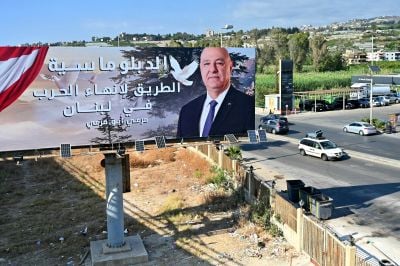
A vehicle carrying mattresses passes in front of a billboard displaying the portrait of Lebanese President Joseph Aoun and the slogan "Diplomacy is the way to end the war in Lebanon," along the highway of the coastal city of Saida, as displaced families return to their villages in southern Lebanon, on June 15, 2026. (Credit: Fadel Itani/AFP)






BEIRUT — As a new three-day round of talks between Lebanon and Israel, under the auspices of the United States, began Tuesday in Washington, the presidency has been active from the Presidential Palace in Baabda to reassert the Lebanese state’s role in discussions about a cease-fire and the withdrawal of Israeli forces from the South. President Joseph Aoun, during a meeting Tuesday afternoon with Army Commander Rodolph Haykal and members of the advisory team accompanying the talks, defended "the choice of direct negotiations" with Israel and promised "an end to all foreign tutelage," according to a message on the Lebanese presidency’s X account.
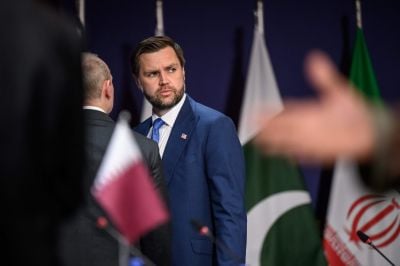
The president then received a phone call from U.S. Vice President JD Vance and Secretary of State Marco Rubio, during which the two leaders of U.S. diplomacy reiterated the "United States’ support for the positions of the president and the Lebanese government in their efforts to extend the authority of the legitimate state and to strengthen its national sovereignty over the entire national territory," according to another message from the Lebanese presidency.
'Negotiations, the only way'
Aoun said that "the developments of recent days have demonstrated the correctness of our choice to opt for negotiation" with Israel, alluding to the fragile "cease-fire" observed since Sunday in southern Lebanon, which Israel repeatedly violated during the day on Tuesday. At a time when Hezbollah is pleased with Iran's ability to reign in a cease-fire in Lebanon, and with the U.S.-Iran talks on the Lebanese issue, Aoun added that Lebanon "will accept nothing less than the end of the Israeli occupation of southern Lebanon and, at the same time, the disappearance of all foreign tutelage." "Today we have begun — and will continue over the next two days — a new round of negotiations that we hope will be decisive on the path to achieving what we want for our homeland and our people," he said.

According to him, negotiations are “the only globally recognized means to achieve national goals and recover all rights.” “Our only choice is our national sovereignty, and our only bet is on the Lebanese state which alone, and no other, protects all citizens, preserves freedoms and everyone’s dignity, values the sacrifices made, and dispels for all all forms of fear and injustice. This is the lesson of our contemporary history, this is the will of our people, and we have sworn to embody it in the interest of Lebanon and for the good of all Lebanese,” the president continued.
'Deconfliction' cell
Vance and Rubio highlighted during the telephone conversation the "deconfliction cell" designed to prevent any further escalation between Hezbollah and the Israeli army, which had been announced for the first time in a joint statement issued following the negotiations held on Sunday in Switzerland between Iran and the United States.
Vance and Rubio thus emphasized that the United States was “continuing to monitor the implementation of what was agreed at the meetings in Switzerland, in particular the creation of a cell comprising the United States, Lebanon, and the Islamic Republic of Iran to consolidate the cease-fire in Lebanon and oversee the implementation of related measures.”
They stated that “the operational arrangements for this task force, as well as its composition, are currently under consideration.” Press reports, however, suggest a difference of opinion between Vance and Rubio, with the latter viewing the task force as an “Iranian trap” aimed at circumventing direct negotiations between Israel and Lebanon.
For his part, Aoun thanked the two U.S. officials “for the interest the United States shows in Lebanon with a view to ending the war on its territory and strengthening the authority of the state and the independence of its decision, as the only body responsible for preserving national sovereignty, the dignity of the Lebanese people and their security.” Aoun informed Prime Minister Nawaf Salam of the phone call, as well as Parliament Speaker and Hezbollah ally Nabih Berri.
On his arrival in Abu Dhabi, Rubio himself stated, in response to questions from journalists, that the “Lebanese issue” was “separate” from that of Iran. “It is a separate process because the Lebanese state is sovereign,” he said, in comments broadcast by local television channels. “We are dealing directly with the Lebanese government; I spoke with [President] Aoun today [Tuesday] and on Friday,” he noted.
He did, however, point out that there was an “Iranian issue concerning Lebanon, namely the funding and support for Hezbollah,” and that this would be “discussed as part of our negotiations with Iran.” He added that “it is not possible to end hostilities in the region if Iran’s proxies continue to fire rockets.”
The Lebanese file has progressed in the context of Iranian-U.S. negotiations, even before advancing in the Lebanese-Israeli talks held under U.S. sponsorship. The renewed Washington negotiations, which resumed on Tuesday, now appear to be an extension of the Iranian-U.S. dialogue, according to some observers.

 7 p.m. recap: Netanyahu seeks mastermind behind Flydubai incident; Washington sanctions 2 French nationals; Ben Gvir's 'I want to kill you' threat