





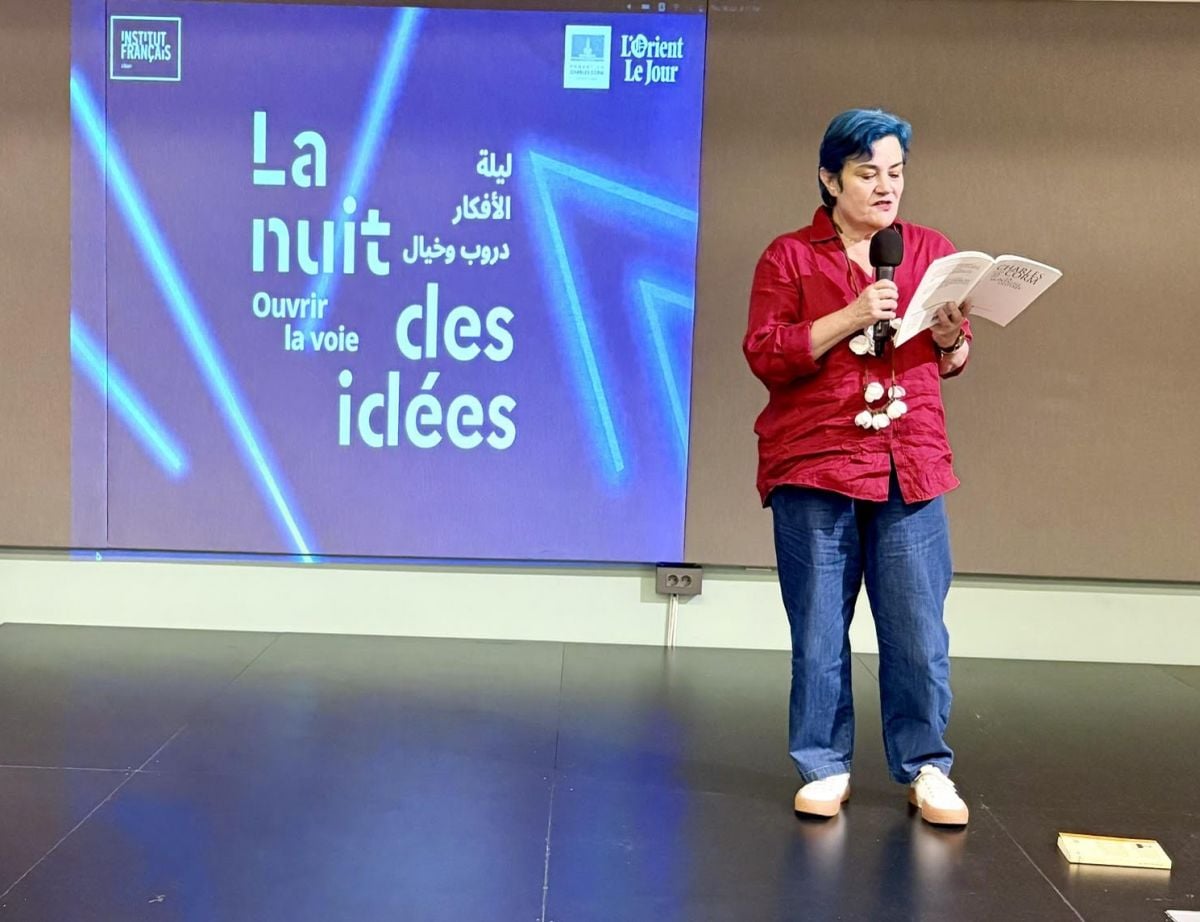
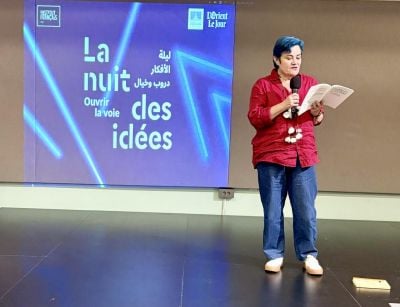
Fifi Abu Dib, journalist with a poetic style. (Credit: Zena Zalzal/L'Orient-Le Jour)






What if poetry were worth a thousand debates? What if a few verses were enough to express the world, its wounds, hopes and aspirations with more force than lengthy speeches?
At a time when world powers play with our destiny, when part of the country remains a battleground, and when positions harden and tempers flare to the point that dialogue seems nearly impossible, what space remains for encounter, sharing and humanity? What is left, if not poetry? What other escape remains from a reality so often violent, painful and bogged down, if not that “anywhere out of the world” so dear to the king of poets, Baudelaire?
It is precisely this power of poetry to open a space for breathing that no doubt explains — along with the country's security instability — the organizers' decision to place the 11th edition of the Night of Ideas in Beirut under its exclusive banner. A wager brilliantly taken up by the French Institute of Lebanon, which, in partnership with L’Orient-Le Jour, brought together dozens of lovers of words at the Charles Corm Foundation in Beirut to celebrate poetry in all its forms.
Qannoubine, from Charles Corm to Fifi Abu Dib
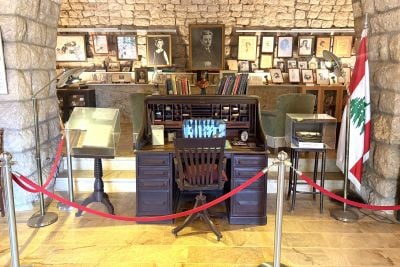
A Night of Ideas titled “Paving the Way” could not have found a better setting than this singular home resembling a white skyscraper, “designed and built nearly a century ago by Charles Corm, pioneering entrepreneur and poet,” as his son and host of the house, David Corm, recalled. The home remains inhabited by the memory of the author of "The Inspired Mountain," to whom several reciters paid tribute by bringing his verses to life once again.

A daughter of the North deeply attached to her roots, Fifi Abu Dib, “the most poetic pen of L’Orient-Le Jour,” invited the audience to rediscover "Qannoubine," taken from the iconic collection of the “herald of Lebanese identity.” She then continued with her own prose text, echoing both Corm's words and the evening's theme. In a spiritual and vernacular style, she described the “at once mystical and magical” experience of descending into the holy valley, “which gives, she says, the sense that the earth, at that precise point, is an inverted sky.”
“Poets, change the world or get lost!” It was with this famous injunction from Etel Adnan that Sarra Ghorbal, head of the Book Office at the French Institute of Beirut, set the tone for the evening, placed under the sign “of commitment, transmission and hope.” Under the guidance of Ghada Karaki, a literature professor at Collège Notre-Dame de Jamhour and mistress of ceremonies, poetry unfolded in both Arabic and French, carried sometimes by voice alone and sometimes by the music of pianist Henry Ishkanian and handpan player Alain Osta.
Youth’s appetite for poetry
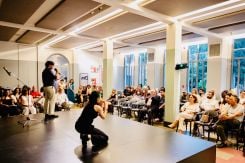
Before an intergenerational audience, adult reciters, budding versifiers and winners of writing contests took the stage in succession. They were accompanied by young poet and dancer Pamela Hayek, who wove a gestural thread between the different voices, sensibilities and worlds through her performance.
While adults mainly drew their readings from the great poetic repertories, the young participants showed they are far from indifferent to poetry, contrary to popular belief. This Night of Ideas revealed an unsuspected appetite for poetry among new generations.
Among the many voices heard that evening were Anthony, who beautifully read a moving piece of prose by Christian Bobin, and Myriam, winner of the Dreaming of Lebanon writing contest, who shared a vibrant poem inspired by her summers in Sour.
There were readings and recitations in Arabic and French by winners of the Poetic Challenge contest and students from the Questioning Tomorrow — Lebanon project. Marielle, as part of Questioning Tomorrow, recited "I Wish You." Joya chose a passage from "The Inspired Mountain," evoking “a solstice in the firmament that restores order and justice in Lebanon.” Mariana recited "Mesdames" by Grand Corps Malade, which she dedicated “to the women of Beirut.” Clara celebrated love through a poem by Gibran Khalil Gibran translated into French, then continued in Arabic with a stirring rendition of "A3tini al-Naya wa Ghanni" by the same author.
Pamela Hayek presented a text she wrote, recited and embodied in a performance blending words and movement. With humor and tenderness, she evoked a conversation with her grandmother, whose memories portray the transformation of a convivial and united Lebanon into a country marked by loss and chaos.
Writer, teacher and researcher Carole Awit presented "A Way," a poem echoing Lebanese suffering and resilience. Lawyer, mediator and poet Youmna Pharès also shared an original piece.
Poetic challenges in a city that has 'fought all the wars'
The most moving moments came from the youngest participants. Winners of the Poetic Challenge contest organized by the French Institute, several children amazed the audience with their maturity.
Serena al-Helou, 12, expressed her “dream of peace” and her hope that war would someday be confined to the yellowed pages of old newspapers. At just 11, Sam Bitar put into verse the fight against violence, injustice and racism. Another young participant reinterpreted the evening's theme in a piece titled “Choosing My Way,” boldly denouncing political injustices around the world and the war in Gaza. Abel read an excerpt from "Opening the Way to a Child," reminding everyone that the future belongs first and foremost to those for whom it is still being built.
The second part of the night — which included the participation of Éléonore Caroit, minister delegate for the French language, international partnerships and French nationals abroad, who was visiting Beirut, as well as French Ambassador to Lebanon Hervé Magro — paid tribute to several great literary figures. Joelle Hajjar honored the centennial of Michel Butor by reading "Beyond the Horizon," while Sara Hobeika presented two poems by Venus Khoury-Ghata. Then Ghada Karaki once again took the floor, offering a sensitive and heartfelt interpretation of a famous work by Palestinian poet Mahmoud Darwish on attachment to the land, which she dedicated to Lebanon.
The evening concluded with music: "Je l’aime à mourir," performed by Mariana and dedicated to Beirut. As the final lines — “She must have fought all the wars to be so strong today” — were sung in unison by the audience, poetry seemed to have kept its promise: to open, for one night, a common path between voices, generations and dreams.
This article was translated from L'Orient-Le Jour.

 Evening recap: Netanyahu announces West Bank offensive; 7 killed in Jordan church shooting; tents burned in south Lebanon
 US strike on Iran this weekend? ‘Absolutely,’ says Barrack; ‘I have no idea,’ says Trump