






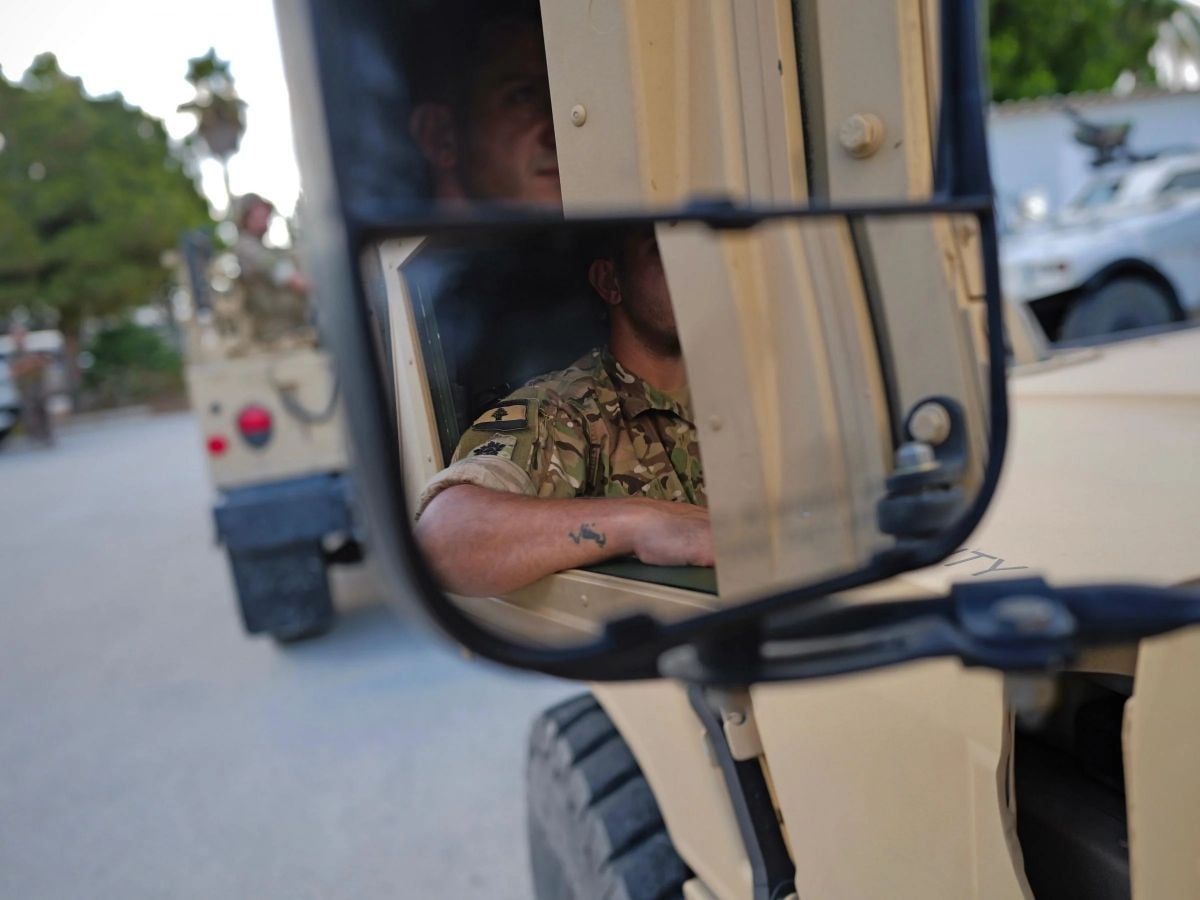
A Lebanese Army convoy at a base located in Sour, southern Lebanon, on July 8, 2025. (Credit: Matthieu Karam/L’Orient-Le Jour)






The draft version of the U.S. defense spending bill for the upcoming year introduces new restrictions on Pentagon assistance to the Lebanese Army, with part of that aid contingent on progress regarding Hezbollah's disarmament and monitoring of recruitments, according to a Thursday report by the American site Al-Monitor.
The executive summary of the National Defense Authorization Act (NDAA) for 2027, published by the U.S. Senate Armed Services Committee, states that funding for the Lebanese Army is now explicitly tied to its "willingness to counter Hezbollah."
Capped aid and tighter oversight
The bill, which is still under discussion in the upper chamber, sets a cap of $36 million in aid from the U.S. Department of Defense to the Lebanese Army.
However, only a limited portion of this package, 5% or $1.8 million, could be released immediately. The remainder would be subject to Pentagon certification to Congress, attesting that the Lebanese Army is actively working toward the complete disarmament of Hezbollah and is working to prevent any form of Iranian military or financial support to the militia-party.
The draft also provides for the possibility that the U.S. Secretary of Defense could completely suspend military aid if the Lebanese Army's commitment to countering Hezbollah is deemed insufficient.
Compared to the current framework, which requires an annual report on the progress of the Lebanese Army, the new proposal significantly tightens monitoring requirements. It calls for quarterly reports, every 90 days, to be submitted to the U.S. Congress detailing: weapons seized from Hezbollah by the Lebanese Army; Iran's capacity to support the group; threats to Israel and Syria; Lebanese Army deployments during these operations; U.S.-led training, equipping and mentoring programs.
The text also calls for information on the Lebanese special forces trained by the U.S., including the number of recruits and their "sectarian composition."
The bill further broadens the scope of U.S. assistance. The Lebanese army would henceforth be supported not only in its fight against Hezbollah, but also against several "terrorist groups," including Islamic State, al-Qaida, the Muslim Brotherhood, Hamas, and Palestinian Islamic Jihad.
Political pressure in Washington
According to Al-Monitor, these measures are generating "cautious optimism" in Congress, as several Republican lawmakers call for a tougher line.
Last April, Senate Armed Services Committee Chairman Roger Wicker said that "Congress should suspend all aid to the Lebanese Army if it does not proceed with the full and immediate disarmament of Hezbollah."
During a hearing in May, Wicker nevertheless expressed measured support for Pentagon efforts to boost the capabilities of the Lebanese army, saying it would be a "major accomplishment" if Hezbollah could be "eliminated."
The United States remains the leading foreign supporter of the Lebanese Army, with several hundred million dollars’ worth of military aid and cooperation programs in the past eight years. At the end of 2025, the U.S. administration had approved a $230 million package for Lebanese security forces, including $190 million earmarked for the army.
Officially launched in September 2025, the Lebanese Army's Hezbollah disarmament strategy was interrupted following the renewed hostilities with Israel on March 2. In January 2026, the army claimed to have completed Hezbollah's disarmament south of the Litani River. However, the fighting led to the return of Hezbollah elite forces to the area.
Despite a recently concluded U.S.-Iran agreement that includes provisions related to Lebanon, low-intensity clashes continue in the country's south. Israeli strikes have again been reported, while Hezbollah has carried out several operations targeting Israeli positions still present in southern Lebanon.