







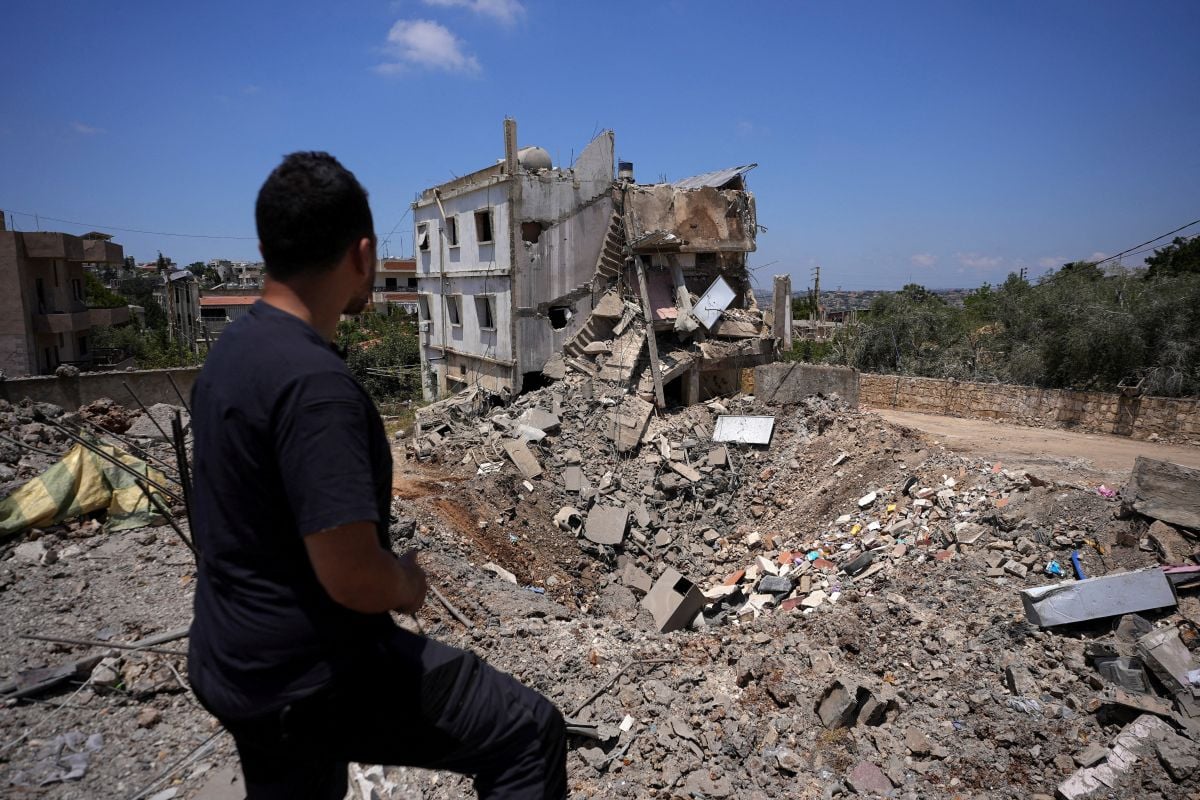
A man views the site of a previous Israeli strike in Kfar Sir in the Nabatieh district, Lebanon June 16, 2026, following a deal between the United States and Iran. (Credit: Reuters)






SOUTH LEBANON — Two days after a preliminary U.S.–Iran agreement, Israeli strikes in Lebanon have eased in intensity, while growing numbers of displaced residents are heading back south to the areas they fled during the war.
According to our correspondent, traffic on Tuesday was heavier than the day before on the main road linking Rmeileh to Saida, while numerous testimonies from residents discovering their homes destroyed by Israeli shelling were broadcast by the media and news agencies.
In a video shared by our correspondent, residents of the village of Maaroub in the Sour district found a large unexploded shell embedded in the ceiling of one of the floors of their home.
In Hadatha, in the Bint Jbeil district, where the Israeli army blew up houses on Monday, the Lebanese Army set up several checkpoints after inspecting the main road connecting Harris to this locality. In the morning, an Israeli drone strike forced residents to turn back.
In the Nabatieh district, what residents found instead of their homes were often unrecognizable ruins, such as in Kfar Sir or Jebsheet, according to photos taken by the Reuters agency.
Rescue teams have recovered around 70 bodies from under the rubble in two villages in the Bint Jbeil district. According to medical sources cited by local correspondents, 52 bodies were found in Kafra and surrounding areas, while 18 others were retrieved from Hadatha. Search and recovery operations are continuing in areas that had remained inaccessible during the fighting.
In addition to a death toll nearing 3,800 in Lebanon, according to the latest figures from the health ministry, the damages from the war are estimated at billions of dollars.
Ghalibaf speaks with Berri
Israeli drones continued to fly over several regions of the country, amid uncertainty about the future of the war in Lebanon after an agreement commended by President Joseph Aoun and Prime Minister Nawaf Salam, who followed the lead of Parliament Speaker Nabih Berri, the first of the three main leaders to speak on the subject Monday.
But while Berri directly thanked Tehran for including Lebanon in the memorandum of agreement, the two heads of the executive branch merely mentioned a "positive factor for the reduction of tensions in the region," while referring to the continuation of direct negotiations with Israel.
Israeli Prime Minister Benjamin Netanyahu, for his part, said Monday night that Israel intended to remain in Lebanon, Syria and Gaza as long as necessary, echoing the words of his Defense Minister, Israel Katz.
On the Iranian side, Foreign Affairs Minister Abbas Araghchi said Tuesday that "any Israeli attack" against Lebanon or "any maintenance [of Israeli forces] on Lebanese territory" would now constitute a violation of the memorandum of understanding reached with the United States.
For his part, Berri spoke with his Iranian counterpart, Mohammad Bagher Ghalibaf, about the memorandum of understanding between Tehran and Washington. The two men stressed the need for the United States, the parties guaranteeing the memorandum of understanding, as well as the international community, to force Israel to end its military campaign, stop the destruction of Lebanese villages, respect Lebanon's sovereignty, and immediately withdraw from the territories it occupies. Finally, speaking from the G7 summit in France, President Donald Trump called on Benjamin Netanyahu to act "responsibly" in Lebanon.

Nighttime clashes
On the ground, Hezbollah and Israel clashed during the night from Monday to Tuesday at the Kfar Tibnit crossing in the Nabatieh district. Hezbollah stated in a statement that after "repelling an attempted advance by an enemy unit toward this sector," the Israeli army reinforced its deployment there by sending in an armored force comprised of five Merkava tanks and four military vehicles.
Our correspondent reported that around 4 a.m., an Israeli army vehicle was targeted as it attempted to advance from the outskirts of Kfar Tibnit toward the heights of Ali Taher.
During the same night, Israeli artillery fire targeted the hills of Ali Taher as well as the outskirts of Kfar Roummane and Wadi Slouki toward Touline (Marjayoun), while about ten shells fell on the sector of Mansouri and Majdal Zoun in the Sour district. Eight more shells targeted Jabal al-Rafih in the heights of Aaramta (Jezzine). During the day, a drone dropped a stun grenade near residents in Beit Yahoun (Bint Jbeil), causing no injuries. By mid-afternoon, violence escalated significantly.
An Israeli army drone first struck an area between Nabatieh and Nabatieh al-Fawqa, without causing injuries, before Israeli artillery shelled the latter village. More than 25 shells in total were fired at Nabatieh al-Fawqa, Kfar Tibnit and the heights of Ali al-Taher.
This was the most intense shelling since the announcement of the agreement between the United States and Iran on Sunday night into Monday. At that time, the Israeli army was advancing toward this region of the Nabatiyeh district, near the city of the same name. The shelling caused several fires in the woods of Ali al-Taher, from which columns of smoke rose. The Israeli army was advancing toward this area before the announcement of the U.S.-Iran agreement on Monday.
On Monday, Israeli army drones targeted three towns in South Lebanon, while the outskirts of eight villages were hit by artillery fire. The Israeli army also carried out demolitions in five localities in the South, three of which are occupied. In Braasheet (Bint Jbeil), houses on the outskirts of the village were destroyed.
Reporting contributed by our regional correspondent, Muntasser Abdallah.
