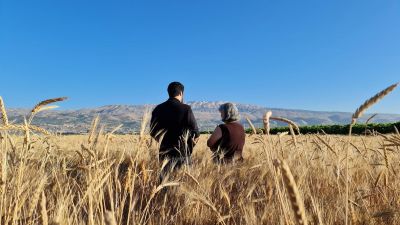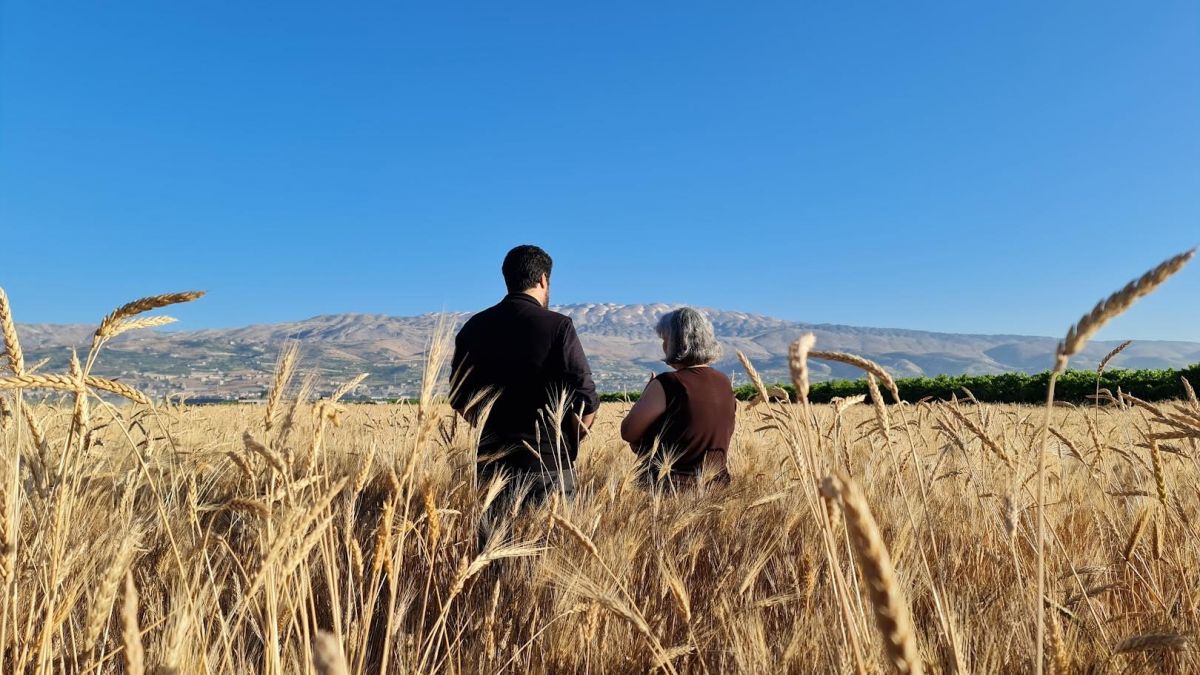
Choucriya Azzam and her son Adham Dimachqi, a face-to-face encounter marked by family memories and the scars of war. (Credit: Ralph Moussa)






The performance ''Saj'' — written, directed, and performed by Adham Dimachqi alongside his mother, Choucriya Azzam — revisits memory, confession, and family intimacy. It evokes the warmth of home, where evenings once revolved around stories told by grandmothers and mothers, before smart screens reshaped private life and disrupted the simple act of gathering, listening, and sharing silence together.
The show bears little resemblance to traditional theater, moving away from established concepts, labels, schools, and classic stage frameworks. It feels closer to a Sufi meditation session, set in dim light and a calm atmosphere, or a ritual of purification and confession facing the past, time, and suffering, expressed through a dense, symbolic dramatic form rooted in the natural cycle of life and creation.
Between simplicity and symbolism
The title « Saj » and the choice of venue — a warm, intimate « Mother’s House » — already set the tone of simplicity and authenticity, embodied by the maternal figure and far removed from spotlights, fame, scripted text, or rigid control of movement and rhythm.
Yet the work is driven by symbols: the house as a space of refuge and human warmth ; the staging and soft lighting, suggesting spontaneity, purification rituals, and a form of intimate therapy ; and the visual tableaux, shaped by imagination, waiting, fear, and anxiety about the unknown.
Next comes the radio, a symbol of a vanished era and a revolution of the voice, from which the stories emerge in the first scene. Choucriya never parted with it: she made it her main source of entertainment, thus defying a conservative society that condemned music, even taking it with her out to the fields.
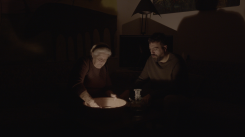
As for the wheat, the starting point of the story, it becomes dough kneaded and then rolled out on a table around which mother and son gather. A way of softening the harshness of the text, fate, work and fatigue that shaped their lives. In the end, we eat that wheat, transformed into warm, ripe, generous bread that we literally take with us. But the fundamental symbol remains the mother herself: a figure of giving, rooted in the earth like an ear of wheat, a constant presence at the heart of all stories.
On the surface, the show resembles a simple conversation between a mother and her son, woven with confessions, memories, reconciliations and stories of childhood, love, family, marriage, motherhood, or the body. True stories of emancipation, daily struggle, life’s hardships, moving from country to country, surviving senseless wars, injustice and social hierarchies, and migrating from village to village to earn their bread. Two generations meet here: that of Adham, in his thirties, and that of his mother Choucriya, in her seventies.
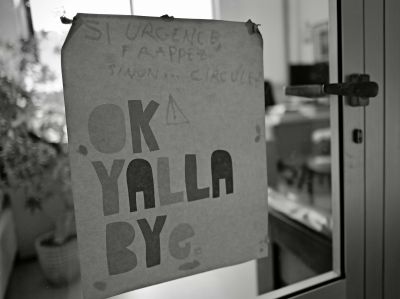
Beneath the surface of these autobiographical accounts lie existential questions about the philosophy of life, loss, pain, poverty, oppression, confession, the reopening of old wounds and their healing. Here Adham opens a window toward healing his own scars and those of his mother, who gradually, throughout the performance, transforms from an ordinary woman into a woman proud of her simplest accomplishments: raising her children, educating them, working, fighting for individual freedom against group pressure, rebelling against certain dogmas through music, against patriarchy, or against feudalism and forced labor. Without ever making her a supernatural heroine, he shows her as a survivor among others — survivor of war, of death, of patriarchy, harassment and social inequalities.
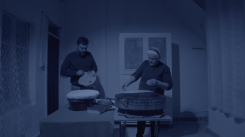
The show thus tells the story of the survival of our souls as free beings, and the fight waged to preserve our humanity and kindness, like centuries-old trees struggling to remain standing with dignity, anchoring their roots in the memory of the earth and nature, that nature capable of healing itself from all impurities, epidemics and wounds.
The fluidity of storytelling
The show opens with audio recordings of an old woman, in a mountain dialect, recalling days of abundance in the plains of Sweida, Syria, when she refused to go to the fields with her family unless she was allowed to bring her radio and her father bought her a gold ring.
This woman — who we later learn is Choucriya, Adham’s mother — gradually reveals a strong personality, unable to give up her right to choose her own companion, to defend her love or protect her children. She tells how she threw herself from the second floor and tried to commit suicide in protest over her family’s refusal to let her marry the man she loved, before being forced to marry another man, with whom she had Adham — the writer, director, painter and poet — and three daughters.
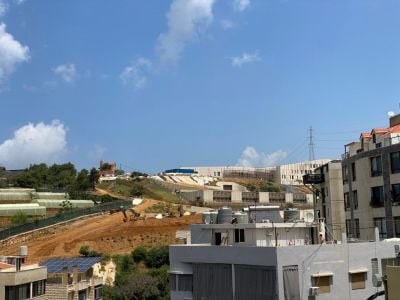
We are in Choucriya’s home, in a ground-floor apartment of an old building on Geitawi Street, Achrafieh, surrounded by flowers, trees and a small terrace, like the traditional houses of villages or old Beirut. Adham serves us maté, the emblematic drink of the Mount Lebanon region, where he comes from, but also of the Druze mountains of Sweida, Choucriya’s birthplace.
After living for six years in this place, gnawed by crushing loneliness that led him to adopt a dog named Godot for company, Adham decided, in the aftermath of the Beirut port explosion, to turn this intimate and modest space into a workshop and cultural venue hosting exhibitions, plays, concerts and poetry evenings. It was here that his dog Godot got lost on Aug. 4, and here that he returned alone after surviving the blast. The place thus became a refuge for survivors of death and trauma.
Catharsis
In an interview with L’Orient-Le Jour, Adham explains that ''Saj'' is not just a confession, but a real reconciliation with oneself. “I deeply believe that when an individual reconciliation is transformed into a creative work, it can lead to a collective reconciliation. When we place our own peace in an artistic work given to the public, it produces a kind of catharsis, in the sense Aristotle gives to the term in his ''Poetics.'' That’s what you find in Greek theater, where the hero struggles against his fate before the public, who identify with him, and that identification generates a form of healing or purification.”
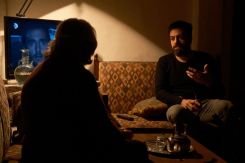
He continues: “My reconciliation with my stories and my personal narratives, transformed from suffering into creative work, joins with this essential idea that art has the capacity to turn ugliness into beauty… This intimate reconciliation allows the artist to overcome his pain through his work, be it poetry, theater or visual arts, to the point it becomes a form of collective healing.”
“You can’t force anyone into catharsis or reconciliation with a particular pain or question,” he adds. “But at least we can offer a model to those who wish to begin this journey. For those who do not wish to, they will simply have attended the performance without being pushed toward a place for which they are neither ready nor willing.”
Adham concludes that “life sometimes puts us in the role of the victim, but remaining there is a personal choice. We can stay victims, become executioners, or choose to be victorious survivors. Not every homeless person becomes Charlie Chaplin: some become dangerous criminals, fugitives, or prisoners.” He, however, says he believes “in the therapeutic power of art,” which for him “is the fundamental objective of 'Saj,'” symbolized by that grain of wheat which opens the performance and remains its backbone.
Saturday, May 30, 8:30 p.m., Achrafieh. Tickets at Antoine Ticketing.