








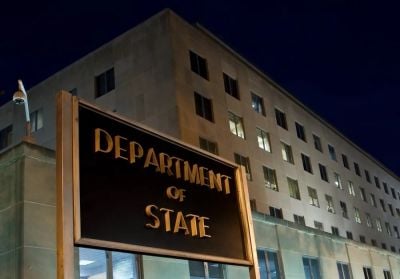
The headquarters of the U.S. State Department in the Foggy Bottom neighborhood in Washington, April 15, 2025. (Credit: Jim Watson/AFP)






Israeli and Lebanese representatives met Thursday in Washington for a first session of direct negotiations, under U.S. mediation, just days before the extension of the cease-fire in place since April 17 is set to expire. The cease-fire, however, has not stopped ongoing Israeli strikes in Lebanon, which, according to an AFP count based on official sources, have killed more than 400 people.
Just hours before the talks began, Lebanese Parliament Speaker Nabih Berri warned that if the discussions did not result in a "genuine cease-fire, everything will collapse." "We will accept nothing less than the withdrawal of the Israeli army, then reconstruction, the deployment of the Lebanese Army, and the return of the displaced residents," he insisted.
According to the Jerusalem Post, citing unspecified sources, the United States urged Lebanon to "offer something significant to the Israelis," warning that otherwise extending the cease-fire might "become more difficult."
The meeting, held at the U.S. State Department, is expected to last two days. It comes after two previous preparatory meetings, including one on April 23, during which U.S. President Donald Trump announced a three-week extension of the truce and expressed hope for a historic rapprochement between the two countries, which do not have diplomatic relations.
Hezbollah rejection
In Lebanon, Hezbollah reaffirmed its rejection of these negotiations. MP Ali Ammar denounced them as a "free concession" to Israel, while his colleague Hussein Hajj Hassan said the negotiations were taking place due to "American pressure." He asserted that Lebanese officials entered the talks before establishing a cease-fire, calling this a political mistake and accusing the United States of being "even more aggressive than Israel."

Lebanese Foreign Minister Joe Rajji, for his part, clarified that Beirut is "not talking, at this stage, about a peace agreement." "The priority is to end the attacks, halt the destruction, protect civilians, and create the proper conditions for serious and lasting negotiations," he said, emphasizing that "serious negotiations cannot take place while civilians are being killed and villages destroyed."
The minister also stressed the need for Israeli forces to withdraw from southern Lebanon, allowing displaced people to return to their homes, as well as addressing the issue of prisoners.
Asked about Hezbollah's weapons, Rajji emphasized that "the Lebanese people want to live in a normal sovereign state where the monopoly on military force belongs exclusively to the state and its legitimate institutions." He specified that this is "not a demand to satisfy Israel or the international community, but a matter of national sovereignty," adding that the Lebanese government has called on Hezbollah to disarm and sees its military actions as operating outside the legitimacy of the state.
'A cease-fire is in the works'
On the Israeli side, Ambassador to Washington Yechiel Leiter said that a "cease-fire is in the works" but Israel "will under no circumstances allow Hezbollah to rearm." He mentioned the discovery of "thousands of rockets and weapons" in southern Lebanon and stressed that Israel "wants to see how the Lebanese government strengthens the Lebanese army and takes concrete action."
"We are ready to follow two paths. The first is to negotiate total peace, as if Hezbollah doesn’t exist: borders, embassies, visas, tourism, everything. Such an agreement could be reached in a few months. But it will be conditioned on the success of the second path: the dismantling of Hezbollah," he added.
Washington, which is hosting the discussions in the absence of Secretary of State Marco Rubio and President Donald Trump, who are currently visiting China, is represented by its ambassadors to Lebanon and Israel, Michel Issa and Mike Huckabee. Lebanon is this time represented by Simon Karam, a 76-year-old lawyer and diplomat and a staunch defender of Lebanon’s sovereignty, and Israel by its ambassador Yechiel Leiter, 67, a longtime ally of Prime Minister Benjamin Netanyahu.