Can one be both against Israel and against Hezbollah? While there are no polls on the subject, it is fair to say that a large part of Lebanese society would answer yes.
Most feel no sympathy for a state that bombs and occupies their country,erasing part of their territory — particularly in a context where that same state has devastated the Gaza Strip with impunity. Nor do they feel any more sympathy for a party-militia that threatens civil war, is widely believed to have assassinated some of the country’s most prominent figures, and has dragged Lebanon into three wars (not to mention its intervention in Syria) since Israel’s withdrawal from southern Lebanon in 2000.
There is, of course, a minority that openly calls for normalization with Israel, independently of the Hezbollah question, and sees it as Lebanon’s natural ally. And there is the party-militia’s own popular base, which is larger, and which — while sometimes critical of its actions — ultimately tends to forgive it regardless.
Both camps existed before the current war, and while the conflict has had an impact on them, they are not where the main dynamics are playing out.
Neither Israel nor Hezbollah: on paper, this slogan could rally the widest support and offer Lebanon a third way. It asserts the country’s sovereignty vis-à-vis both Israel and Iran, and rejects the rhetoric and ignominious actions of both belligerents.
In theory, it is more than appealing. In practice, however, it quickly runs up against reality, especially in times of war.
While most people support neither camp, many still end up gravitating toward one or the other, not out of any real sympathy for the first, but out of outright rejection of the second.
The more one digs, the more the grey takes on the color of yellow or blue. A simple question helps clarify the dynamic: if you had to settle into a (cold) peace with one of the two, which would it be? Or rather, with which one does it feel impossible to live in peace?
In the end, most Lebanese do not wish for the victory of Israel or Hezbollah, but for the defeat of one of them. They hope that one, however unpalatable, will help them get rid of the other.
The problem is that this logic, too, runs up against reality. Hezbollah can hold out for years, even decades, but it is incapable of inflicting a decisive defeat on its adversary. Betting on Hezbollah means betting on an endless war whose only realistic objective is to prevent the other side from achieving a total victory. But at what cost?
Israel, for its part, can significantly weaken the party-militia, destroying its infrastructure and decimating its leadership, but it is equally incapable of delivering a total defeat. Betting on Israel means betting on an endless war whose only attainable goal is to keep its adversary, ad vitam aeternam, in the position of a hunted prey. But at what cost?
In both scenarios, Lebanon would pay a heavy price. Under these circumstances, a third way appears to be the only path out of the impasse. But that depends on agreeing over what it actually means. The debate is far from new in Lebanon.
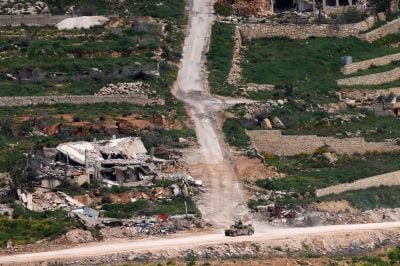
During the Civil War, it revolved around the possibility of voicing a position that was not aligned with either of the main camps, while drawing on the strongest arguments from both.Later, it sought to move beyond the 8 and 14 March divide, both discredited for different reasons, and briefly gained momentum during the Oct. 17 uprising.
Today, while it has taken on an even more existential dimension, the substance remains much the same.
There is broad agreement in intellectual, activist, and diplomatic circles that the state is the only viable way forward. But the state cannot fully exist as long as it has not regained its sovereignty. And it cannot do so as long as a militia aligned with a foreign power continues to challenge it. Up to this point, most of those who oppose both Israel and Hezbollah are on the same page. The debate becomes far more complex when it comes to how to deal with Hezbollah itself, particularly in a context of Israeli occupation of southern Lebanon.
Part of Lebanon’s intelligentsia is determined to avoid marginalizing the Shiite community or being seen as collaborators with Israel. It therefore advocates for disarmament through dialogue, more or less forceful, with the backing of the international community, once the Israeli army has withdrawn from the territory.
But this approach, however well intentioned, ends up reinforcing what it seeks to challenge. On the one hand, Hezbollah has been explicit that it will not give up its weapons and is ready to fight to keep them. As long as it remains dominant within its own community, any idea of an internal revolt against it is simply unrealistic. On the other hand, Israel will not withdraw — even if it were to commit to doing so in a future agreement — as long as the Hezbollah question is not definitely resolved.
Thus, the more the state remains passive, the more the third way is doomed from the outset. It can only exist if the state takes its destiny back into its own hands — not by negotiating a peace deal with Israel, which is not the priority, but by neutralizing the militia, first politically and then through policing. The third path would require doing so not at Israel’s behest, nor within a sectarian logic, but through a state-centered discourse that is both firm and inclusive.
One can still argue that the state lacks the means, that the timing is not right, or that the cost would be too high for Lebanon. But beyond the fact that each of these arguments can be challenged, the alternative is once again far worse for the country: either Israel will resume a full-scale war, or it will turn the Lebanese state, under international pressure, into the executor of its own policy. And once again, Lebanon will be left to face the consequences.
This editorial originally appeared in French on L'Orient-Le Jour and was translated by Joelle El Khoury.