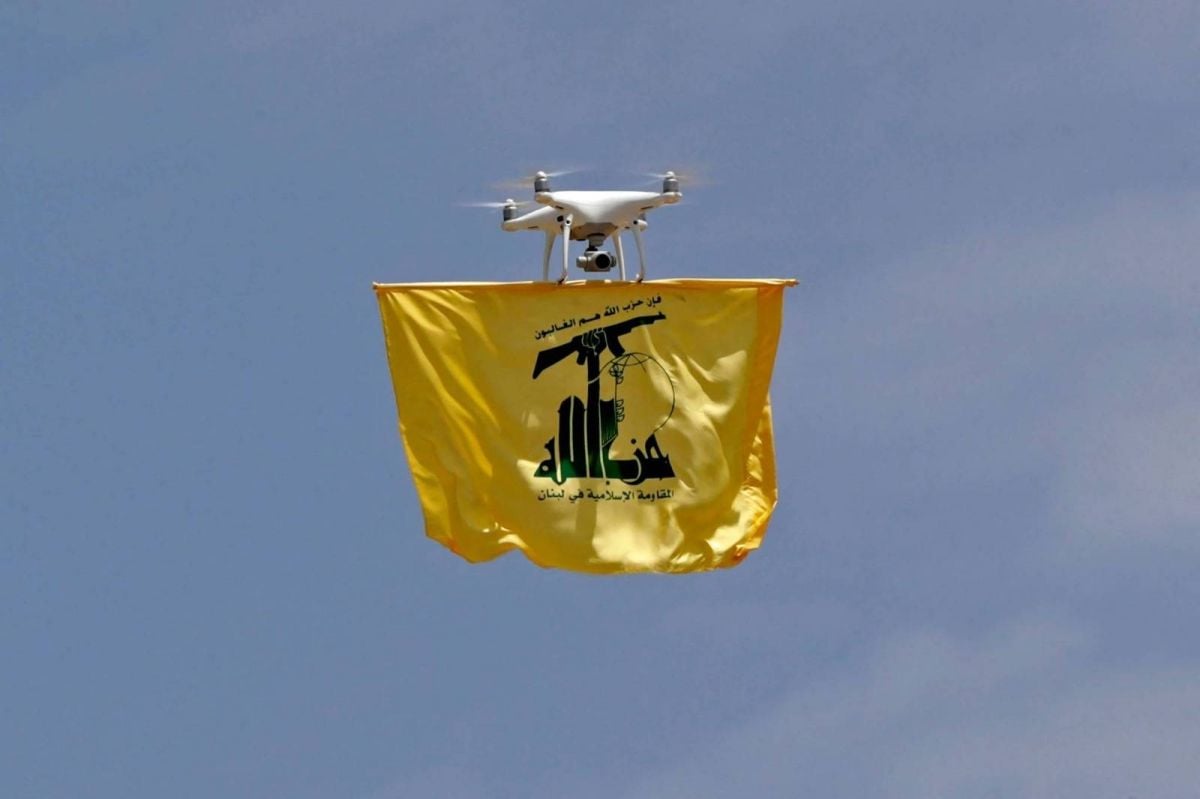
A drone bearing a Hezbollah flag in Aramta, southern Lebanon, during a military parade held in May 2023 to commemorate the liberation of the South from Israeli occupation. Photo Anwar Amro/AFP






Under pressure from Hezbollah's explosive drones in southern Lebanon, the Israeli army has developed a new interception technology, consisting of drones equipped with nets, reports the Israeli daily Haaretz on Sunday evening.
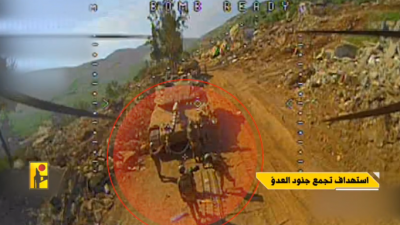
In recent weeks, Hezbollah has made impressive use of attack drones loaded with explosives that are launched at Israeli forces occupying southern Lebanon and explode on impact. Some of these devices are guided not by a wireless network but by fiber optic cables, which are resistant to conventional electronic interception techniques such as jamming. This invention, manufactured at low budget in Lebanon, according to a Hezbollah official, has posed a real challenge to the Israelis. Last week alone, according to figures from Haaretz, these drones killed three people (two soldiers and one Defense Ministry employee) and wounded 15 others. In Israeli media, numerous observers and military experts have criticized the Israeli army's lack of preparedness for this aerial threat.
Artificial intelligence and parachute net
"The Iron Drone Raider is an automated technology operated by artificial intelligence and developed by Airoboticss, combining radar and interceptor drones to detect threats and respond to them," according to Haaretz. "Once the threat is identified, the interceptor drone is launched and autonomously guided to its target by radar. Operators can then choose to continue pursuing the targeted device or deploy a net to capture and neutralize it," the newspaper continues. This capture is carried out using a parachute-shaped net that deploys to bring the pursued drone relatively gently to the ground, thereby reducing the risk of explosion. A leaked video in Israeli media last week showed a Hezbollah explosive drone being shot down near Israeli soldiers evacuating wounded by helicopter, and crashing to the ground with a massive explosion.
"Many Israeli soldiers have recently admitted that the army was not prepared for Hezbollah's massive use of attack drones," reports Haaretz, which adds, citing a military official, that "the anti-drone technologies currently used by the [Israeli] army do not effectively counter the threat, or they are 'not always available in sufficient quantity.'"
'Several operational scenarios'
On Sunday evening, Prime Minister Benjamin Netanyahu addressed this issue by announcing the launch of a "special project" and an investment of 350 billion shekels ($118.9 billion) "in domestically designed weaponry and aircraft over the next ten years."
At the beginning of April, the Israeli Directorate of Defense Research and Development issued a call for projects to startups and companies to find solutions against fiber optic drones. Developers were invited to propose responses to several operational scenarios, notably technologies that could be mounted on vehicles or carried by infantry to protect ground troops, without necessarily having to deploy infrastructure.
Images, which L'Orient-Le Jour could not immediately verify and that are circulating online, appear to show an Israeli army armored vehicle covered with a makeshift protective net to prevent drone impacts. This technique has notably been popularized by the Ukrainian army and Russian forces to protect against explosive drones, installed on vehicles, roads, or at the entrance of tunnels.
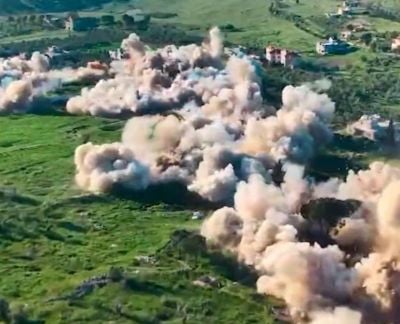
Israel renewed its full-blown war on Lebanon after Hezbollah opened a support front for Iran on March 2. Since then, Hezbollah combatants have continued their clashes in southern Lebanon despite the so-called cease-fire reached on April 16. In reality, the cease-fire has only applied to regions other than the South, where the Israelis occupy a "buffer zone" about 10 kilometers deep along the border and continue their daily attacks, strikes, demolitions, and invasion.