



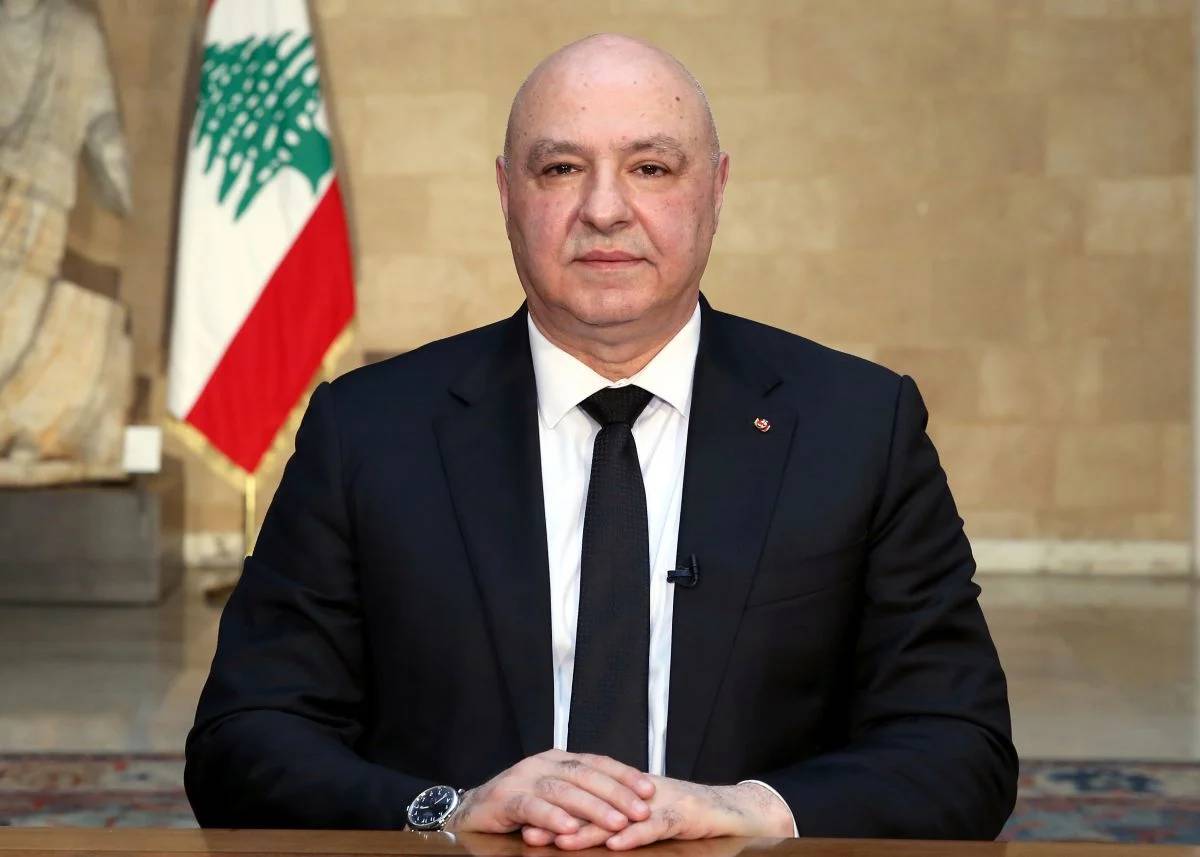
President Joseph Aoun. (Credit: X account of the Lebanese presidency)






Lebanese head of state Joseph Aoun said Wednesday that Lebanon will seek to obtain a cease-fire extension in Washington, during the second direct contact between Lebanon and Israel since 1983, once again at the level of their respective ambassadors to the United States.
Lebanese ambassador Nada Hamadeh Mouawad "will raise the issue of extending the cease-fire agreement as well as pushing Israel to stop demolition operations in villages and towns in the South," Aoun told the Democratic Gathering parliamentary group, which is mainly made up of MPs affiliated with the Progressive Socialist Party (PSP), according to the Lebanese presidency on X.
Citing an official source quoted by AFP, Lebanon will request a one-month extension of the truce.
Aoun has taken charge of the negotiations dossier with Israel, drawing the ire of Hezbollah circles. The cease-fire, which took effect on April 17 at midnight and was initially set for 10 days, is due to expire at midnight on Sunday.
'In contact with Berri, Salam and Joumblatt'
Presenting himself once again as the strongman of the state, Aoun said he had "chosen negotiation, because past experiences have taught us that wars lead only to death, destruction, and displacement."
The president explained that he is "in constant contact with Parliament Speaker Nabih Berri, Prime Minister Nawaf Salam, former MP Walid Joumblatt, and several Lebanese officials, in order to support the ongoing initiatives to consolidate the cease-fire."
He added that the "current phase requires realism, wisdom, rationality and a sound understanding of the Lebanese reality, so that everyone can support this direction and help end the suffering of Lebanon as a whole, and its South in particular."
He specified that this part of the territory "has been, since 1969 [the year of the signing of the Cairo Agreement, which legalized the presence and armed action of Palestinians in southern Lebanon against Israel] until today, the scene of wars that have brought tragedies and suffering whose consequences we still endure."
In front of the parliamentary commission for the protection of civil property, made up of MPs and which began its work this week amid systematic demolitions of villages in the South, Aoun specified that the Lebanese side's negotiations rest on "a total halt to Israeli attacks, Israeli withdrawal from Lebanese territory, the return of prisoners, the deployment of the army to the international borders, as well as the launch of reconstruction for what was destroyed during this war."
'American support'
He stated that "the American support communicated to us by President Donald Trump, as well as that of brotherly and friendly countries, has given us an opportunity that must not be missed, because it may not come again."
Aoun spoke by phone on April 16 with his American counterpart, a few hours before the latter announced a ten-day truce between Beirut and Tel Aviv.
On displaced persons, he emphasized that their return is a "priority," before the parliamentary commission for the protection of civil property. "I will spare no effort to end the abnormal situations currently facing Lebanon."
He also responded to Hezbollah's criticisms regarding the negotiations with Israel, which the militia-party categorically rejects. Aoun told the PSP-affiliated MPs that despite the expected opposition of "some," without naming Hezbollah, he remains "convinced that this choice is the safest for Lebanon and the Lebanese, regardless of their affiliations."
"The majority of political forces are aware of the sensitivity of the current phase and stand firmly against any form of discord and anything that would harm civil peace in the country," he added, referring to a "shared national mission, and not the responsibility of a single person, even if that person is the president of the Republic."
'Criminal logic and sectarian hatred'
Jaafarite mufti Ahmad Qabalan, regarded as an unofficial spokesperson for the Amal-Hezbollah alliance he is close to, again lambasted Aoun's decision to negotiate with Israel, even implicitly threatening the president in a letter he sent him.
"Mr. President, I tell you: What Lebanese presidents have not been able to assume since the birth of Lebanon, it will be difficult, if not impossible, for you to bear," he said, in reference to a peace agreement with Israel and the disarmament of Hezbollah, according to remarks reported by the state-run National News Agency (NNA).
"Ignoring this reality will place you, and the country, at the center of the worst catastrophe that will destroy it. What Israel and the United States could not swallow or seize will not be possible today," he wrote.
He then judged that "the error here is not that of May 17 [1983], it is a thousand times more serious." "I hope you will avoid falling into this mistake, because you would burn your country," the religious leader also wrote. He continued: "I am relying here on your national conscience, but I fear certain advisers who live in a criminal logic and sectarian hatred."
Under President Amine Gemayel, Lebanon signed, on May 17, 1983, an agreement for normalization (but not yet peace) with Israel in exchange for the withdrawal of its troops from Lebanon. The agreement was initially approved by the Lebanese Parliament, but was subsequently abandoned by Gemayel in March 1984, under military pressure from Syria and its allies.

 1 p.m. recap: Third death in 2 days in Israeli-occupied south Lebanon, Salam comments on the Dahr al-Baidar case, Saudi Arabia bombs Yemen