





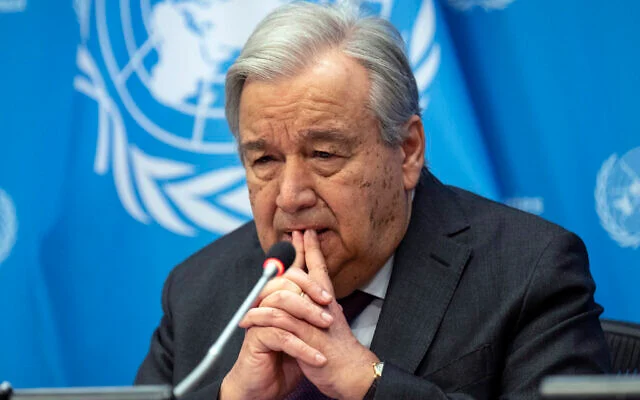






The United Nations is preparing to choose a new secretary-general, a process under unusual scrutiny amid weakened multilateral cooperation, rising global crises, and growing challenges to international law, ten years after António Guterres took office.
Four candidates will take the stage on Tuesday, April 21 and Wednesday, April 22, during public interactive dialogues organized in New York, a now central step in a selection process intended to be more transparent.
Presiding over the proceedings, General Assembly President Annalena Baerbock set the tone by highlighting the political and institutional stakes of this moment. "In an era of growing challenges and when the fundamental principles of the United Nations Charter are under question, the world needs the United Nations — and a secretary-general capable of ensuring strong, principled, and effective leadership — more than ever," she said, before underscoring the strategic dimension of the upcoming mandate.
"The role of the secretary-general is crucial — he or she must be the firmest defender of the United Nations Charter, the foundation of the rules-based international order."
Coded procedure and highly political
The selection process relies on a delicate balance between increased transparency and geopolitical realities. According to practices strengthened since 2016 and confirmed by General Assembly resolution 79/327, candidates must be officially nominated by a member state or a regional group. Each application must be accompanied by a curriculum vitae, a strategic vision statement, and information on campaign financing.
The interactive dialogues constitute a major innovation: for three hours, each candidate will present their priorities and then respond to questions from member states and civil society. It is an unprecedented accountability exercise at this scale, even though the final decision remains in the hands of the Security Council, whose five permanent members have veto power. The General Assembly then formally ratifies the nomination. "The choice of secretary-general will also demonstrate whether the United Nations truly represents the eight billion people we serve," Baerbock reminded.
Four profiles for a role to be redefined
Four candidates are currently in the running, reflecting varied diplomatic, political, and technocratic backgrounds. Michelle Bachelet, former president of Chile and former High Commissioner for Human Rights, embodies an approach focused on fundamental rights and executive experience.
Rafael Mariano Grossi, director-general of the International Atomic Energy Agency (IAEA), brings technical and strategic expertise on nuclear and international security issues. Rebeca Grynspan Mayufis, current secretary-general of the United Nations Conference on Trade and Development (UNCTAD), gives voice to economic development and the Global South. A former vice president of Costa Rica, she emphasizes issues of inequalities, debt, and reform of the international financial system — central to current debates on global economic governance. Former Senegalese President Macky Sall represents a political candidacy from the African continent, with significant regional experience and an active role in diplomatic mediation.
The interactive dialogues are not just an exercise in presentation: they have become a major political test. For three hours, each candidate must defend their vision and answer direct questions from states and civil society. Before the dialogues open, Baerbock will make a statement to the press at 9:45 a.m., marking the official launch of the sequence. All these interventions will be broadcast live and available on demand on U.N. Web TV. Shortly after their appearances, the candidates will have the opportunity to answer press questions at the East Foyer press point, outside the General Assembly Hall.
Beyond the profiles, it is the very nature of the job that is at stake. The next secretary-general will have to contend with increasing fragmentation of the international system, prolonged conflicts, and mounting pressure on multilateral institutions. The roadmap outlined during the dialogues centers on two axes: leadership and responses to the United Nations' three pillars—peace and security, development, human rights. But one question remains: what real room for maneuver exists in a world dominated by power rivalries?

 Evening recap: Netanyahu announces West Bank offensive; 7 killed in Jordan church shooting; tents burned in south Lebanon
 US strike on Iran this weekend? ‘Absolutely,’ says Barrack; ‘I have no idea,’ says Trump