




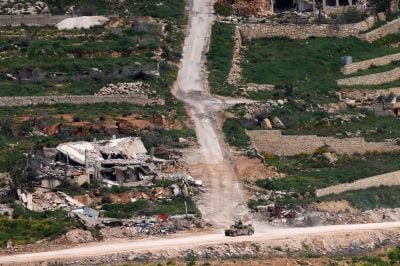
A building destroyed by Israeli attacks in the village of Debbine, Southern Lebanon, amid a ten-day cease-fire on April 19, 2026. (Photo: Reuters/Stringer)






SOUTH LEBANON — Hezbollah, which had not announced any attacks on the Israeli army during the first three days of the cease-fire, claimed responsibility Monday morning for an operation involving "explosive devices" in South Lebanon, where neighborhoods and homes are being systematically demolished by Israel, which seeks to establish a "buffer zone" inside Lebanese territory along the border.

In a statement released Monday morning, Hezbollah said that "eight armored vehicles were moving from Taybeh towards Deir Siryan" when "improvised explosive devices, previously planted" by its fighters, were detonated. Two explosions occurred at 3:40 p.m. and 4:40 p.m., causing "the destruction of four Merkava tanks," which were then evacuated. The Israeli army had been operating in the area since the afternoon and had redeployed towards Deir Siryan and Qantara, according to our correspondent in the region. The Israeli army announced over the weekend the death of two of its soldiers in explosive device detonations planted by Hezbollah, while military sources said this tactic posed the greatest risk to soldiers operating in the area.
Demolitions in the 'buffer zone'
The Israeli army, for its part, continued demolishing houses and neighborhoods in villages of the so-called "buffer zone," and demolitions were reported in Qantara, Robb Thalathin (Marjayoun), as well as in Rshaf, Beit Yahoun, Tiri (Bint Jbeil), and Bayyada (Sour), according to information from our correspondent. The Israeli army's Arabic-language spokesperson, Avichay Adraee, issued a statement ordering residents not to move about in the villages within the demarcation line, effectively denying access to 55 border villages in territory it now occupies.
In a message accompanied by a map identical to that published the previous day, Adraee called on people not to "move south of the line" marking the zone, which stretches from west to east from Mazraat Beit al-Sayad, on the coast, to Kfar Shuba and Ain Ata.
He also banned all movement "near zones bordering the Litani River, the Salhani valley and Wadi Slouki valley," as well as the return of residents to dozens of villages south of this zone, which extends over several hundred square kilometers along the Blue Line and includes dozens of towns and villages, a few localities on the north bank of the Litani at the river's bend in the eastern sector, a portion of the territorial waters and exclusive economic zone off the country’s coast, and part of the Anti-Lebanon mountain range.
Adraee also specified that Israeli forces "continue to deploy at their positions in South Lebanon," despite the truce supposedly in place. The Israeli army also announced that it struck, overnight, a "loaded and ready-to-use" launch pad in Qalaouieh (Bint Jbeil), southern Lebanon.
Meanwhile, since this morning, Israeli army drones have been flying intensively over many localities and villages in South Lebanon, the Beqaa, as well as over the capital Beirut.
Searches for bodies in Sour
In the Sour region, search operations are continuing for missing bodies trapped under the rubble of buildings bombed by Israel just minutes before the cease-fire came into effect, in the night from Thursday to Friday. A body was found on Monday, bringing the toll to 19 people killed, according to our correspondent. Four other people are still missing.
At the same time, maritime rescue teams from the city began operations this morning in search of the bodies of two people missing since March 22, when they were on the coastal Qasmieh bridge, which connects Sour to Saida and to the rest of Lebanon, our correspondent in southern Lebanon reports. Rescuers believe the blast from the explosion may have thrown them into the river. Excavation work may then be launched on the road leading to the bridge. The bridge will be closed from 9 a.m. to allow for these search operations, the state-run National News Agency (NNA) said.
