






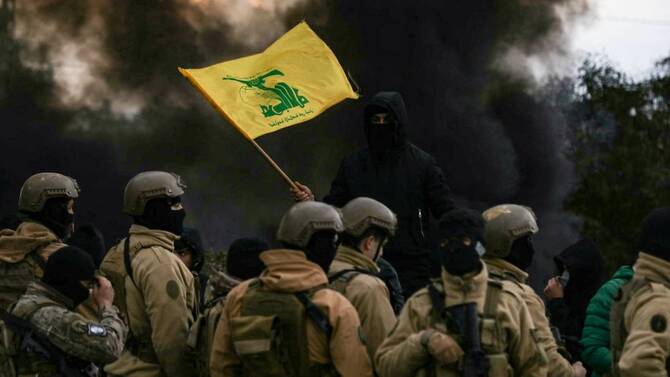
A Hezbollah supporter waves the party's flag in front of Lebanese Army soldiers on the road to Beirut airport, Feb. 7, 2025. (Credit: AFP archive photo)






BEIRUT — A comment by Hezbollah official Nawaf Moussawi comparing President Joseph Aoun to Anwar al-Sadat sparked widespread condemnation in Lebanon on Sunday.
In an interview with Al-Manar, Moussawi, head of Hezbollah’s resources and borders dossier and former member of its political bureau, said that if Aoun “wants to make decisions unilaterally, he is no more important than Anwar al-Sadat.”
Sadat, the former Egyptian president, signed a peace agreement with Israel at the Camp David Accords and was assassinated in 1981 by Islamist extremists after being ostracized by several Arab states.
Moussawi added that any negotiation or agreement between Israel and Lebanon would be “rejected, unrecognized and thrown in the trash, like the May 17, 1983 agreement.”
That accord, reached under former President Amine Gemayel, was later abandoned under pressure. He also said that if Aoun “submits to [U.S. President] Donald Trump and meets [Israeli Prime Minister] Benjamin Netanyahu," he would “lose his status as president of the country.”
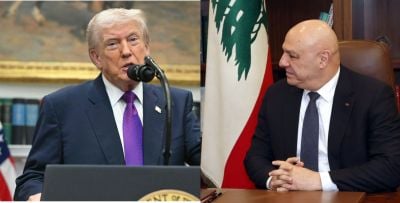
Former MP Fares Souhaid condemned the remarks on X as an “unacceptable threat.” He added that “Lebanon’s diversity has prevented coups and attempts to impose a single-color regime.”
Kataeb MP Elias Hankash said that “if Tehran itself is negotiating with what it calls the ‘Great Satan’ [the United States], Hezbollah should learn from this.”
He described the attacks on Aoun as “unjustified and unacceptable,” adding that the president “embodies legitimacy and has taken the initiative for direct negotiations with Israel, which will eventually take place.”
Separately, Hezbollah officials also criticized Aoun. On Saturday, Mahmoud Qomati, vice president of Hezbollah’s political council, denounced what he called “blatant official ingratitude,” saying Aoun had “thanked the criminal and assassin without thanking those who saved us, namely Iran.”
The same day, Hezbollah MP Hassan Fadlallah warned during a press conference in Tibnin, Bint Jbeil district, that “anyone who wants to be a new Antoine Lahad will be fought as we fought Israel.”
Lahad was the former head of the Israeli-affiliated South Lebanon Army.
Meanwhile, the Future Movement condemned remarks by Ali Akbar Velayati, a senior adviser to Iran’s supreme leader.
In an interview Friday with Iranian agency Fars, Velayati said that “every time a Lebanese government has aligned itself with the resistance, stability and national dignity have been preserved,” while governments linked to former Prime Minister and head of the Future Movement Rafik Hariri or figures such as Prime Minister Nawaf Salam had led to “diminished sovereignty.”
He also said that criticism of Hezbollah “plays on the enemy’s turf” and that the group’s “deterrence force” remains “the only guarantee” of Lebanon’s territorial integrity.
In a statement Sunday, the Future Movement denounced what it called “repeated Iranian attempts to appropriate Lebanese decision-making and sow chaos in Arab societies.”
It said Velayati’s remarks reflected “the discontent of the Iranian authorities with the Lebanese state’s reassertion of sovereign decision-making in negotiations.”
Chouf MP Bilal Abdallah, from the Progressive Socialist Party bloc, also criticized what he described as “a new inappropriate intervention” by Velayati, accusing him of meddling in Lebanese affairs and attacking state institutions and figures, including Hariri.
“Whatever efforts such statements may make to sow discord among the Lebanese, our national unity will be preserved,” he said.
The controversy comes on the third day of a 10-day cease-fire following more than six weeks of war between Hezbollah and Israel.
Since the start of the war, Aoun has advocated direct negotiations with Israel to end the cycle of violence. The proposal took a concrete step on April 14, with an unprecedented meeting between the Lebanese and Israeli ambassadors in Washington.
