









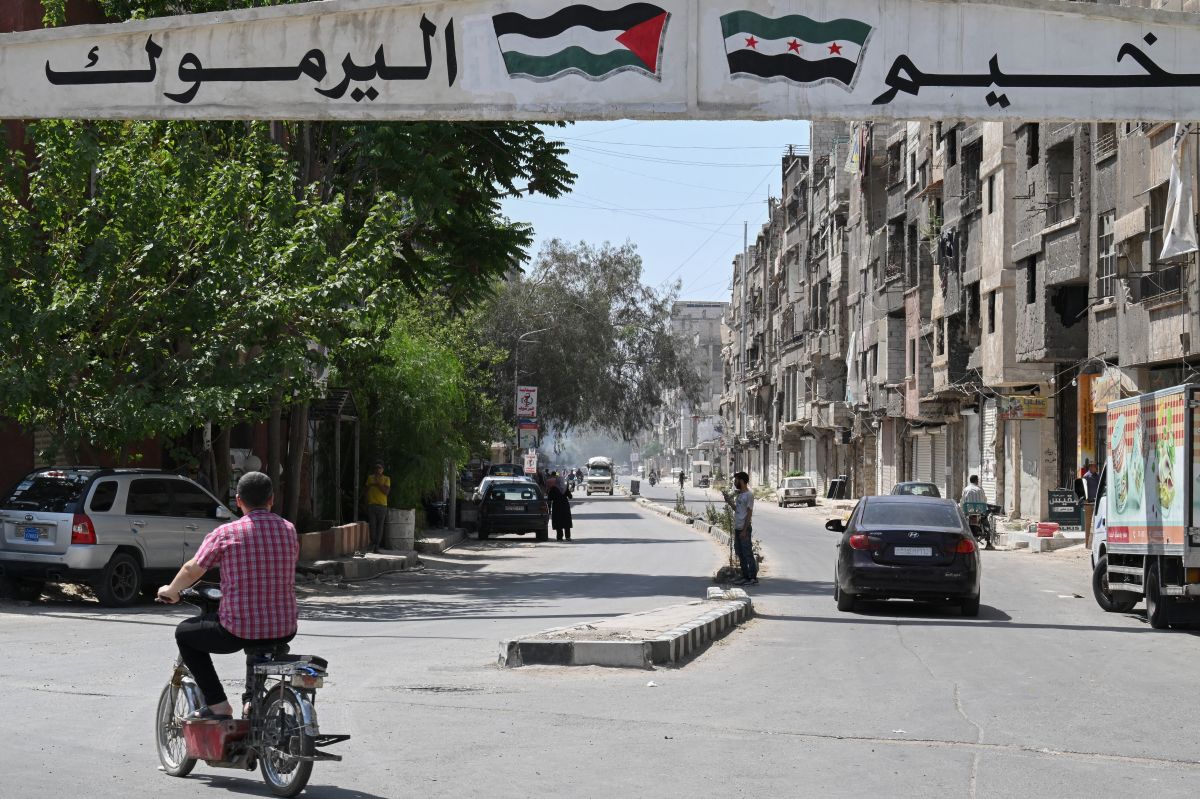
A man rides a motorbike at the entrance of the Yarmouk camp for Palestinian refugees in southern Damascus on May 22, 2025. (Credit: Louai Beshara/AFP)






Khaldoun al-Mallah is a Palestinian doctor and writer from the Yarmouk refugee camp in the suburb of Damascus, Syria. During the siege of the camp by the Assad regime and its allies (2012–2018), he was among the few doctors who remained there. Under the pen name “Abou Al-Kholoud,” he published around 70 texts on the “Sard” platform, dedicated to preserving the memory of the Syrian revolution, particularly that of the camp. After the end of the war, he helped found the cultural association “Al-Beit al-Falastini.”
When Prometheus abducted fire from the heavens and bestowed it upon humankind, Zeus, lord of all gods, was seized with fierce anger and sought vengeance upon these mortals. In the height of his wrath, he entrusted a a clay vessel to Pandora, the wife of Prometheus’s brother.
Pandora, ever curious, wondered: what might God have concealed inside the jar? Strawberry jam? A lovely kitten? An iPhone 17 Pro Max? A stash of Bitcoin? Or perhaps the remaining Epstein files that the U.S. Department of Justice has yet to release?
Pandora lifts the lid of the jar, and evils come pouring out: pain, death, disease, hunger, senescence … Terrified by what she has unleashed, she rushes to seal the jar again, leaving one last thing at its bottom: hope, Elpis, Nadezhda, Esperanza, Hope.

Then the factions diverged in their interpretations of the myth: what was hope doing in a vessel filled with evils? And what is the meaning of its remaining trapped inside?
Nietzsche wrote: “Zeus did not wish man, however much he might be tormented by the other evils, to fling away his life, but to go on letting himself be tormented again and again. Therefore, he gives man hope, in reality it is the worst of all evils, because it prolongs the torments of man.”
Plausible enough, but Nietzsche forgot that hope remained in the jar.
A shield against permanent madness
Then came those who sought to scrutinize the translation, informing us that the Greek word “elpis” does not signify “hope” in its radiant sense alone, it also denotes deceptive hopes, false expectations, “the sting of hope that is more toxic than despair,” as someone once put it.
Perhaps, but again, why has this diabolical Elpis remained trapped in the jar?
And speaking of hope and evils pulls me, almost by the nose, toward the region called the Middle East, toward its never-ending wars, the latest of which Al Jazeera calls “the Iranian-U.S.-Israeli war, the Iranian attacks on the Gulf states, and the situation in Lebanon,” a title long enough to serve as the name of a Salvador Dalí painting. In this surreal region, despair finds an abundance of conditions in which to grow; it feeds and multiplies here as bacteria do in a Petri dish. And here, this question raises its devilish head: through what paths does hope come to you?

In a tiny corner of this region, the author of these lines lived for six years (2012–2018) in a besieged, starving, sick camp called Yarmouk. On top of that, as a surgeon, he had to care for thousands of trapped, starving patients. He might have thought, at some point, that he had reached the peak — or the abyss — of despair, when he remembered the time of the Second Palestinian Intifada, the Al-Aqsa Intifada, an American friend had expressed her sorrow to him that despair was driving Palestinian youths to blow themselves up among soldiers and settlers. His objection then was simple: the despairing become depressed, emigrate, abuse drugs, or commit suicide, but he does not resist, does not kill, and is not killed out of a desire for a better life, a life worthy of its name.
And that memory eventually lost its driving force, so he armed himself with a series of shining slogans: I must live to spite those who want me dead, I must live to see the final episode of this long-running series, I can end my life at any moment… Then he invented a clumsy quote, attributing it to an unknown German poet: As long as there is death, there is hope.
But what use is the brilliance of slogans and quotations in the absence of a unifying Arab project?
But what use is the brilliance of slogans and quotations in the absence of a unifying Arab project? What economic impact can they have in societies and populations divided vertically, horizontally, and “diagonally” or across national lines? It was then that he turned to memory as an act of resistance, and to writing and reading as a safeguard against permanent, inevitable madness.
Despair as a driving force
And because our mother Nature’s cabinet is full of teachings, the most precious one came to him one Yarmouk evening from a slug crawling slowly, as if there were no tomorrow, leaving behind a silver path that shone like the Milky Way. The slug spoke to him (yes! for the sensory deprivation of those days had taught him the logic and language of animals and inanimate things): despair, too, can be a driving force; it can be the egg from which hope hatches. And to convince him, she portrayed to him Albert Camus standing and addressing the Nazis:

You have besieged us tightly, and left us with the armies with which we will defeat you: despair. The slug advised him not to surrender to despair, but to embrace it. Her final words carried a special weight: be full of despair, but do not be despairing. With despair you destroyed yourself; with it, rebuild yourself within the endless circle of eternal return that existence has cast you into. I know you as well as you know yourself, and perhaps even better. Shall I remind you of the evening when something of you flew into the future, only to return and tell you how wondrous life is there?
"Her final words carried a special weight: be full of despair, but do not be despairing."
That Yarmouk slug was neither an absurdist nor a nihilist philosopher, nor a researcher in etymology. No one had taught her that life on Earth (or in the Middle East) is a curse or a sin. Perhaps she had read the myth and drawn a simple, clear conclusion from it: hope exists, but it is imprisoned in the jar, confined at the bottom; you must search for it and extract it with your claws and fangs.
Perhaps hope lies in religious faith, in the progressive flow of time, in the cunning of history, among masses, in the human conscience, in the sprout of a plant emerging from the rubble, how would I know? And perhaps it lies in despair itself, for despair, if we understand it in the way my friend the slug does, may not be as terrible as it seems.
Translated from Arabic by Mira El-Hayek.