


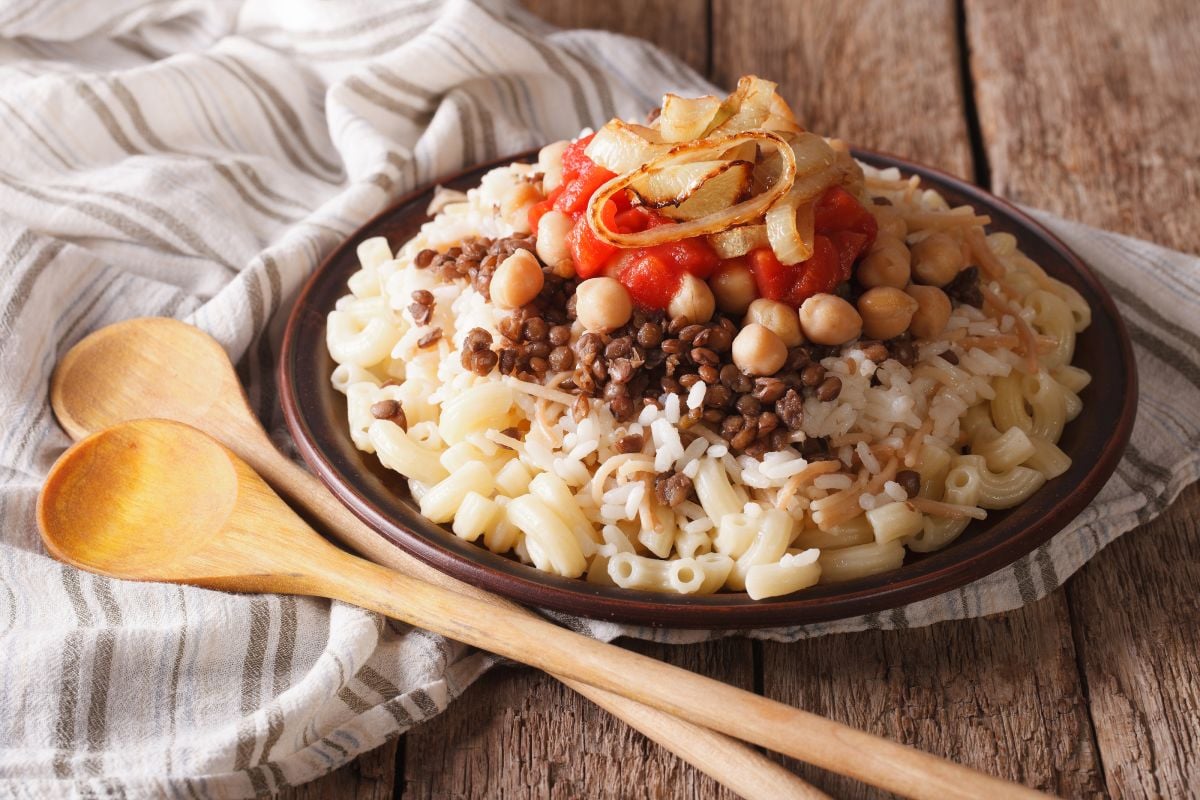
Kochari, originally a "poor man's" dish, now enjoys international fame. (Credit: Bigstock)






Long considered a staple of daily life, koshari was added to UNESCO's list of Intangible Cultural Heritage in December 2025, a month after the inauguration of the Grand Egyptian Museum in Cairo. Its recognition by the United Nations Educational, Scientific and Cultural Organization (UNESCO) is "a very important message signifying that there's a very rich Egyptian culinary culture, which should not be underestimated," historian and Egyptian food specialist Mennat-Allah al-Dorry told AFP.
This typically Egyptian mix of ingredients was born out of the need to provide the less well-off with a nutritious diet using low-cost products. This clever recipe gradually moved beyond the family setting to become a street food staple, served on every street and alley of Cairo — in modest restaurants and by street vendors.
As for the dish’s distant origins, one must look to ancient Egyptian texts of Genesis, where the term kushir or kwšr is said to have meant “food of the gods’ rituals,” before later being dubbed “food of the poor.”
More recently, reinvented and brought back into vogue, it has been enjoying an irresistible rise — now appearing on the menus of celebrities and influencers alike.

'Abou Tarek,' Cairo’s quintessential eatery
Most recently, Massad Boulos, the Lebanese adviser to Donald Trump, was seen on TikTok during a visit to Cairo at the legendary Abou Tarek, famous for its signature koshari.
Born Youssef Zaki, he started out at a young age selling the iconic national dish from a cart, tirelessly roaming the streets of Cairo with a recipe that quickly won unanimous praise. Before long, he built up a small fortune that allowed him to open, in 1963, a restaurant popular with both locals and foreigners, eventually expanding to five floors.
In 2015, Abou Tarek set a Guinness World Record by preparing the largest koshari platter, weighing eight tonnes, and was ranked among the “100 best restaurants in the world” by TasteAtlas, the online guide for travelers seeking authentic traditional cuisine.
Since 2018, the brand has expanded into major shopping malls and internationally, with a presence in London, Dubai, and Saudi Arabia.

A must for the 'Rich and Famous'
Egyptians’ reaction to their iconic dish becoming a craze among the “rich and famous” is mixed. For some, its popularity is a boost for tourism, but they worry that visitors — who sometimes put their own spin on the recipe — may alter its identity.
Meanwhile, its inclusion on UNESCO’s World Heritage list has reignited debate over its origins. For a long time, the dish was believed to come from the Indian subcontinent, where a similar preparation called khichdi combines rice and lentils. This theory stems from the period of British rule in Egypt, when Indian soldiers are thought to have introduced khichdi to the local population.
However, further research into the country’s culinary history has clarified matters: koshari is an ancient Egyptian dish, predating the British era and any foreign military presence. Historical records and Egyptian food historians attest that variations of koshari existed in the national culture long before any British or Indian influence. While its modern form has evolved over time — incorporating new ingredients and techniques — its essence remains deeply rooted in Egyptian culture.

A blessing for vegetarians
According to the website of Abou Tarek, a guru of this mouthwatering dish in all its variations, koshari in ancient Egypt was originally made with lentils, wheat, chickpeas, and onions, as rice had not yet been introduced. However, in the Middle Ages, with the arrival of rice cultivation in Egypt, rice was added to the dish.
Koshari became firmly rooted in Egyptian culture during World War I and spread across the country. It even reached a region inhabited by an Italian minority, which added pasta to the mix. Egyptians later put their own spin on it as well, introducing a vinegar and garlic sauce, transforming koshari into an emblematic national dish that would go on to spread to many other countries.
Not to mention that it is a blessing for vegetarians, thanks to its combination of protein-rich ingredients and flavorful seasoning.

 7 p.m. recap: 1 person killed near border with Lebanon; 200 kilos of explosives carried by mules; Riyadh shuts its airspace