






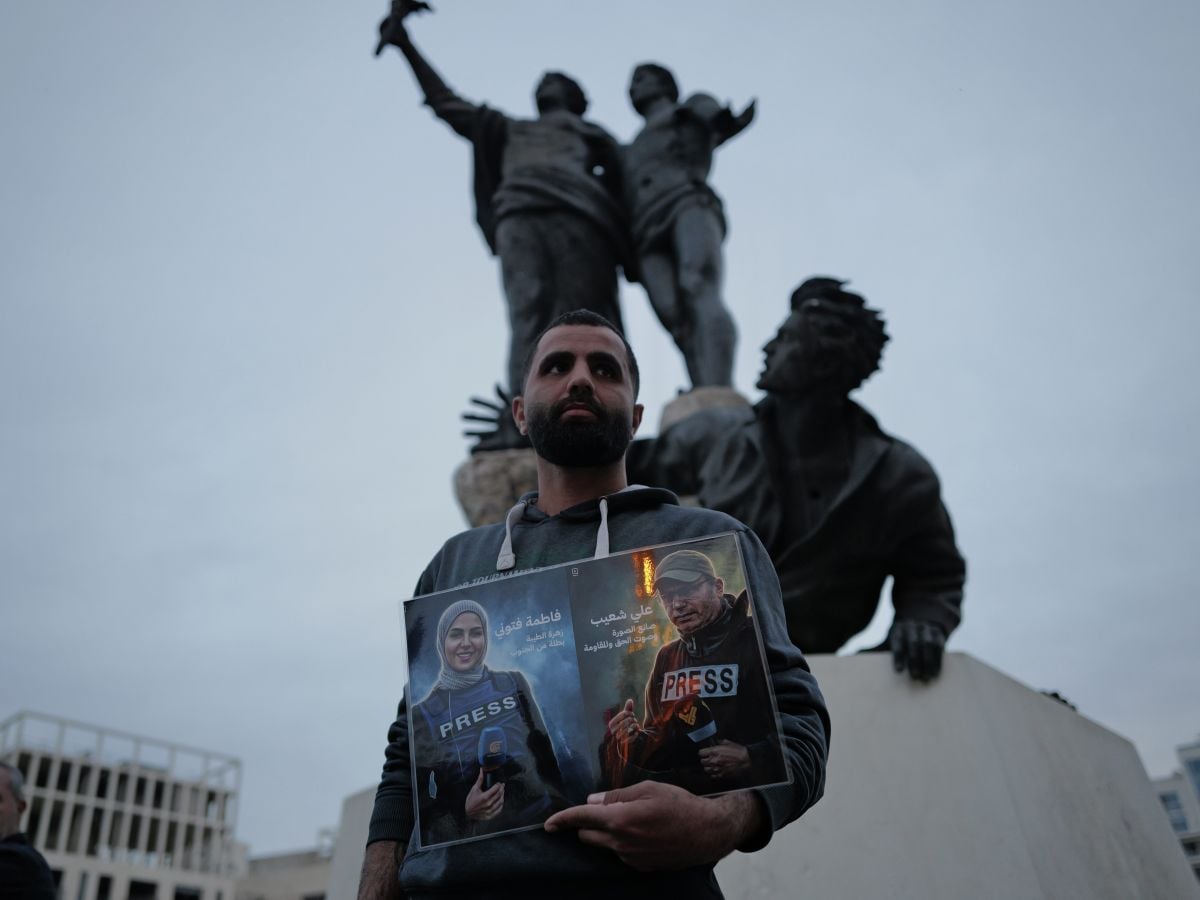
A man holds portraits of journalists Ali Choeib and Fatima Ftouni in Beirut on March 28, 2026; the two were killed that same day in Jezzine when their vehicle was struck by an Israeli airstrike. (Credit: Matthieu Karam/L'Orient-Le Jour)






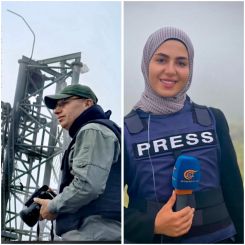
Israel killed two journalists, Ali Choeib of al-Manar and Fatima Ftouni of al-Mayadeen, on Saturday in a drone strike targeting their car on the main Jezzine road. Ftouni’s brother, a videographer, as well as a relative of Choeib, were also killed in the strike, according to our correspondent in southern Lebanon.
It was the first time Israeli forces had targeted this road since the start of the war on March 2.
The Israeli army said it had targeted Choeib, one of the longest-serving war correspondents for al-Manar, a TV channel affiliated with Hezbollah, and described him as “a member of the intelligence unit of Hezbollah’s Radwan Force.” He was also accused of using “his media platform to disseminate propaganda in favor of Hezbollah.”
‘Blatant crime’
Lebanese President Joseph Aoun condemned what he described as a “blatant crime.”
“Once again, the Israeli aggression violates the most basic rules of international law, international humanitarian law and the laws of war, by targeting journalists, who are ultimately civilians carrying out a professional duty,” Aoun said in a statement posted on X.
“This is a blatant crime that violates all norms and conventions under which journalists are afforded international protection in times of war,” he added, calling on international bodies to act to stop what is happening in Lebanon.
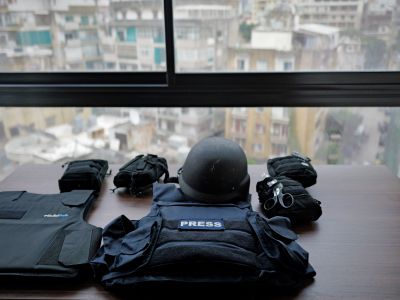
Prime Minister Nawaf Salam said targeting journalists “constitutes a blatant violation of international humanitarian law and a clear breach of the rules that guarantee the protection of journalists in times of war.” He added that Lebanon “reaffirms its commitment to protecting journalists and calls for respect for international law, the protection of civilian lives, and an end to Israeli attacks targeting them.”
Information Minister Paul Morcos described the strike as a “deliberate and clear war crime against the media,” adding that it “comes on top of a growing series of attacks targeting journalists.”
The Lebanese press editors’ syndicate also condemned what it called “a crime … revealing the hostile and destructive nature of the Israeli state toward Lebanon and the Lebanese, particularly media professionals documenting its actions.”
The target of several assassination attempts
Several demonstrations were also held in Beirut, including a sit-in organized by the press union at 5.30 pm in Martyrs’ Square, in central Beirut, followed by another later that evening.
During this second sit-in, Moustapha, a photographer at the newspaper al-Modon who had worked extensively with Ali Choeib, revealed that “Israel had already tried to assassinate him, notably in 2006 and then in 2024 in Hasbaya.” A strike had then hit a shelter housing journalists from several media outlets covering the ongoing war, several of whom were killed. “He was not a member of the al-Radwan Force; he was a seasoned war reporter with over 35 years’ experience,” the photographer told L'Orient-Today.
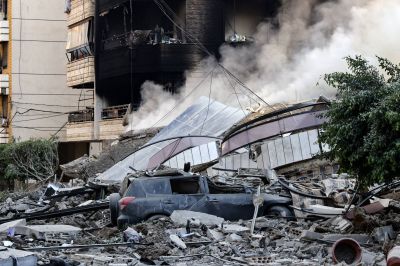
The National Human Rights Commission in Lebanon announced that it had begun forensic documentation work on this murder in preparation for the complaint to be filed by Lebanon before international bodies. “Stripping journalists of their civilian status or leveling terrorism charges against them to justify targeting them constitutes an extension of the policy of genocide pursued by the Israeli occupier in Gaza, which has killed hundreds of journalists under similar pretexts,” it wrote in a statement.
This is not the first time Israel has targeted and killed journalists. Between October 2023 and October 2025, 13 journalists or media workers were killed in Lebanon in Israeli strikes. In some cases, including the killing of Reuters video journalist Issam Abdallah in October 2023, multiple international investigations concluded the strike was deliberate.
More recently, on the night of March 17-18, 2026, Israel targeted the home of Mohammad Cherri, head of political programs at al-Manar, killing him and his wife, and wounding their children and grandchildren. On March 19, two Russia Today journalists were wounded in an Israeli attack while reporting on the Qannayat bridge.

 7 p.m. recap: Iran warns Egypt, Israeli soldiers vote in south Lebanon, Haret Hreik responds to Kataeb