


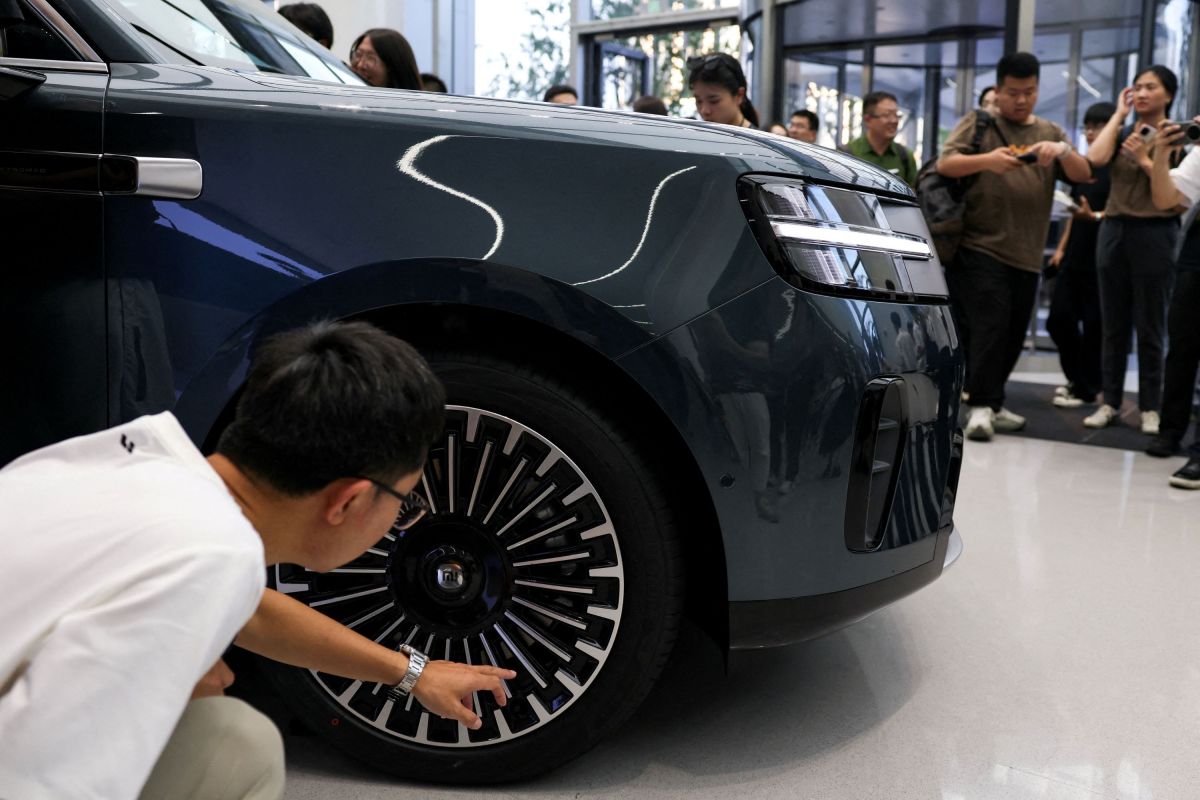
A person inspects a tire of a Xiaomi range-extended electric vehicle on display before the vehicle's launch event, in Beijing, July 30, 2026. (Credit: Tingshu Wang/Reuters)






U.S. company Tesla, its Chinese competitor Xiaomi, and nine other Chinese automakers on Friday launched software updates and vehicle recalls as part of the largest automotive recall campaign ever carried out in China, as authorities tighten their monitoring of emergency door unlocking systems in electric vehicles, several media outlets report, citing a series of announcements made Friday by the Chinese regulator and the concerned brands.
The Chinese specialized media outlet CnEVPost references a total of more than 7 million vehicles affected and specifies that the recalls are not related to mechanical problems, but mainly to safety issues concerning the door unlocking systems and software fixes. A significant portion of the recalls involve remote software updates that do not require the vehicle to be taken to a mechanic, dealership or manufacturer. Besides Tesla and Xiaomi, the wave also involves Geely, Chery, Leapmotor, Xpeng, Dongfeng, Arcfox (BAIC Group), FAW, Zeekr (Geely Group), and Lynk & Co (Geely Group). The vast majority of the recalled vehicles are electric or hybrid models.
Although the recalls affect only vehicles intended for the Chinese market, it is not impossible that some of these vehicles have been exported, particularly via the so-called "zero kilometer cars" market: new vehicles are first registered in China, allowing manufacturers or dealerships to count them as sold on the domestic market, before being exported abroad as used vehicles, even though they have barely been driven.
Almost 6 million for Tesla
The largest wave of recalls concerns Tesla, the brand owned by billionaire Elon Musk, which will have to deploy software fixes on 2.98 million Model 3, Model Y, Model S and Model X vehicles made in China or imported, due to emergency door release handles that may be difficult to identify, which could complicate occupant evacuation or rescue operations following a serious accident accompanied by electrical system failure. Specifically, a label will be placed near the mechanical emergency door release devices to make them easier to identify. Nine out of the 11 affected brands will make the same type of modification.
Tesla is immediately recalling 2.74 million Model 3 and Model Y vehicles manufactured in China to deploy an update meant to improve the system that monitors driver attention when power steering and other driver assistance functions are activated. The goal is to reduce the risk of collision when the driver does not react quickly enough. The recalls concerning the other 2.98 million vehicles will begin on Sept. 25, for a combined total exceeding 5.7 million vehicles.
In addition to Tesla, at least five brands — including Xiaomi, Leapmotor, Xpeng, Zeekr, and Lynk & Co — have announced the largest recalls in their respective histories, according to statements filed with the SAMR. However, the number of affected vehicles for each of them is far smaller than Tesla’s.
Xiaomi, for instance, must recall 339,069 SU7 vehicles produced between Aug. 8, 2024, and March 4, 2026, according to the Chinese market regulator. Besides adding labels, the manufacturer will deploy a remote software update to optimize the unlock logic from the central console and the window lowering mechanism. Leapmotor, for its part, must recall around 371,000 of its cars and Xpeng about 264,000. Other brands that have filed plans with the regulator are conducting recalls on a much smaller scale.
Tesla and Xpeng did not immediately respond to a request for comment from Reuters, whereas Geely declined to comment. Xiaomi said it had no further information beyond the regulator’s notice. Leapmotor stated it is committed to safety. The manufacturer clarified that the intervention involves only adding a warning label and updating the power window control software but decided to “handle and declare this operation according to the recall procedure, out of responsibility towards our users.”
Systems allowing doors to be opened using an electronic key, a smartphone or a pressure-activated mechanism are drawing increased attention from regulators in China and the United States, due to concerns that unlocking devices may be difficult to access in emergency situations.

 7 p.m. recap: Netanyahu seeks mastermind behind Flydubai incident; Washington sanctions 2 French nationals; Ben Gvir's 'I want to kill you' threat