


Aoun discusses future of UNIFIL with Meloni
President Joseph Aoun met with Italian Prime Minister Giorgia Meloni. They discussed Lebanese-Italian relations and ways to develop them in all fields. Read more on the meeting here.
Iran and Oman discuss the resumption of negotiations and navigation in the Strait of Hormuz
The Omani and Iranian foreign ministers discussed, during a telephone call, ways of creating the right conditions for the resumption of dialogue and negotiations, as well as developments affecting shipping in the Strait of Hormuz, the official Omani news agency reported on Friday, as quoted by Reuters.
Israel has killed 4,348 people and injured a further 12,703 in Lebanon since March 2
Israel has killed 4,348 people and injured a further 12,703 in Lebanon since it re-escalated its onslaught on March 2, according to the Health Ministry's latest casualty figures updated two days ago.
Israeli bombing in Markaba; Artillery shells Braasheet
An explosion caused by an Israeli bombing was heard in the village of Markaba, in the Marjayoun district. Meanwhile, Israeli artillery shelled the outskirts of Braasheet (Bint Jbeil) with three shells.
Several countries are prepared to assist the army in the pilot zones, but Israel is opposed to this, says Mitri
Deputy Prime Minister Tarek Mitri stated that “a group of countries has declared its readiness to assist the Lebanese Army when it enters the pilot zones in the south, but Israel is opposed to this move,” in an interview with Sky News Arabia.
He was referring to the plan set out in the framework agreement concluded last June between Beirut and Tel Aviv, which provides for the deployment of the army to positions where Lebanese soldiers have been deployed to disarm Hezbollah and where the Israeli army has undertaken not to intervene.
Mitri also expressed the hope that prospects for international support for the Lebanese Army would improve in the coming period, adding that the army was ready to take control of the Ali Taher hills in southern Lebanon, a strategic position that Israel has been attempting to seize for several weeks. He added that there had been a “clear hardening of Israel’s stance” towards the United Nations Interim Force in Lebanon (UNIFIL), emphasizing that Beirut did not want southern Lebanon to remain without an international presence tasked with monitoring developments there. “Israel is not prepared to show goodwill regarding the negotiations and the framework agreement” with Lebanon, he asserted.
Israel carries out two air strikes on Bouyout al-Sayyad
Two Israeli air strikes targeted Bouyout al-Sayyad, in the district of Sour, according to our correspondent in southern Lebanon. Meanwhile, artillery fire targeted Mansouri, in the same region.
Twelve Arab and Muslim countries condemn Israeli airstrikes in Syria
In a joint statement carried by the Pakistani news agency APP, the foreign ministers of Turkey, Algeria, Indonesia, Jordan, Lebanon, Malaysia, Mauritania, Pakistan, Palestine, Qatar, Saudi Arabia, and Somalia strongly condemned on Friday the Israeli air strikes targeting the Abu al-Duhur military airbase in north-western Syria. These attacks constitute “an extreme escalation and a flagrant violation of the sovereignty, territorial integrity and political unity of the Syrian Arab Republic,” the signatories of the statement emphasized.
They argued that the repeated attacks on Syria’s territory and infrastructure risked undermining the country’s efforts to restore security, rebuild its institutions and address the humanitarian consequences of the conflict.
The ministers also warned that Israel’s ongoing violations of Syrian sovereignty risked exacerbating tensions, undermining regional peace and stability, and eroding respect for international law.
Finally, they called on the international community to take concrete measures to put an end to these violations, ensure compliance with the 1974 disengagement agreement and secure the withdrawal of Israeli forces from the areas they occupy.
Southern Lebanon: Israel injures shepherd and carries out demolition on outskirts of Braasheet
An Israeli army drone fired a stun grenade at a shepherd in the border village of Shebaa (Hasbaya), injuring him, according to reports from our correspondent in southern Lebanon. Furthermore, Israel carried out a demolition on the outskirts of the village of Braasheet (Bint Jbeil), near Aitaroun.
Israeli airstrike on Braasheet: Israeli army says it targeted ‘suspicious individuals’
The Israeli army said it had carried out a strike on a “building” in Braasheet, a village in the Bint Jbeil district bordering the “buffer zone” established by Israel in southern Lebanon, after spotting “several suspicious individuals who had crossed” the line demarcating that zone. The army cited “a threat to its forces” as the justification for the strike.
Earlier that morning, the Israeli air force had bombed a house in the village.
Another demolition in Kfar Tibnit; Israel sets fire to houses in Beit Yahoun
At around 3 p.m., Israel carried out a further demolition in Kfar Tibnit, in the Nabatieh district, the second in less than two hours. In the Bint Jbeil district, Israeli forces also set fire to houses in Beit Yahoun and fired towards the village of Haddatha.
Pezeshkian says it is time to end war while Iran is 'in a position of strength'
Iranian President Masoud Pezeshkian said it was time to end the war with the United States, claiming that Tehran was in a “position of strength” vis-à-vis Washington. “It is better to end the war now, while we are in a position of strength and with dignity, with the whole world recognizing our victory and emphasizing that the United States attacked our schools, hospitals and infrastructure in violation of all rules, and that it is hated around the world,” he said during a meeting with doctors.
His remarks came after Iran’s Foreign Ministry accused the United States of “economic terrorism” and “crimes against humanity” following Washington’s announcement of tighter economic sanctions aimed at increasing pressure on Tehran. “Those responsible for and instigators of these sanctions deserve to be tried and punished for committing such heinous crimes,” the ministry said in a statement.
U.S. Treasury Secretary Scott Bessent vowed Thursday that Washington would make the Iranian regime “collapse” through the announced sanctions campaign, nearly six months after the war began.
Israeli army blows up buildings in Kfar Tibnit and Arnoun, Nabatieh district
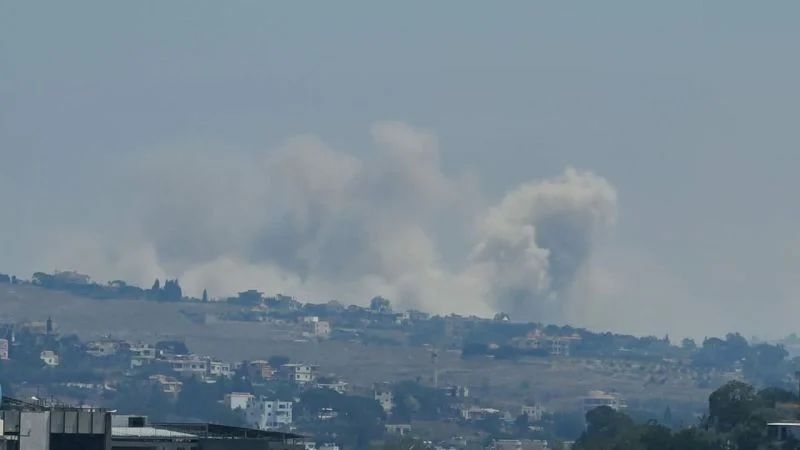
Smoke rises after Israeli blows buildings up between Arnoun and Kfar Tibnit in southern Lebanon. (Credit: Photo shared by our correspondent)
The Israeli army set off two powerful explosions, one between Arnoun and Kfar Tibnit and the other in the village of Kfar Tibnit, in the Nabatieh district, according to our south Lebanon correspondent Mountasser Abdallah. The blasts were heard for several kilometers around.
Meanwhile, machine-gun fire targeted Haddatha (Bint Jbeil), while artillery shells have been intermittently targeting Mansouri (Sour).
South Lebanon: Airstrike hits Braasheet in Bint Jbeil district; demolition carried out in Majdal Zoun
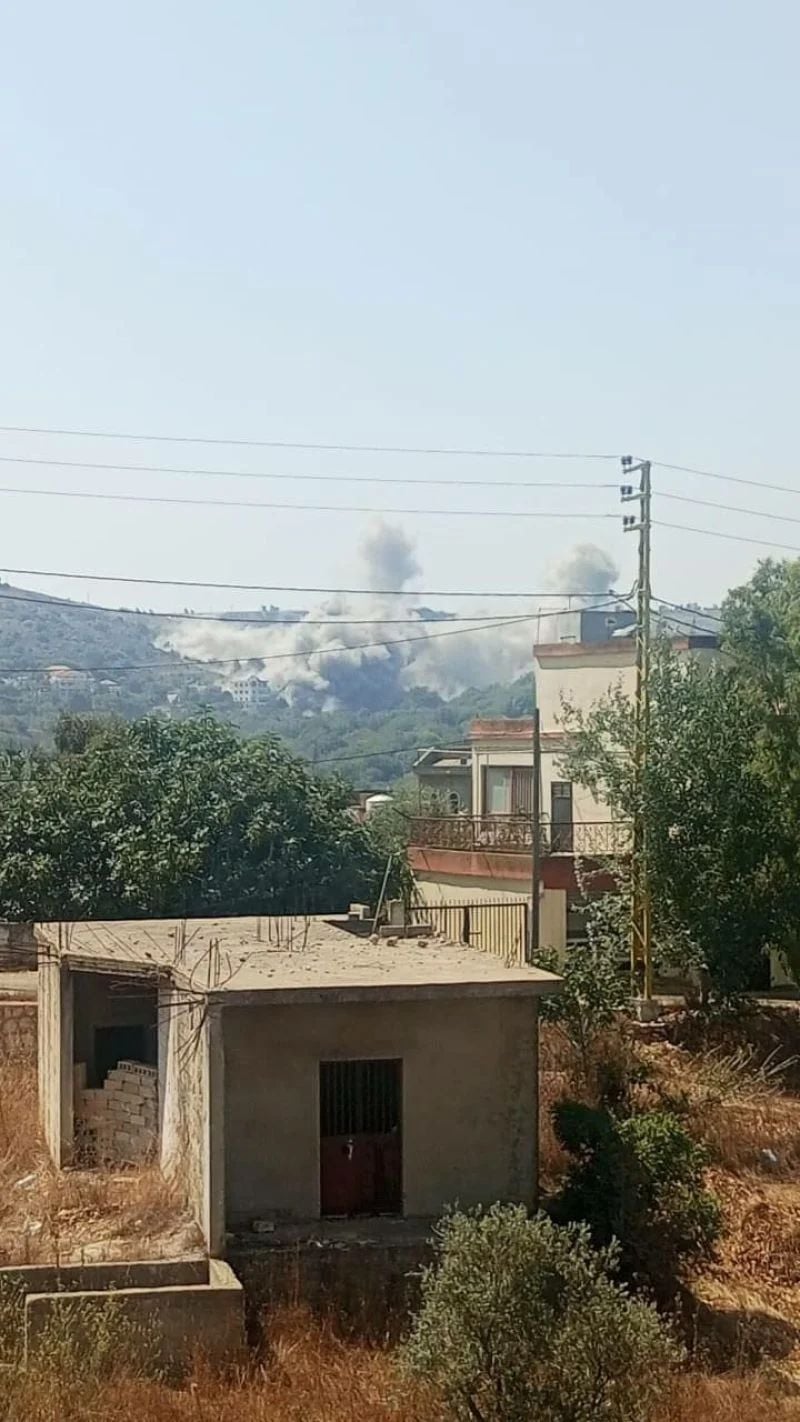
Israeli bombardment in Brasheet (Bint Jbeil). (Credit: Photo shared by our correspondent Mountasser Abdallah)
The Israeli air force struck Braasheet this morning, a village in the Bint Jbeil district bordering the “buffer zone” established by Israel in southern Lebanon, according to our correspondent Mountasser Abdallah. A house was targeted in the village, which is near Haddatha, where Israeli forces have carried out numerous operations in recent weeks.
Meanwhile, artillery fire targeted, in turn from 8:30 a.m., the Wadi Slouqi and Wadi al-Jamal valleys between Mais al-Jabal and Houla in the Marjayoun district, the outskirts of Mayfadoun in Nabatieh, Wadi al-Jamal, and Shebaa in the Hasbaya district.
Another demolition was carried out in Majdel Zoun, in the Tyre district. The explosion shook homes in neighboring areas, according to residents.
Ghalibaf: Iran must prepare to overcome 'unjust US sanctions'
Iranian Parliament Speaker Mohammad Bagher Ghalibaf said, according to remarks reported by Reuters, that Iran must prepare to overcome the “unjust sanctions” imposed by the United States.
U.S. Treasury Secretary Scott Bessent had announced that Washington would impose what he described as the toughest sanctions ever imposed on Iran.
Aoun continues his visit to Rome
Currently visiting Rome, Lebanese President Joseph Aoun is due to meet with Italian Prime Minister Giorgia Meloni to discuss the future of the United Nations Interim Force in Lebanon (UNIFIL), whose mandate expires at the end of 2026, as well as Italy’s already expressed commitment to maintaining an international force in southern Lebanon after the peacekeepers’ mandate ends.
During his visit to the Italian capital, Aoun met Pope Leo XIV on Thursday, while the Vatican expressed “serious concerns” over the difficulties in implementing the framework agreement between Lebanon and Israel. The agreement, signed in Washington on June 26, is intended to establish “pilot zones” in which the Lebanese Army would disarm Hezbollah. The continuation of the “pilot zones” project has, however, been suspended due to a lack of progress during the latest round of direct talks between the two countries in Rome in early August.
Washington threatens countries that refuse to join its economic war against Iran
The United States on Thursday evening urged its allies and China to join a sweeping economic pressure campaign against Iran, intended to “bring down the regime” in Tehran without resuming military operations. Iran’s Foreign Ministry responded by accusing Washington of “economic terrorism,” according to the Iranian news agency IRNA.
“Any country that maintains a connection with Tehran will send its own economy into oblivion, whether that connection is maintained willingly or deliberately ignored,” U.S. Treasury Secretary Scott Bessent warned on X. Without providing any details about the measures under consideration, he had already warned shortly beforehand that countries that do not support the campaign would be considered “against us,” in an interview with CNBC. He is due to hold a press conference Monday on how the United States plans to further increase pressure.
“We are sort of in a new phase where the most effective tool we have is the economic pressure we can impose on them,” Vice President JD Vance said in a conservative podcast. “It will be a delicate dance” because Iran “will try to put economic pressure on us,” he warned.
Massaad Boulos: We are determined to dismantle Hezbollah’s financing networks
Iran “uses Hezbollah to sow chaos in the Middle East, undermine Lebanon’s sovereignty and threaten our regional allies,” Massaad Boulos, adviser to U.S. President Donald Trump, said on his X account.
Boulos, who is of Lebanese origin, added: “The measures currently being taken by the U.S. Treasury, which include redesignating Hezbollah as a sanctioned entity and imposing sanctions on 10 individuals who transferred funds between the Islamic Revolutionary Guard Corps and Hezbollah, confirm our determination to dismantle these terrorist financing networks.”
The U.S. Treasury announced Thursday evening that it was redesignating Hezbollah under its sanctions regime over its activities in support of the Revolutionary Guards.
Ali Taher hill bombarded for more than 5 hours straight overnight
The night was particularly tense in southern Lebanon, notably in the Nabatieh area around the strategic Ali Taher hill and in Mansouri, Sour, according to our correspondent Mountasser Abdallah.
Israeli artillery fire began after 11 p.m. on the Ali Taher hill and continued until dawn, around 5 a.m. Israeli drones flew over the area throughout the night. The attacks on the site, where Israel alleges Hezbollah has strategic military installations, were particularly intense, according to witnesses.
Other localities in the Nabatieh area were targeted by Israeli strikes overnight, including Dohat Kfar Roummane at around 11 p.m. and again around 3 a.m. The village, on the outskirts of Ali Taher, has been repeatedly targeted in recent days.
Mansouri, Sour, was targeted several times overnight, as it has been for several days. The Israeli army caused powerful explosions there shortly after 10 p.m. A drone dropped a sound bomb shortly after 11 p.m., alongside artillery fire. Airstrikes were also carried out around 3 a.m. At 8 a.m., Wadi Slouqi in Marjayoun was targeted by Israeli artillery.
Haddatha, in the Bint Jbeil district, was targeted by artillery fire shortly after 11 p.m. In the Marjayoun district, Kantara was also hit around 3 a.m.
Read Mounir Rabih’s latest analysis here.
Already have an account? Login here
You have reached your article limit
Add L'Orient Today to your syllabus.
Subscribe for $0.5/month for 3 months.
This article is only available to L’Orient Today subscribers.
Already have an account? Login here
