


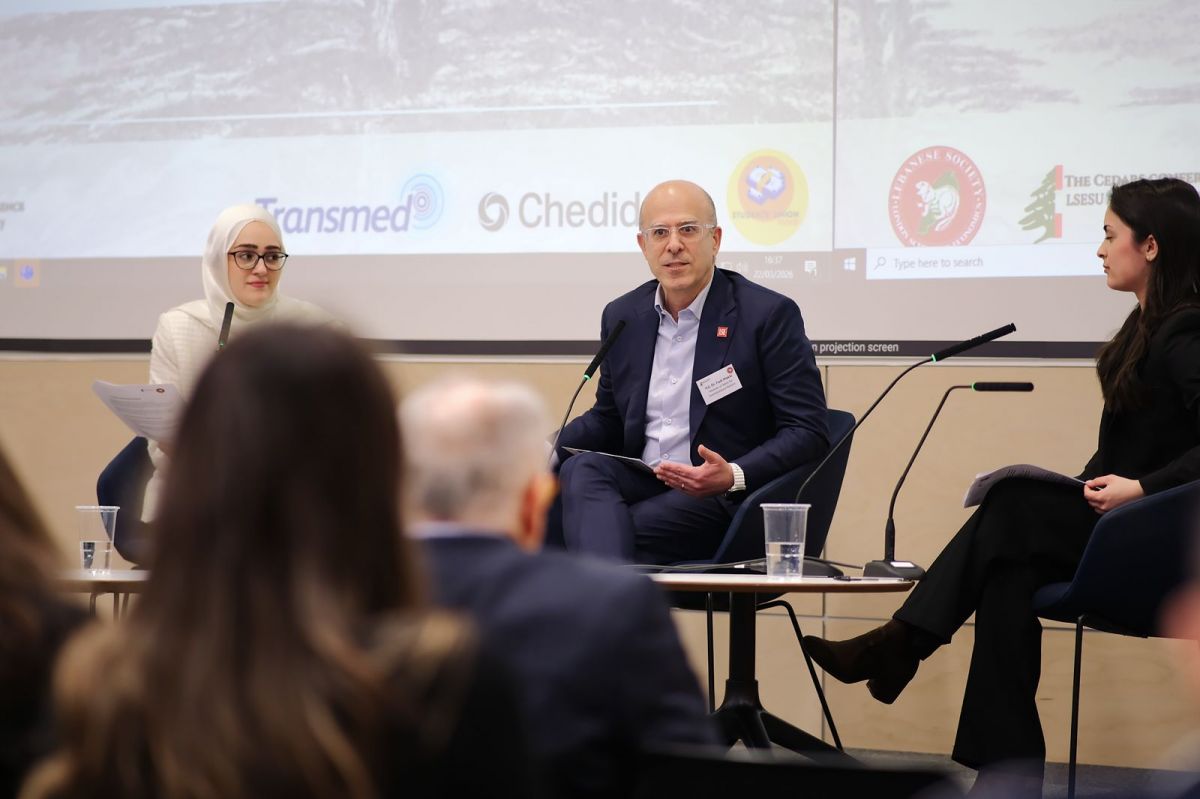
Minister of State for Administrative Reform Fadi Makki speaking at the Cedars' Conference, on March 21, 2026. (Credit: Anya Wickremasinghe/L'Orient Today)






The first edition of the Cedars Conference was designed to inspire hope and uplift Lebanese students in the UK as they look towards their future careers and the country's future. But after the war escalated back home, members of the Lebanese diaspora and industry experts gathered at the London School of Economics (LSE) in central London with more pressing concerns.
Ten months ago, a small team of students from Lebanese societies across London universities, with support from the Lebanese embassy in the UK, came together to organize a pilot project aimed at uniting their compatriots and activating the diaspora network. LSE’s Lebanon Society President Zoe Baroud, who led the planning of the event with Nour Samman, explained that the initiative grew out of “a desire within the Lebanese student community to come together,” adding that “it felt important to create something for the Lebanese community that could stand alongside” the university’s strong tradition of student-led national conferences.
“We are all far from home,” Baroud added, “and having a space that combines community with professional development provides both a sense of belonging and opportunities for growth. The timing inevitably made the organization more complex and we gave serious consideration to postponing the event due to the war. However, we ultimately felt that this was precisely the moment when creating a space for connection mattered most.”
Over the weekend of March 21-22, the conference opened the floor to a broad range of Lebanese speakers across various sectors. While Saturday’s programming focused on careers in business, finance, and commercial law, Sunday’s sessions turned to discussion of Lebanon’s economic collapse, its geopolitical positioning, and the challenges of reform.
The sold-out event drew in rows of suited and polished attendees, giving it the air of a business conference rather than a student society gathering. They listened attentively to speakers including Alain Bifani, Karim Bitar, and Minister of State for Administrative Reform Fadi Makki, as they set out their diagnoses of Lebanon’s crises. Yet questions from the audience revealed their underlying desire to glean practical ways of engaging in solutions from abroad. “We don’t want to hear about the problems of the past or the current reality; we want to know what we can do,” Stephanie, a member of the audience, told L’Orient-Le Jour.
Day two’s talks began with Alain Bifani, former director general of the Finance Ministry and current chairman of the Citizen Foundation, who reflected on his time in government, the economic collapse, and his vision for economic renewal. Citing what he called the “enemy within,” Bifani argued that meaningful reform would require confronting entrenched political interests, the lack of accountability and rampant sectarianism. He also placed particular emphasis on rejecting misinformation and false narratives surrounding government failure, such as those attributing the economic crisis to the government’s default in 2020.
His remarks on the need for state-level solutions to tackle the problem of brain drain were particularly resonant among the diaspora members of the room. “I would be ashamed to tell a young person in Lebanon to stay, but I wouldn’t like to tell them to leave,” he commented, raising a dilemma that came up throughout the event.
Following Bifani’s assessment of the country’s internal dysfunction, the discussion shifted to the geopolitical during a panel comprising International Relations Professor Karim Emile Bitar (USJ and Sciences Po), Associate Fellow at Chatham House’s MENA Program Professor Lina Khatib, and Assistant Professor at Aarhus University, Anne Kirstine Rønn.
Professor Bitar opened with a discussion of Lebanon’s external problems while cautioning against overlooking its domestic responsibility. He drew parallels between the current situation and 1982 when, he said, leaders sought to “fragment the entire region into ethnic states.” Though he credited the government for taking what he described as “historic decisions,” he also argued that current attitudes towards Hezbollah risked mirroring the "Machiavellian naivete" of past leaders who believed they were exploiting foreign powers to remove the Palestine Liberation Organization (PLO) when in reality they were the ones being manipulated.
A notable disagreement emerged between Bitar and Khatib when the latter rejected the former’s suggestion that Israel’s attacks were motivated by the pursuit of “Greater Israel.” Her calls for negotiations between Lebanon and Israel and for Lebanon to recognize Israel to undermine Hezbollah’s resistance narrative prompted discussion among panellists and attendees alike. However, audience members noted the value of debate and the speakers’ “candour.” Kinan, a student on an exchange program at the LSE, told L’Orient-Le Jour that the debate reflected how “even in our disagreement, we are united in our dedication to the country.”
A more technical policy discussion came from Makki, who focused on his unique approach to policy making, which draws on his background in behavioral economics and places people at the center of policy design. Speaking in his capacity as a minister and as founder of the NGO Nudge Lebanon, he advocated for more experimentation, testing, and evidence-based processes in public policy, as opposed to the conventional systems that often rely on intuition.
Yet even these ideas appeared constrained by present realities. “All of this is on the back burner,” he acknowledged when probed by an audience member who queried the prioritization of such efforts amid the ongoing humanitarian crisis.
Among attendees, the overall atmosphere was one of enthusiastic engagement, with participants valuing both the diversity of perspectives and the opportunity to connect as a diaspora at such a critical moment. Yet the inherent “contradiction,” as one audience member described it, of discussing Lebanon’s future while grappling with the present crisis, remained palpable.
 2 Israeli soldiers injured in 'operational accident,' as army continues attacks in the South