



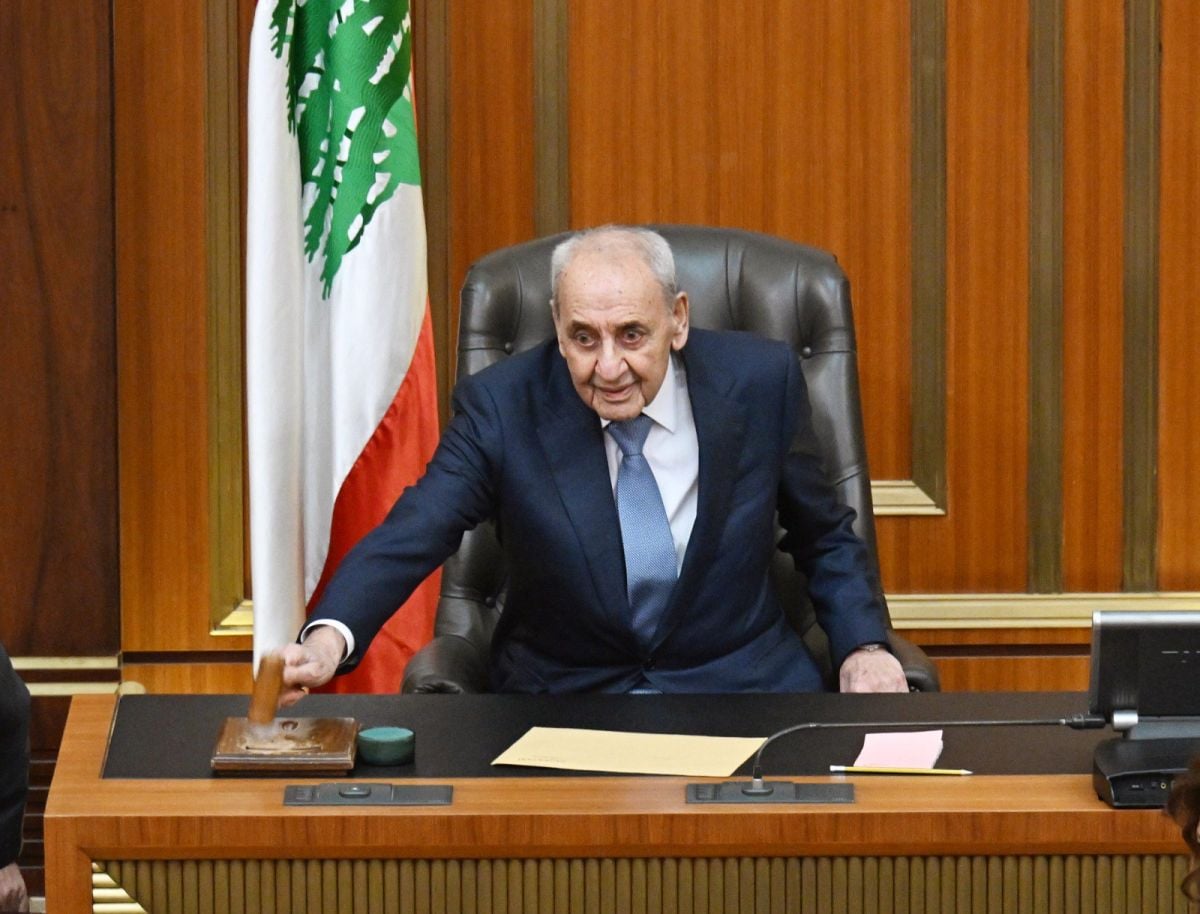
Parliament Speaker, Nabih Berri, during a legislative session, on March 9, 2026. (Credit: Lebanese Parliament)






BEIRUT — Speaker Nabih Berri said Monday that the November 2024 cease-fire terms should remain the basis for restoring calm between Hezbollah and the Israeli army, insisting negotiations rely on the cease-fire monitoring committee known as the “Mechanism.”
Berri, a Hezbollah ally who was reportedly surprised by the militia’s entry into the regional conflict, made the remarks after meeting French Ambassador to Lebanon Herve Magro. He also met Washington’s representative Michel Issa as part of a series of diplomatic talks at Ain al-Tineh.
After his meeting with Magro, Berri praised “the efforts and initiatives undertaken by France and its president Emmanuel Macron to end the Israeli war against Lebanon and enable the return of displaced people to their villages.”
Some media had reported a French initiative that might include normalizing Lebanon-Israel relations to pave the way for a cease-fire, but Paris denied leading any formal initiative. The French ambassador said France had “ideas” rather than an official plan and stressed that it “continues [its] efforts and [its] work to resolve the issue” of the war.
Berri also emphasized the importance of abiding by the November 2024 cease-fire, which ended 13 months of war between Hezbollah and Israel, including a two-month expanded offensive. Despite the truce, Israel continued strikes in South Lebanon for 15 months, causing more than 400 deaths and maintaining at least five positions in the south. Israel, in turn, accused Hezbollah of violating the agreement by keeping armed forces south of the Litani.
The speaker stressed that the “Mechanism,” the cease-fire monitoring committee including Lebanese and Israeli army representatives, U.N., and U.S. and French military personnel, must remain the “practical and negotiation framework” for implementing the truce. The committee’s scope was expanded in November 2025 to include civilian representatives.
Berri had led Hezbollah’s negotiations with Washington in 2024 to reach the truce that took effect on Nov. 27. However, his position as the primary interlocutor appears weakened now, as Lebanon no longer faces an executive vacuum.
President Joseph Aoun and Prime Minister Nawaf Salam are seen as more reliable partners for the international community. Facing these shifts, Berri has been actively engaging on multiple fronts in recent days and appears more flexible regarding proposals to end the war, including potential deployment of the Lebanese army in southern Beirut.

 7 p.m. recap: Netanyahu seeks mastermind behind Flydubai incident; Washington sanctions 2 French nationals; Ben Gvir's 'I want to kill you' threat