






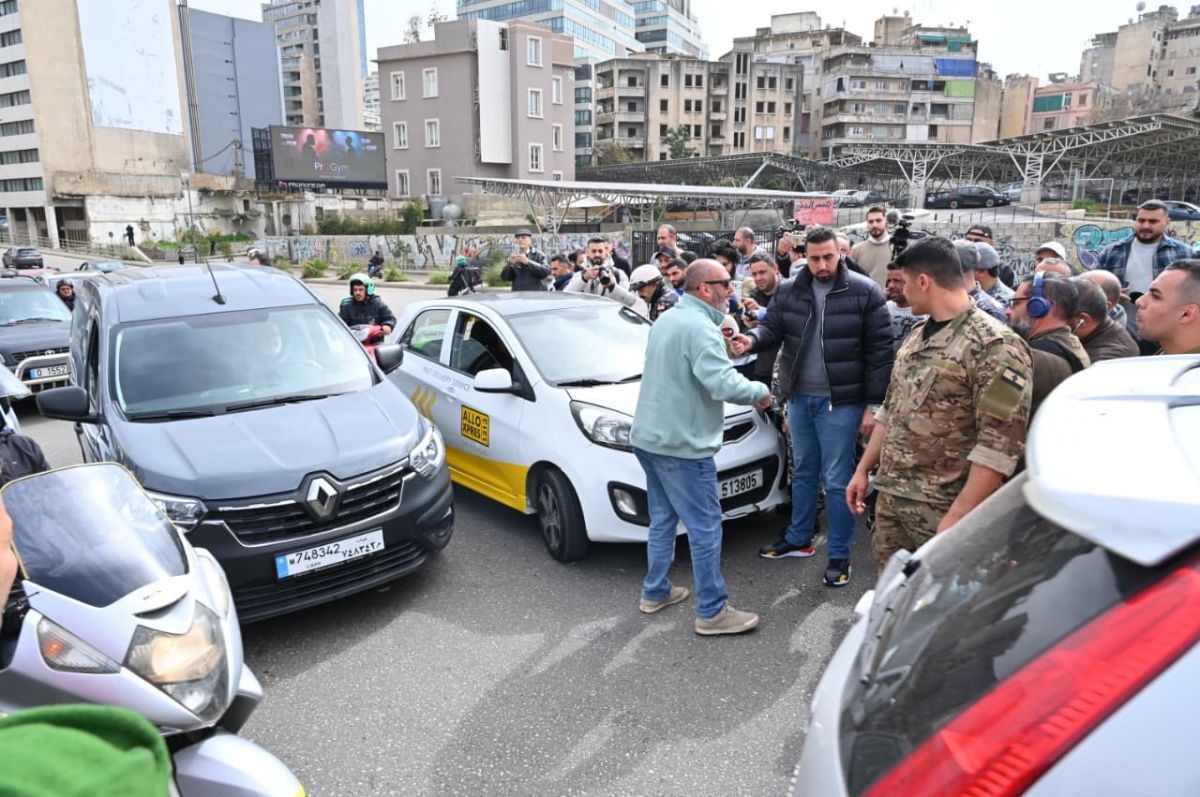
Demonstration on the Ring expressway in downtown Beirut against the increases voted by the government, on Feb. 17, 2026. (Credit: Mohammad Yassin/L'Orient-Le Jour)






"Dangerous policy of impoverishment"; "broken promises"; "increases funded from citizens’ pockets": The day after the Cabinet meeting, anger was already brewing on Tuesday in Lebanon, both among political and labor union circles and on the streets.
The reason is a 1 percentage-point increase in VAT and a 300,000 LL (about $4) increase in gasoline prices to finance an additional increase equivalent to six times the base salary for all public employees, whose pensions and wages have collapsed in the wake of the 2019 economic crisis.
The first concrete repercussion of this decision: On Tuesday morning, the price of a can of gasoline rose by 361,000 LL (about $4), reaching 1,785,000 LL for a 95-octane can and 1,828,000 LL for 20 liters of 98 octane.
Numerous roads were blocked this morning in Beirut by protesters angry about these decisions, notably in Khaldeh, on the Ring expressway, downtown Beirut, near the Cola roundabout, and the Salim Salam highway, paralyzing traffic.
A widespread call to demonstrate at Riad al-Solh Square at 6 p.m. in downtown Beirut, launched by the Tol'it Rihetkon movement, is circulating on social media. These episodes are reminiscent of the 2019 social unrest, when a popular uprising broke out against the ruling class.
Salam, Jaber justify government decisions
During a visit to Tripoli on Tuesday morning, Prime Minister Nawaf Salam defended the Cabinet's decisions as unionists demonstrated on-site against his government’s actions.
"We were forced to raise the price of gasoline, but we canceled the diesel price hike, which affects poor groups," he said.
He added: "We want public servants to get their rights and are working to improve tax and customs collections, to issue tax orders for quarries and to review maritime properties, as well as to adopt a VAT that targets the wealthy."
Several politicians slammed the government. Industry Minister Joe Issa al-Khoury said on X that ministers from the Lebanese Forces (LF) "opposed the fact that no detailed study was distributed to ministers before the session, the increase of taxes and levies on citizens and the private sector, such as gasoline and VAT, instead of working to end customs evasion and improve tax collection, and the lack of a study on the repercussions of tax and levy increases on inflation and private sector productivity."
"This is a reneging of promises and a total disregard by the government and the Energy Ministry for citizens’ rights and high living costs," said Gebran Bassil, head of the Free Patriotic Movement (FPM).
In a statement, the FPM denounced the government’s "resort to an illegal measure that we had already challenged before the State Council and managed to have revoked, by adding an exorbitant increase on fuel [in addition to VAT]."
‘The government’s decision will not pass’
A similar message from the Kataeb party, whose MP Elias Hankash said on X that "the government’s decision to fund the public sector from the Lebanese people’s pockets will not pass."
Progressive Socialist Party (PSP) MP Bilal Abdallah called for "a radical review of the fiscal policy based on indirect taxation, namely taxes imposed on the consumer citizen."
The parliamentary bloc of the Amal movement also announced its opposition to the government's decision to adopt the tax hike.
Anger is also mounting among unionists. Bechara al-Asmar, president of the General Confederation of Lebanese Workers (CGTL), said, "It would have been preferable for the government to seek other sources of funding, instead of granting an increase that does not meet requirements and that is not included in the base salary."
He called for "an emergency meeting to examine measures to stop the systematic destruction of the working classes."
‘Dangerous policy of impoverishment’
The National Federation of Trade Unions and Employees in Lebanon (Fenasol), led by Castro Abdallah, deplored the fact that the government "has once again chosen to make workers, employees and retirees bear the cost of the crisis, instead of moving toward imposing progressive taxes on windfall profits, banks and large monopolies."
"We hold the government fully responsible for this dangerous policy of impoverishment," added Fenasol, saying it was preparing a broad meeting of union forces, labor unions and social organizations to draw up a plan of action in response to these decisions.
"We refuse to make citizens and the transportation sector bear this additional burden," said Bassam Tleiss, president of the Road Transport Federation.
"Any increase in gasoline prices or VAT will immediately impact transportation costs and the price of goods. It is necessary to find fair alternatives, away from citizens' pockets," he argued.
‘Finding fair funding sources’
The public education leagues said that the government's decision "does not live up to their aspirations and does not satisfy their demands. We also refuse to make the Lebanese people bear the cost of this increase, whether it be raising gasoline prices or increasing VAT."
For the union of employees of public hospitals in Lebanon, the increases approved by the government "do not reflect the extent of the economic and social collapse that has hit the country and its employees."
"We were surprised to learn that these so-called increases would be funded from the pockets of citizens and employees themselves, by imposing additional burdens," it added, calling on the Salam Cabinet to "find fair sources of funding, instead of easily reaching into people’s pockets."
The president of the Lebanese Press Editors’ Association said, "What the government undertook yesterday was a misguided measure, which won’t solve the problem but will generate major social crises."

 8 p.m. recap: Israel again threatens Beirut’s south suburbs; 2 ships hit near Hormuz; Riyadh football matches canceled