






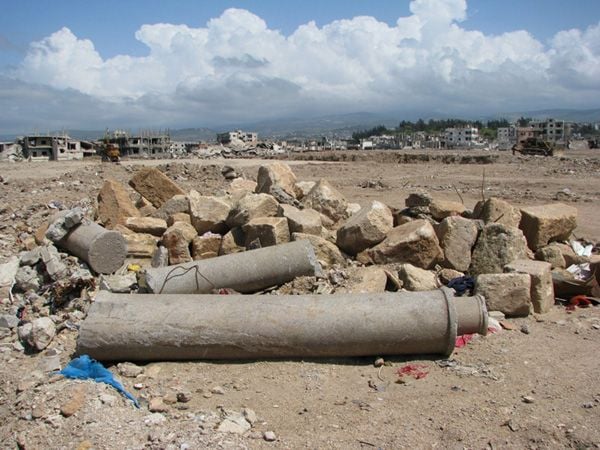
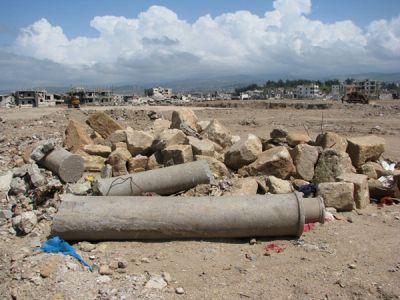
Beneath the rubble of the destroyed Nahr al-Bared camp in North Lebanon, unexpected traces resurface. (Credit: Photo taken from the website hadjithomasjoreige.com)






Some heritage sites disappear without a sound. They fade away under the effects of urbanization, neglect or deliberate destruction.
The latter are sometimes part of an intentional strategy of erasing memories – such as that carried out by Israel in South Lebanon and Gaza. But invisibility can also result from a social and political decision, a choice dictated by necessity.
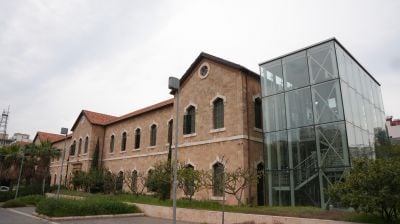
This was the case with the ancient city of Orthosia (or Ortosias), whose "dizzying history" was highlighted at the Sursock Museum as part of the exhibition "Remembering the Light," shown from May 9 to Sept. 7, 2025.
The installation, created by artists and filmmakers Joana Hadjithomas and Khalil Joreige – in collaboration with archaeologist Hadi Choueri, as well as Maissa Maatouk and Karim Chaya – looked back at a spectacular discovery and its nearly immediate erasure.
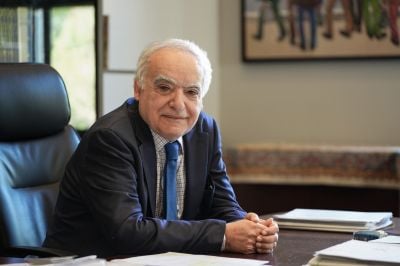
The story has recently resurfaced beyond artistic circles. A documentary broadcast by BBC News Arabic brought the events of 2009 back into the spotlight, sparking numerous reactions on social media. Outrage, questions, hasty accusations: the debate has ignited around a sensitive question – did Lebanon sacrifice an archaeological treasure?
Let's recall the facts.
In 2007, the Palestinian refugee camp of Nahr al-Bared in northern Lebanon was largely destroyed following violent clashes between the Lebanese army and the group Fateh al-Islam. Two years later, during clearing and demining operations, ancient remains emerged from the ground. Stylobates decorated with moldings appeared – the stylobate being the base upon which the columns of a temple rest. Soon, granite columns and the remains of a monumental structure were uncovered.
Alerted, the Directorate General of Antiquities conducted excavations on a section of the site. The evidence converged: it could be the tell of Ortosias, a Hellenistic city later occupied by the Romans and Byzantines, mentioned by Strabo, Ptolemy and other ancient sources.
But rebuilding the camp could not be put on hold. Thousands of refugees were waiting to return home. By decision of Prime Minister Fouad Siniora's government, the excavations were stopped. The site was protected by a fill of about one meter, then sealed with a concrete slab. Orthosia was reburied – not destroyed, but put on hold, preserved for possible future research.
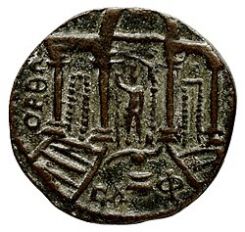
According to historian and archaeologist Nina Jidejian, a fervent defender of heritage who died in 2020, Orthosia was a major religious center of northern Phoenicia. There, the cult of the Heliopolitan triad was practiced, drawing pilgrims and merchants from across the Mediterranean. A maritime stronghold since Hellenistic times – mentioned in the "Books of the Maccabees" – the city minted its own bronze coins in the Roman era. Some depict Emperor Elagabalus, others the goddess Astarte on the prow of a ship, evidence of a thriving economy.
In the fifth century, historian Ray Jabre-Mouawad notes, Ortosias became the seat of a Greek bishopric under the metropolitan of Sour and the Patriarchate of Antioch. John Rufus wrote of the exile of Peter the Iberian, a leading figure of miaphysite resistance to the Council of Chalcedon, who found refuge in 491 in this "sparsely populated town, equipped with a large reservoir supplied by the springs of Mount Lebanon." He described a church and a martyrium dedicated to Saints Sergius and Bacchus, whose relics inspired deep devotion.

In the Crusader era, the city lost its religious autonomy: its episcopal seat became part of the Latin diocese of Tripoli, and its church passed to the Frankish clergy. Then, in 1289, the capture of Tripoli by the Mamluk sultan Qalawun marked a dramatic turning point in the region. All trace of Ortosias disappeared.
Until it resurfaced, briefly, from a wounded earth, only to return there, sealed under concrete.
This tension – between ancient memory and contemporary urgency – is what the Sursock Museum exhibition and the BBC documentary have rekindled. In Lebanon, history is never simply buried: it always remains a battlefield.

 8 p.m. recap: Israel again threatens Beirut’s south suburbs; 2 ships hit near Hormuz; Riyadh football matches canceled