






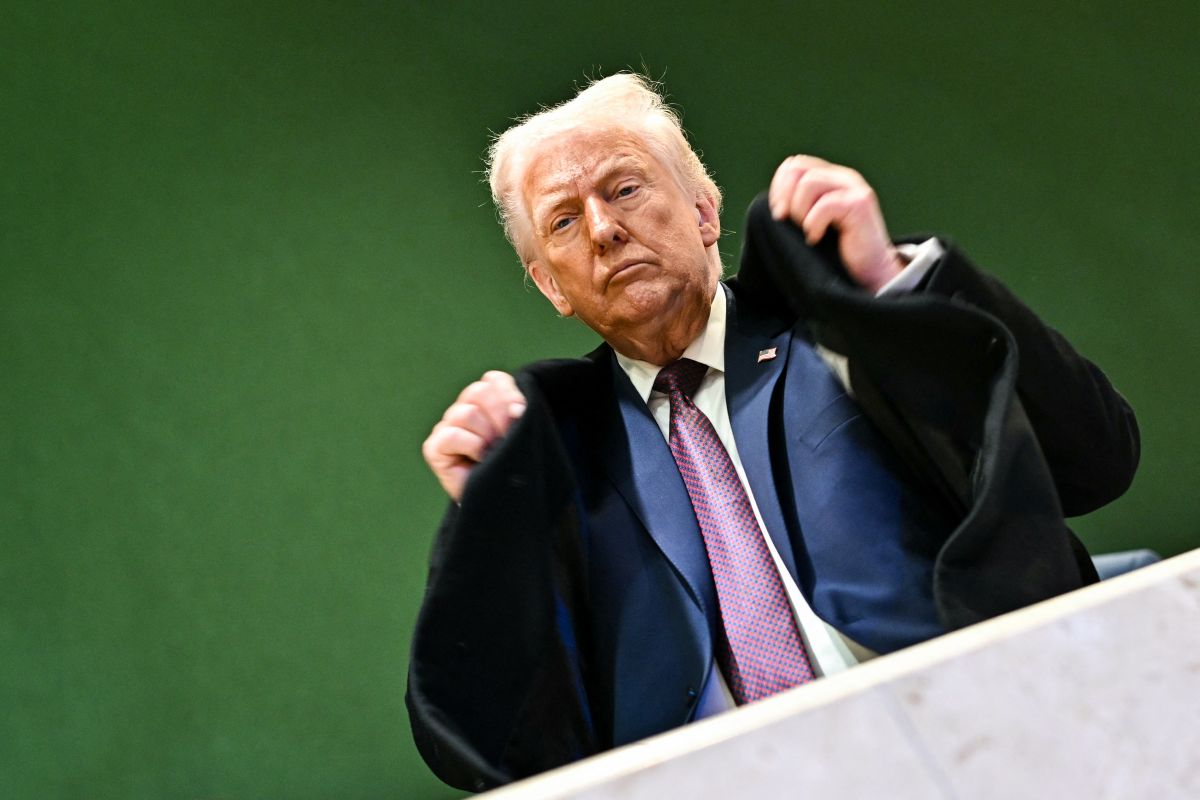
U.S. President Donald Trump adjusts his jacket as he leaves the Congress Centre during the World Economic Forum (WEF) annual meeting in Davos on Jan. 22, 2026. (Credit: Fabrice Coffrini/ AFP)






This is not about liking a man or defending a personality. Put Trump aside for a moment and focus on the decision the United States now faces.
The hard choice is this: whether America is willing to act early and decisively to reshape a changing global order, even at the cost of disruption and backlash, or whether it will wait for comfort, consensus and permission until others set the terms instead.
I say this as someone who comes from a country that learned the hard way what happens when hesitation is mistaken for responsibility. Lebanon did not collapse because of one reckless decision. It collapsed because hard choices were never taken. Excuses and procedural caution became tools to stall decisions.
Delay was not a failure of governance. It became a method of governing.
This is not a comparison of power or destiny. The U.S. leads, while Lebanon is led. But the dynamic is the same. When a country stops making its own decisions, those decisions do not disappear. They are made elsewhere, often by actors with very different interests.
What the U.S. is living through right now is not normal politics. It is a moment of consequence. One of those rare points in history when the global order shifts and delay carries a real cost. The system that delivered decades of American prosperity and relative peace is under strain. Moments like this do not come with second chances.
Power is moving and old assumptions are breaking. Much of the world is waiting for direction. Europe is fragmented and distracted by its own internal struggles. The Western center of gravity is fractured and denial only deepens the delay.
Still, many Americans treat this like just another election cycle, as if the next ballot will reset everything. It will not.
History does not offer refunds for missed moments.
Moments like this punish comfort and endless debate.They demand courage and decisive action.
The Federal Reserve has an important role, but it was never meant to decide where the country goes. Monetary policy can stabilize markets. It cannot replace strategy or define national direction.
Right now, the U.S. is acting with more unilateral pressure, not out of arrogance, but out of necessity. This is what leadership looks like when timing matters. Traditional allies are divided and inward-looking. Waiting for agreement among partners who cannot agree among themselves is no longer a strategy. It is a decision to stand still while others move.
That delay has consequences. Avoiding decisions creates instability rather than preserving order.
Most decline does not come from chaos at the bottom, but from hesitation at the top. When leaders pause, adversaries position early, shape the rules quietly and lock in advantages before democracies finish debating the process.

When entrenched institutions undermine the only political effort attempting to reposition the country for what is coming, the impact is neither neutral nor innocent. Real change does not happen in one term.
It takes time, often two terms, and it only works if people can feel momentum and relief along the way. When economic pressure is intensified prematurely, public support collapses before strategy can take hold. Undermining that support weakens not only a presidency, but the country at a moment when continuity matters.
This pattern is not limited to institutions. It is visible in political leadership across much of the Western alliance.

Recent reactions from leaders in France and Canada reveal the same instinct. When faced with change, some respond with alarm instead of strategy. Instead of tackling internal weaknesses, adaptation is seen as recklessness and change as a threat.
Emotion replaces strategy and their energy is spent resisting rather than reforming. This does not slow history. It only ensures that those shouting the loudest are left behind while others quietly set direction.
Much of Europe’s and Canada’s current leadership reflects a bureaucratic pedigree. A mindset designed to preserve systems rather than disrupt them.
Bureaucratic leadership excels at managing decline politely, not reversing it.
History offers clear guidance here.
Winston Churchill promised sacrifice when Britain’s fall seemed likely and led it through survival to victory. Franklin Roosevelt pushed America through depression and war and helped design the postwar order through Bretton Woods, shaping a financial system the world still relies on today.
Ronald Reagan made deeply unpopular decisions that accelerated the end of the Cold War.
None of them were liked at the time. All acted when waiting was more dangerous than deciding.
As a great philosopher once observed, "History is the system of human actions, not of human intentions."
Modern politics too often masks fear as restraint, avoiding decisions while presenting inaction as responsibility and claiming moral superiority in the process.
In Lebanon, years of delayed decisions and fragile consensus did not look dangerous at first. Each pause was defended as caution. Every compromise was sold as stability. Over time, the ability to decide weakened, if not lost. Institutions were hollowed out and paralysis set in. Not because of one catastrophic mistake but because the habit of choosing disappeared.
The U.S. still has choices. Lebanon lost them.
The U.S. was never meant to be a mere global policeman. Its role has always been larger than that. To lead, to shape and to set direction when systems break down and others cannot hold them together.
In moments like this, the rules of leadership change. How power is exercised, when pressure is applied and who sets direction are decided in real time, not after the fact. That role requires accepting discomfort early to prevent a crisis later.
This is not about liking Trump or planning the next election. It is about recognizing a now-or-never moment while it still exists. While attention is consumed by personalities, adversaries are positioning themselves, alliances are distracted and power is quietly shifting.
This is the hard choice before the U.S.
It's either lead early and absorb the cost, or wait politely and live with the consequences.
History does not wait, and it does not forgive nations that confuse comfort with leadership.
Philip Honein is an engaged observer and nonprofit leader who has worked as managing director and strategic advisor for leading conglomerates in the Gulf.

 8 p.m. recap: Israel again threatens Beirut’s south suburbs; 2 ships hit near Hormuz; Riyadh football matches canceled