






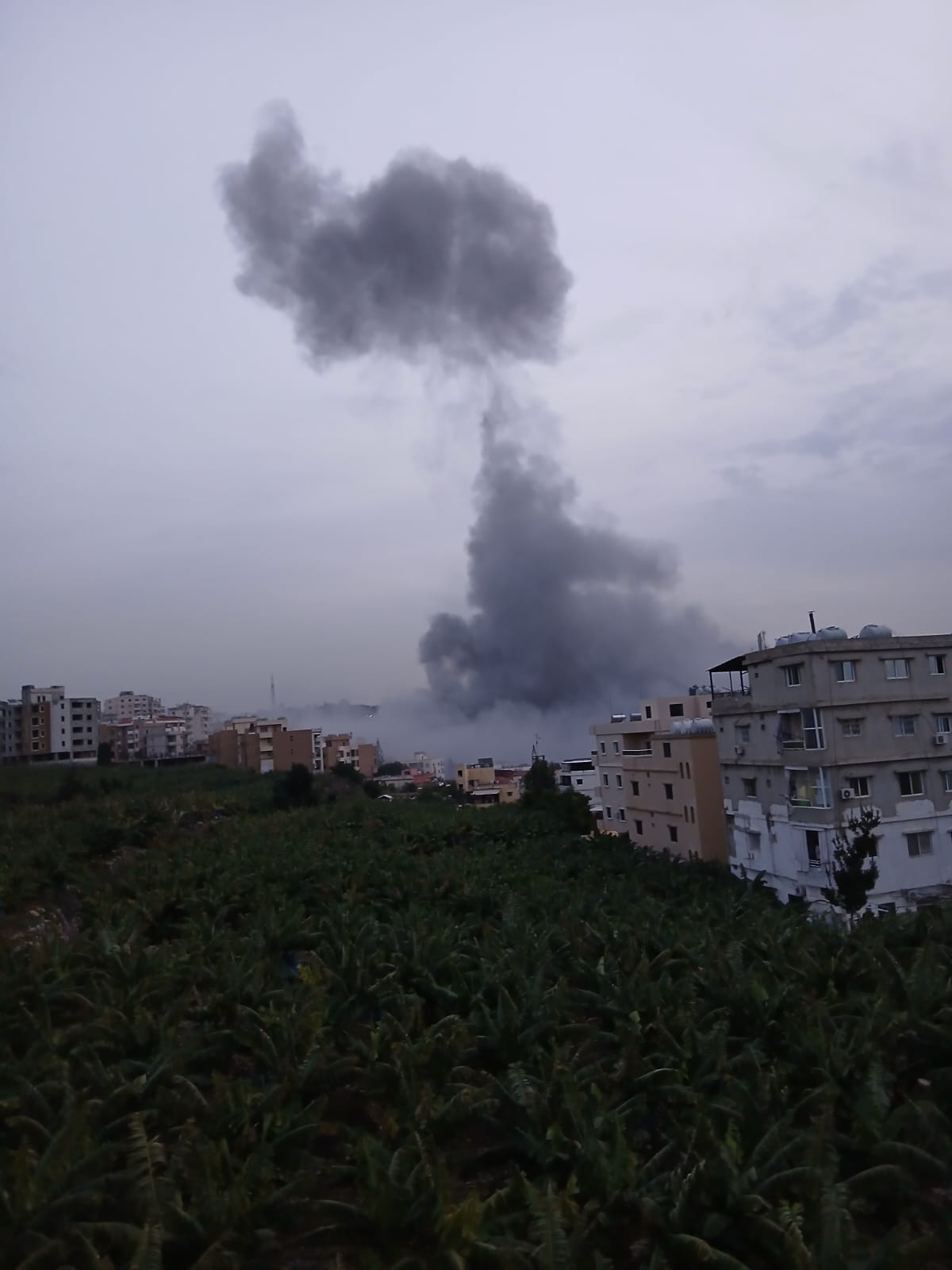
Israeli strike in Qanarit, in the Saida district, on Jan. 21, 2026. (Credit: Muntasser Abdallah/L'Orient Today)






BEIRUT — Two people were killed, 19 injured, including journalists, and more than 50 families displaced on Wednesday as the Israeli army carried out multiple strikes across southern Lebanon, claiming it was striking Hezbollah targets, despite a truce agreed in November 2024.
The escalation came even as the cease-fire monitoring committee remains temporarily on hold and two January meetings were postponed. Meanwhile, the Israeli army continues to occupy five positions inside Lebanese territory and continues its near-daily attacks on the South and the Bekaa.

Residents of Qanarit and Kharayeb (Saida district), and Kfour, Jarjou and Ansar (Nabatieh), were forced out of their homes, following evacuation threats on X from Israeli army spokesperson Avichay Adraee. According to municipal sources and residents, more than 50 families lost their homes.
Earlier, two people identified by Israel as Hezbollah members were killed and another wounded in separate strikes in Saida and Sour districts.
Following the attacks, a flurry of condemnation followed from multiple Lebanese officials.
Evacuation, attacks, 50 displaced families and journalists wounded
Around 4 p.m., the Israeli army issued evacuation notices for Qanarit, Kfour and Jarjou. Adraee said the operations targeted "military infrastructure belonging to Hezbollah, in order to prevent its attempts to resume operations in the area." Evacuations caused heavy traffic on the narrow roads between Qanarit and Ghazieh.
Just over an hour later, a Qanarit building was hit. Thick smoke rose as far as Saida, and surrounding buildings and vehicles were damaged.
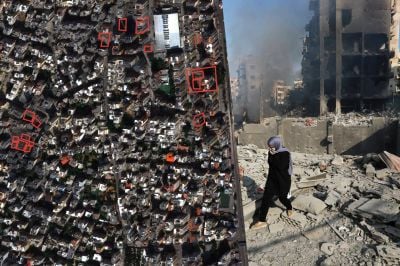
During the powerful Israeli strike, at least four journalists were lightly wounded by flying debris during the strikes in Qanarit, despite being positioned 300 meters from the evacuation zones. They included Mahmoud Zayat (AFP), Ali Hankir (Al Mayadeen), Mohammed Zeinati (Alafdal TV), and Ahmed Mantache (Annahar). Zayat, who suffered shrapnel wounds to his leg, said, "We took shelter 300 meters from the marked zones. We were caught in a very thick black smoke. We had to stop filming. It was a terrible scene of war." Hankir was hit in the foot by debris and required hospitalization.
The Ministry of Health reported 19 injured, including journalists, with two in intensive care, three hospitalized, and 14 treated in emergency rooms.
Joseph Kossaifi, head of the Lebanese Press Editors' Syndicate, said eight correspondents were affected along with their equipment, and called for caution. Lebanese Syndican of Press Photographers warned that “Israeli claims about ‘safe zones’ protect no one,” urging journalists to follow professional rules. Information Minister Paul Morcos also condemned attacks on journalists, noting they were performing professional duties far from strike sites.
In Jarjou, an Israeli airstrike destroyed a multi-story building and sparked fires, while a residential building in Kfour was also struck.
Later, evacuation notices were issued for Kharayeb (Saida) and Ansar (Nabatieh), followed by additional Israeli strikes on both villages. In Kharayeb, after the initial strike, the Israeli army conducted further strikes. And in Ansar, the target was in the center of the village, which caused extensive damage to stores and nearby houses.
Following the strikes, Adraee posted on X that "for the second time this week, the army targeted terrorist infrastructure belonging to Hezbollah, located in the heart of the civilian population in southern Lebanon." He said the strikes targeted arms depots and an underground site used to store combat equipment, claiming that Hezbollah uses civilians as "human shields." He added that measures were taken to minimize civilian risk, including "precision munitions, advance warnings, aerial reconnaissance and reliance on intelligence."

Further Israeli attacks in South and along border with Syria
On Wednesday morning, an Israeli drone strike on Zahrani road south of Saida targeted a vehicle, killing Mohammad Baker Youssef Awada, from Sharqieh (Nabatieh), our correspondent reported. Israel later said that it had targeted a Hezbollah member.
Later, a second drone strike hit a vehicle on Bazourieh road in Sour. The driver, Ahmad Salameh from Yanouh, died of his wounds, and another passenger was injured.
Israel identified Salameh as a Hezbollah liaison officer overseeing operations from private properties in Yanouh. According to Israeli army, Salameh allegedly relayed information to Hezbollah members during a Dec. 13, 2025, Lebanese Army intervention, allowing them to remove weapons from a building. During this intervention, "several suspicious crates were taken out of the complex through the back door," the Israeli army statement said, adding that the Lebanese Army had "in coordination" with Ahmad Salameh, stated that the building was free of weapons.
In the evening, Avichay Adraee also announced that "four border crossings between Syria and Lebanon were struck in the Hermel area, used by Hezbollah to transfer combat equipment." "The army continues to target smuggling routes used by Hezbollah," he said. He recalled that earlier in the day, the army had "neutralized Mohammad Awada… a key Hezbollah arms trafficker and smuggler." "He supervised and organized the transfer of weapons via a shell company that transported illicit goods from Iraq, Syria and several Gulf countries," added the spokesperson. "He had also activated a network of smugglers to transport combat equipment to Syria and Lebanon." "The army continues to monitor all Hezbollah arming attempts and will intervene in the face of any violations of the agreements between Israel and Lebanon," he concluded.
And in the evening, the Israeli army struck several locations along the Lebanon-Syria border. Adraee later posted that the Israeli forces struck four border crossings in the Hermel area, reportedly used by Hezbollah to transfer combat equipment. He said Awada was a key arms trafficker, who supervised smuggling through a shell company from Iraq, Syria and Gulf countries and had activated a network to transport combat equipment to Syria and Lebanon.
In Marjayoun district, residents of Kfar Kila set tires ablaze Wednesday near the ruins of their homes to demand reconstruction. Mokhtar (local official) Hassan Chit told L’Orient Today that residents live in constant fear, without homes or infrastructure. "They have no homes to return to, no infrastructure, and live in constant fear of being targeted by Israeli attacks," he said, calling on the state to address their situation and help them return to their village safely.
Lebanese official respond to Israeli escalation
The Lebanese Army denounced the attacks, calling them a "flagrant violation of Lebanon’s sovereignty and security, the cease-fire agreement and Resolution 1701." In a statement on X, the army said the attacks targeted civilian homes across several areas, undermining its operations and obstructing the implementation of its plans. The attacks "are causing fear among civilians, resulting in deaths and injuries and displacing dozens of families who have lost their homes," the statement added, noting the strikes also threaten regional stability.
President Joseph Aoun condemned the Israeli airstrikes on populated Lebanese villages, calling them part of a "policy of systematic aggression that affects and terrorizes civilians" in a message posted on the presidency’s X account. Aoun said the strikes represent a dangerous escalation that directly targets civilians, threatens their safety, and violates international humanitarian law. He added that Israel’s repeated attacks demonstrate a refusal to respect the cease-fire agreement and a "disregard" for Lebanon’s efforts to maintain stability and prevent further conflict. The president reaffirmed Lebanon’s commitment to "its sovereignty and territorial integrity," holding Israel "fully responsible for the consequences of these aggressions." He called on the international community, especially the guarantors of the agreement, to assume their responsibilities and take decisive action to halt the violations, protect civilians and preserve security and stability in Lebanon and the region.
While in Davos for the World Economic Forum, Prime Minister Nawaf Salam contacted army chief General Rodolph Haykal, the secretary-general of the High Relief Committee, and the head of the Risk Management Unit to coordinate support for those affected.
Following Israeli strikes in southern Lebanon, Parliament Speaker Nabih Berri called on Civil Defense teams from the Scouts of the Islamic Mission, the Amal Movement’s social services office, and local municipalities to mobilize all resources to assist victims. He instructed authorities to provide immediate help to families who lost their homes and are now displaced. Berri said that mere statements of condemnation are no longer enough to protect Lebanon and its citizens. "What saves the homeland, liberates its territory and shields it from Israeli aggression is national unity, and then national unity again," he stressed. He also wished a speedy recovery to the wounded, particularly journalists, and reiterated the need for coordinated national efforts to confront the current challenges.
The state-run National News Agency reported that Council for the South engineering teams will inspect damage in Jarjou, Kfour and Ansar on Thursday.
In efforts of solidarity, dozens of private citizens also offered temporary accommodation to displaced families.
