






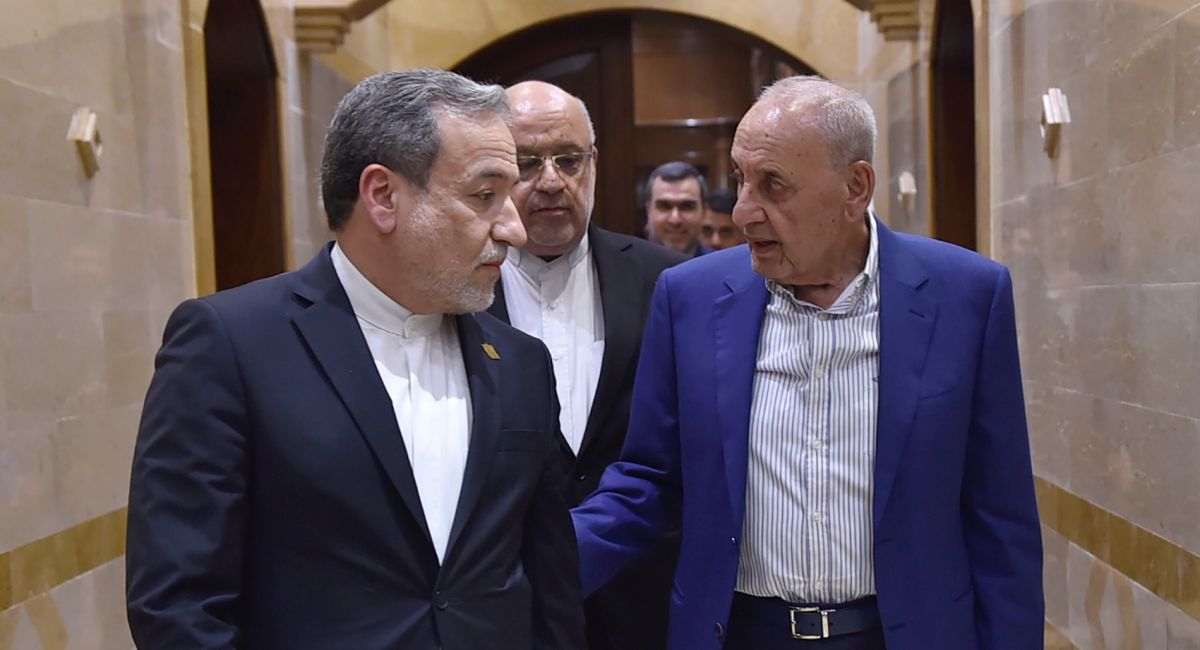
Iranian Foreign Minister Abbas Araghchi received by Speaker of the Parliament Nabih Berri at Ain al-Tineh, in Beirut, on Jan. 9, 2026. (Credit: Hassan Ibrahim/Parliament media office)






BEIRUT — Iranian Foreign Minister Abbas Araghchi accused the United States and Israel of meddling in the protest movement currently taking Iran by storm, in a statement made from Beirut on Friday.
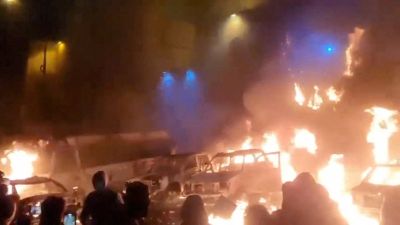
Iran has been experiencing large-scale demonstrations nationwide for nearly two weeks in response to unchecked inflation, and worsening economic hardships.
"What is happening today in Iran is similar to what has occurred in recent years in the streets of Lebanon, due to the rise of foreign currencies, prompting citizens to protest," Araghchi said. "The situation in Iran is comparable to what Lebanon experience."

Mass demonstrations swept through Lebanon in October 2019 in response to increased taxes levied against the public by Cabinet. The movement lasted roughly until the COVID-19 lockdown and resulted in the stepping down of then Prime Minister Saad Hariri.
"The government has started a dialogue and consultations with all parties to resolve these issues," Araghchi said.
"Unlike previous episodes," he added, likely referring to the 2022 women-led protest movement following the killing of Mahsa Amini, "American and Israeli officials have acknowledged their direct involvement in the current unrest in Iran, seeking to turn peaceful demonstrations into violence."
However, he ruled out the prospect of military intervention against Iran. "That scenario is unlikely," he maintained, claiming that "past experiences have been failures and would be so again if repeated."
Addressing information circulating on social media about the presence of his family in Beirut, Araghchi was keen to deny the reports: "I assure everyone: my family is in Tehran, and I will join them there."
The minister was speaking in Ain al-Tineh, following his meeting with Speaker of Parliament Nabih Berri before whom he reaffirmed that his country supports "the independence and prosperity of Lebanon."
He also emphasized the economic ties between the two countries, which he said saw a volume of trade exceeding $110 million over the past year.

Support 'the Lebanese state directly' and not Hezbollah
Araghchi was received at the Bustros Palace by Foreign Minister Joe Rajji earlier in the day on Friday. Relations between the two have been historically marked by tensions, however after Friday's meeting, Rajji referred to Araghchi as a "friend" and stated that "differences of opinion do no affect friendship."
Rajji said he'd had a "frank discussion" with Araghchi during which he called on Iran to support the Lebanese state directly and not Hezbollah, saying he wished for "better relations" with Iran, whose support, he argued, "should be directed to the Lebanese state and its institutions, and not to any other party."
He recalled that the defense of Lebanon should be the responsibility of the state alone, which, "when it holds the decision of war and peace and the monopoly on weapons, can seek help from other states, including Iran."
However, Rajji said, "building a strong state capable of defending its territory and people cannot happen in the presence of an armed organization," alluding to Hezbollah.
"Experience has shown that weapons have not succeeded in defending the Shia community, nor Lebanon as a whole," Rajji argued, urging Araghchi to "put an end to statements and positions by some Iranian officials that constitute blatant interference in Lebanese affairs."
For his part, Araghchi assured that "Iran is committed to the independence, unity, and sovereignty of Lebanon, and its defense is the responsibility of the Lebanese government."
"Iran supports Hezbollah as a resistance movement but does not interfere in its affairs, and any decision regarding Lebanon is up to the party itself," he added.
Economic, diplomatic, and commercial commissions
Araghchi expressed, prior to his trip, Iran's desire to strengthen economic relations between the two countries, and President Joseph Aoun proposed, during his meeting with the Iranian foreign minister, to establish 'commissions' including Iranian and Lebanese representatives at the levels of the ministries of foreign affairs, economy and commerce.
Aoun, in line with what Rajji had already declared, reaffirmed Lebanon's position in favor of "the best relations with Iran within a framework of mutual respect, transparency, candor, and non-interference in the affairs of both countries."
He wished the Iranian people "prosperity, security and serenity, and that the days ahead will be better."
Prime Minister Nawaf Salam also received Araghchi at the Grand Serail, in the presence of Iran's ambassador to Beirut. Salam stressed Lebanon's commitment to "establishing sound relations with Iran, based on mutual respect for the sovereignty of states and non-interference in their internal affairs."
For his part, Araghchi said that his visit to Lebanon was aimed at strengthening and developing bilateral relations, particularly in the economic and commercial fields.
He insisted on "the dangers facing the region, and Lebanon in particular, due to aggressive polices carried out by Israel, and the importance of consultation among the various Lebanese parties, especially Hezbollah, to confront these challenges."
Salam, for his part, said his government is "committed to implementing its ministerial statement, on the basis of which it twice won the confidence of Parliament, including that of Hezbollah MPs."
He emphasized that this document clearly states that the decision of war and peace lies exclusively with the government, which must work to reserve the monopoly on arms solely to the state, according to a statement posted by Grand Serail's official X account.
Meeting with Kassem
Araghchi also met with Hezbollah Secretary-General Naim Qassem, who spoke of the "ongoing American-Israeli aggression" against Lebanon and Israel's non-compliance with the cease-fire agreement, reached in November 2024, "despite Lebanon's commitment and fulfillment of its responsibilities south of the Litani River."
According to Qassem, this "confirms the expansionist intentions of the aggression, which Benjamin Netanyahu himself expressed through his speech on Greater Israel."
Qassem insisted that Israel would not achieve its objectives through continued aggression, as long as "cohesion between the population and the Resistance" endures.
"We will continue to cooperate with the state and the army to drive out the occupier, end the aggression, free prisoners, ensure reconstruction, and build the state," Qassem said, according to a statement released by the party.
For his part, Araghchi told Qassem that his country "wishes to strengthen its relations with Lebanon, in the manner of relations between friendly states," specifying that the presence of an economic delegation aims to "develop cooperation in different fields."