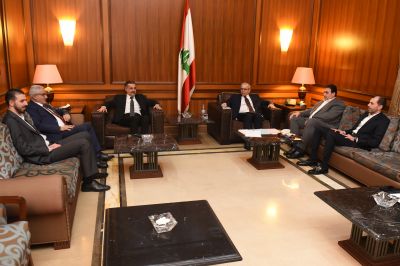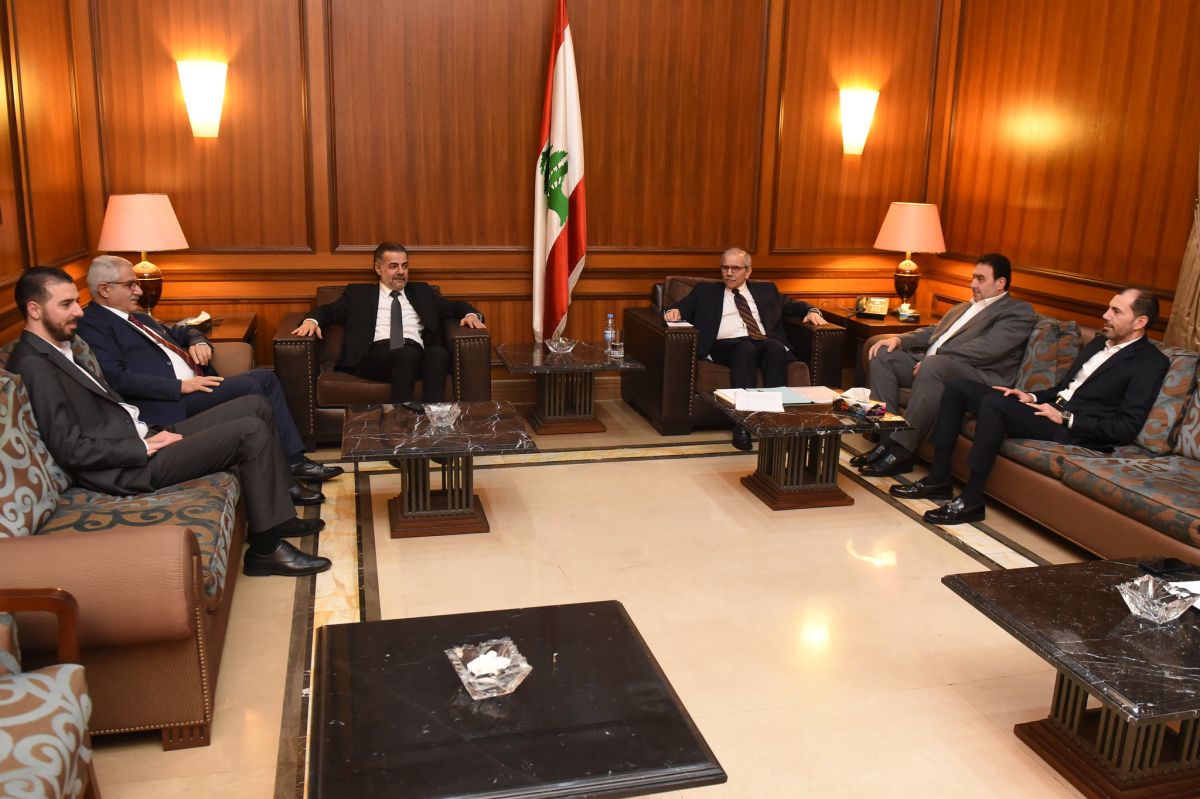
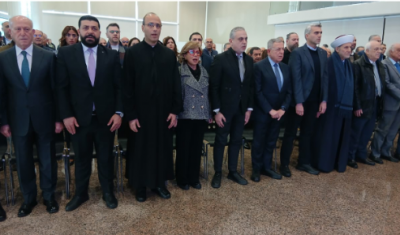
The National Moderation Bloc gathered with Prime Minister Nawaf Salam at Parliament on Jan. 15, 2025. (Credit: Ali Fawaz/Lebanese Parliament)






The National Moderation bloc has collapsed. Walid Baarini’s withdrawal sealed the fate of the group, made up largely of Sunni MPs once aligned with former Prime Minister Saad Hariri.
On the surface, the breakup was one of the direct consequences of the so-called ‘Abu Omar’ affair. The man, presented as a Saudi prince, was said to have contacted several of these MPs, notably during the binding parliamentary consultations to appoint a prime minister in January 2025.
But there is broad agreement that this political and media scandal mainly served as a pretext. It offered Baarini what he described to L’Orient-Le Jour as a chance “to break free,” as legislative elections scheduled for May draw closer.
The collapse of the National Moderation bloc carries added weight. After Hariri decided to bow out of political life engendering fragmentation on the country’s Sunni landscape, the bloc positioned itself as the main channel for expressing the community’s mood.
The split between Baarini and his former allies is also likely to have significant electoral consequences in northern Lebanon.
Baarini’s decision surprised some political circles, but it was largely expected by the other members of the bloc.
“We disagreed several times on how to handle major issues, including the appointment of [Prime Minister] Nawaf Salam,” the Akkar MP told L’Orient-Le Jour, suggesting that the so-called ‘Abu Omar’ affair merely hastened his exit.
That view was echoed by another member of the group. “This can only be explained by Baarini’s electoral calculations, nothing more,” the source said on condition of anonymity.
Within the National Moderation bloc, several figures noted that Baarini was aware that his colleagues Mohammad Sleiman, Sajih Attieh and Hady Hobeiche, the bloc’s secretary general and a former Hariri-aligned MP, were moving toward forming an electoral list that would not include him.
“Baarini could cost us votes, especially in the Christian areas of Akkar, where he is not very popular,” said one of the three members involved in the emerging list.
Baarini, for his part, said he would run with his own list in the elections. He may also count on the support of Ahmad Restom, an Alawite MP who left the bloc shortly afterward in a show of solidarity.
‘The Sunni heart still beats for Hariri’
The collapse of the National Moderation bloc is likely to have consequences both within the Sunni community and at the national level. Since Hariri withdrew from political life, the bloc had been the main structured group representing Sunnis in Parliament.
In that role, its MPs managed to open channels of dialogue with Riyadh, the community’s historic patron, at times tipping the balance one way or another during key political moments.
According to a former Hariri-aligned minister who spoke on condition of anonymity, this was the group’s primary purpose. “But the bloc was always heterogeneous, bringing together figures whose only common ground was a desire to secure a place on the political chessboard,” he said, adding that the National Moderation bloc “never truly represented the Sunni community.”
Political scientist Karim Bitar seemed to concur. “Everyone knows it was an artificial bloc that never represented the community,” he said. “None of its members had any international stature.” He added that “the heart of the Sunni community still beats for Saad Hariri,” whose departure in 2022 left a void no one has since been able to fill.
What, then, lies ahead for Sunni political representation at a time when [Hariri’s] Future Movement is keeping its intentions for the parliamentary elections deliberately unclear.
“Nature abhors a vacuum. That is why today, Sunni urban elites are backing Prime Minister Nawaf Salam, who has taken a firm stance on the monopoly of weapons,” said Bitar. He noted that other figures are also gaining visibility, including Fouad Makhzoumi, a Beirut MP.
“In such a context, the possibility of a return by [former premier] Najib Mikati to the Grand Serail [the government seat] should not be ruled out,” Bitar said.
Baarini, however, appears unfazed by these calculations. “Whether the Future Movement takes part or boycotts the elections makes no difference to me,” he said. “I am the one forming my list. Others will join me. Not the other way around.”
This article was originally published in French on L'Orient-Le Jour and translated by Sahar Ghoussoub.