






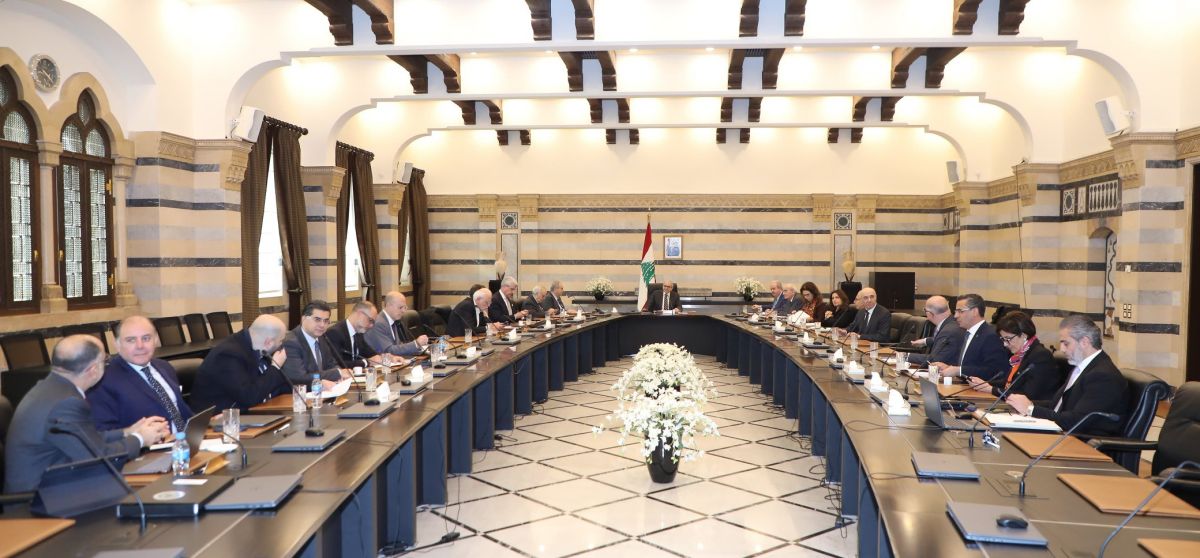
Lebanese ministers gathered Tuesday, Dec. 23, 2025, at the Grand Serail. (Credit: X/Grand Serail)






The Cabinet meeting devoted to examining the controversial draft law on the “restoration of financial order” and the return of deposits ended around 8 p.m. on Tuesday, after more than nine hours.
Speaking after the meeting, Information Minister Paul Morcos said the Cabinet had continued reviewing the articles of the bill and introduced several amendments.
“Discussions have reached Article 8, and some sections require further in-depth examination,” he said, adding that a new session is scheduled for Friday at 10 a.m. to continue the debate.
Morcos outlined the main conclusions reached by the Cabinet, including maintaining the state’s commitments toward the Banque du Liban and defining the financial deficit in coordination with the central bank.
He added that it was decided to broaden the circle of people concerned by transfers carried out illegally while banks were closed at the start of the crisis to include ministers in office at the time, the central bank governor and his deputies, senior bank executives, members of the Banking Control Commission and members of the central council.
The minimum monthly reimbursement to depositors was set at 1,500 dollars.
The minister also said the government would work to unlock a large number of accounts in the coming months, while maintaining the issue of the forensic audit of the Banque du Liban.
He added that the Cabinet stressed the need to recover excessive bonuses and profits distributed to shareholders and senior bank officials in 2016, which were withdrawn or transferred abroad.
Separately, the parliamentary bloc of the Free Patriotic Movement (FPM) announced after its weekly meeting its opposition to the draft law on the financial gap “in its proposed version,” calling for “justice for all depositors through the clear and transparent return of their deposits.”
The bloc said the bill treats depositors “as if they were investors who must bear all the consequences of the crisis, even though they are rights holders.” It added that the proposed law perpetuates injustice dating back to Oct. 17, 2019, arguing that its provisions on deposit ceilings, repayment periods and mechanisms are arbitrary and not based on clear or verified figures.
Hours of discussion on Monday
After a session on the issue held Monday in Baabda, the government began its meeting shortly after 10 a.m. at the Grand Serail, in the presence of Banque du Liban Governor Karim Souhaid, aiming to pass the bill before the end of the year, even if that required multiple sessions.
Following several hours of discussion on Monday, ministers had reached Article 4 of the 16-article bill. Described by Prime Minister Nawaf Salam as “largely in line with IMF requirements,” the text provides for sharing losses between the state, the central bank, commercial banks and depositors, whose number was estimated at nearly one million before the unprecedented economic collapse of 2019.
Under the proposal, small deposits below 100,000 dollars would be repaid at their real value over four years, through monthly or quarterly payments at the account holder’s choice.
Several ministers were involved in drafting the bill, including Finance Minister Yassine Jaber, Economy Minister Amer Bisat, and central bank governor Souhaid.
Article 4 focuses on how to determine the financial “gap” after audits of the central bank’s and commercial banks’ balance sheets — essentially how losses are measured and who must absorb them. This is where the fate of banks’ capital is decided, in line with the IMF-backed principle of loss hierarchy, which requires bank capital to be wiped out first before depositors are further burdened.
According to ministerial sources, Salam is determined to pass the law without amendments that would “undermine its core.” His argument is both political and financial: he considers the text “realistic” and “implementable,” warning that any delay would further erode confidence — among depositors as well as international donors and partners.
On Monday, around 50 people staged a protest near the presidential palace in Baabda during the Cabinet meeting, denouncing the bill as unjust. Several groups took part in the sit-in, answering a call by the association “The Cry of the Depositors,” including the Union of Lebanese Depositors Abroad and the Union for Depositors’ Solidarity.

