






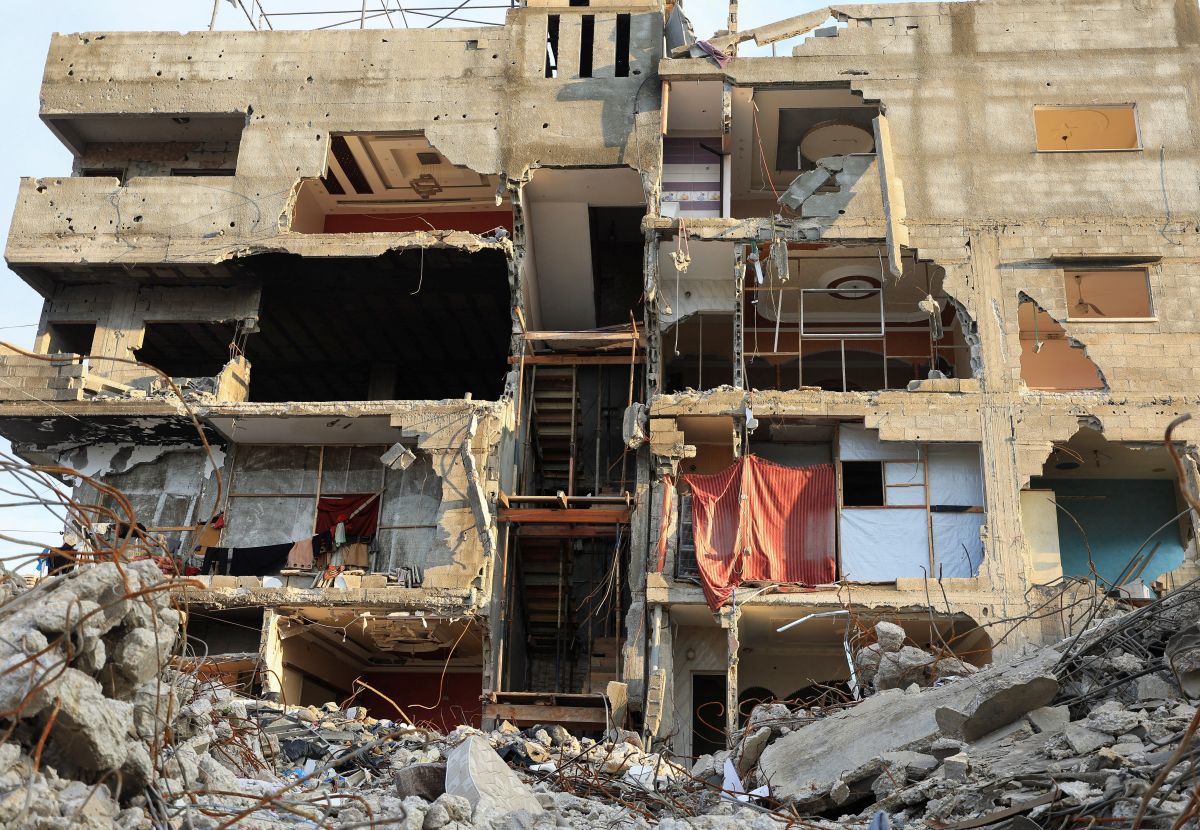
A residential building partially destroyed during the war, in Gaza City, Dec. 14, 2025. (Credit: Dawoud Abu Alkas/Reuters)






The second phase of the Gaza cease-fire, as outlined in the Trump plan, is expected to begin in January, likely in the first or second week of the month, Bishara Bahbah told the Saudi daily Asharq Al-Awsat.
The founder of the "Arab Americans for Peace" organization, Bahbah, is a staunch supporter of U.S. President Donald Trump and has informally served as a mediator between Washington and Hamas.
While one Israeli hostage killed in captivity still has to be returned by the Islamist movement in exchange for 15 bodies of Palestinians, discussions about the second phase are facing implementation challenges.
Israeli Prime Minister Benjamin Netanyahu's fifth visit to Washington on Dec. 29 is expected to be decisive in smoothing differences as U.S. pressure to move forward intensifies.
The cease-fire that took effect on Oct. 10 saw Israeli troops pull out from the western part of the enclave, while still controlling more than half of it.
The next phase foresees a further Israeli withdrawal along a security perimeter, with Israeli forces currently maneuvering around the Yellow Line that's supposed to mark their presence and control over the Palestinian territory.
In their place, an International Stabilization Force is expected to be deployed to guarantee order, security and possibly the disarmament of Hamas. This has generated reluctance among countries approached to participate. The strip of land is also to be administered by a Palestinian technocratic committee, itself overseen by an international board of administrators, reporting to a "Peace Council" chaired personally by Trump.
Management structure in place
According to Bahbah, preparations to manage Gaza are nearly complete, with Palestinian Health Minister Majed Abu Ramadan emerging as the likely head of the Palestinian committee, which reportedly has 42 candidates approved by Hamas, Fatah and Egypt.
Regarding the international board of administrators, U.S. envoy Steve Witkoff, Trump's son-in-law Jared Kushner, and former Director of National Intelligence Richard Grenell are expected to serve alongside former British Prime Minister Tony Blair and Bulgarian diplomat Nickolay Mladenov, who is a possible choice to lead the body.
For the "Peace Council," the U.S. president is said to have spoken to many leaders likely to join, emphasizing the necessary commitment in the form of funding, the provision of security forces, or otherwise, according to the Palestinian-American mediator.
According to the Times of Israel, the Trump administration has already secured the participation of the Egyptian, Qatari, Emirati, British, Italian and German leaders, though this does not yet guarantee additional support.
Washington is still trying to bring in more leaders, particularly Saudi Crown Prince Mohammed bin Salman (MBS) and Turkish President Recep Tayyip Erdogan.
In Asharq Al-Awsat, Bahbah highlighted, from the U.S. perspective, the importance of Turkey in the post-war Gaza setup to ensure the enclave’s stability, as the country is closest to Hamas and most able to engage the group on the weapons issue.
However, Tel Aviv is adamantly opposed to including Turkish elements in the International Stabilization Force, as Ankara has been highly critical of the war in Gaza and hosts Hamas leaders.
The two countries are also at odds on many regional issues, notably Syria.
According to an Israeli official quoted by the Times of Israel, American pressure is expected to intensify in the coming weeks to force Israel to drop its veto on Turkish involvement in the Gaza file, whether by accepting Erdogan as a member of the "Peace Council" or allowing Turkey into the International Stabilization Force's command structure, even without ground troops.
Thorny issue of troops on the ground
On the matter of the international force to be deployed in the enclave, a meeting was held in Doha on Tuesday, Dec. 16, under the auspices of U.S. Central Command.
The goal was, among other things, to determine which countries are willing to contribute troops, security forces, train Palestinian police, provide logistical and technical support, but also how coordination would work, including the possibility that an American commander would head the International Stabilization Force, and where the forces would be deployed.
Most countries willing to participate, however, insist on no role in any disarmament process, mainly seeking to ensure Israel’s withdrawal from the enclave by acting as a buffer between Palestinian civilians and Israeli forces, Bahbah said.
He indicated that Hamas leaders have expressed willingness to discuss disarmament, while some leaders have said they are ready to freeze their weapons.
Although talks in this direction between the Islamist movement and Arab mediators are just beginning, the U.S. has sought to reassure partners by saying they will initially not be required to deploy in the western zone of Gaza, which is still under Hamas control, but along the Yellow Line.
A follow-up meeting is scheduled for Washington in mid-January. However, some Arab diplomats and an Israeli official quoted by the Times of Israel have expressed skepticism about the Trump administration’s aim to deploy the International Stabilization Force that same month.

