





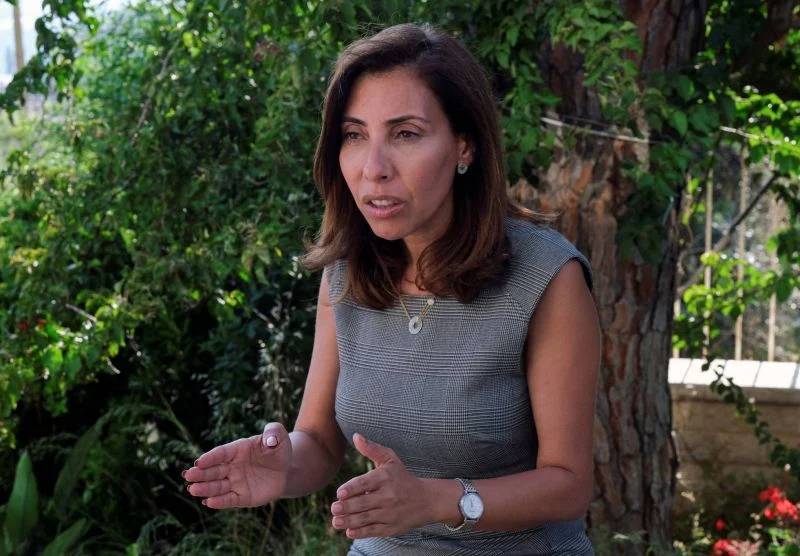
MP Halima Kaakour. (Emilie Madi/Reuters)






In the campaign video against digital violence by the feminist association FEMALE, Lebanese actress Rita Hayek looks terrified as she receives abusive messages sent to her at all hours.
This violence, often involving threats to leak photos or personal information and smear campaigns, causes real suffering — even from behind a screen.
Sophie*, targeted by an intense social media defamation campaign launched by her ex after their breakup, has painful memories. "I stopped eating and sleeping; it was extremely hard to live through," she told L'Orient-Le Jour.

For Hayat Mirshad, executive secretary of FEMALE, "Digital violence drives women into a state of despair." She notes that victims are often "young girls" living in environments "without support."
According to the association, 78 percent of victims suffer from anxiety, depression or post-traumatic symptoms, and 20 percent of cases end in tragedy as online violence extends into real life.
In most cases, the abuser is someone the victim knows, but some target strangers.

"In one case, investigators found that a man threatening to post photos of a young girl from a very conservative background without her veil was blackmailing 72 others at the same time," Mirshad added.
Confronted with the absence of a specific law on this type of violence — attackers are prosecuted under other legal provisions, such as threats or harassment — the association has introduced an independent bill due to the "specific features" of this phenomenon.
Drafted with MP Halima Kaakour, "it focuses on women because they are by far the most targeted and vulnerable," she told L'Orient-Le Jour.

Incomplete statistics
The available data, though incomplete, gives an idea of the scope of the issue. According to FEMALE, the Internal Security Forces (ISF) document almost 300 cases of digital violence each month, at least 80 percent of which affect women and girls aged 12 to 20.
L'Orient-Le Jour tried to contact the ISF, without success. But "only about 12 percent of cases are reported, and most complaints are not taken seriously by authorities," according to the association.
Women "are afraid to file a complaint, fearing their parents' reactions or damage to their reputations, and because they don't trust the proposed solutions," Mirshad emphasizes.
Sophie remembers "facing harsh criticism at the cybercrime unit; the officer present clearly didn't understand the nature of [her] complaint."
Still, she was one of the lucky ones: Her case ended with her ex agreeing to stop targeting her in exchange for dropping the complaint.
For many, however, legal recourse is fraught with obstacles. "These issues aren't handled with the urgency they deserve, due to bureaucracy and the fact that there's only one cybercrime unit in Lebanon, located in Beirut, which penalizes people in other regions," Mirshad added.
A new law?
The bill proposed by FEMALE defines digital violence and establishes a framework for protection and penalties: immediate removal of incriminated accounts, criminalization of blackmail, threats to disclose private content, defamation and cyberharassment.
These acts are considered "serious violations of privacy, dignity and human rights," and not just "digital harms."
The law introduces practical protection measures: secure reporting channels, expedited judicial processes, psychological, social and legal support, and a stronger police response.
Two opposition MPs, Paula Yacoubian and Michel Doueihy, along with MP Bilal Abdallah from the Progressive Socialist Party bloc, have already signed the bill, according to Kaakour, who added that members of the Hezbollah, Amal, Lebanese Forces, and Free Patriotic Movement blocs have also promised to sign.
FEMALE provides a support hotline at 81-111456, offering victims a listening ear, social and psychological help, and legal support if needed.
*Name changed at the subject's request.


 Midday recap: Hebron attack sparks Israeli crackdown, international meeting in Istanbul for regional 'de-escalation'