





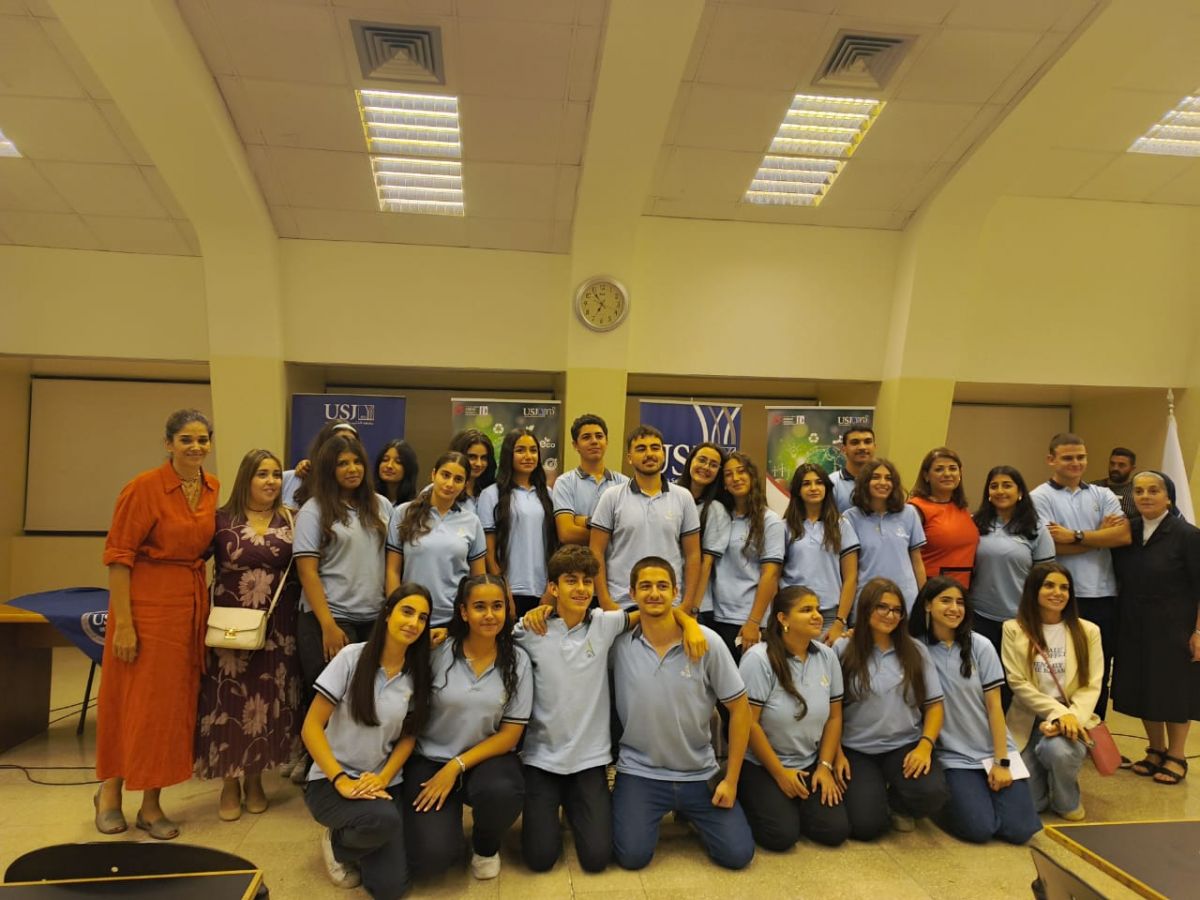
Students from the École secondaire des filles de la charité discussed the political participation of Lebanese women. (Credit: Charitable Girls’ Secondary School)






We never fully understood what “political representation” meant until this class project. We often hear about elections, ministers and promises — but rarely about women in politics. So we wanted to know what young people like us think: Do we want women in politics? Do we believe in their role? And, most importantly, what still blocks their access?
We began with a broad question: To what extent has the participation of Lebanese women in political life since the end of the civil war shown both progress and persistent barriers? Our team focused on the perspective of young people — how we view women’s place in politics and their role in shaping society.
In the computer lab, between two bells, we created a questionnaire on Google Forms. We tested our assumptions — that stereotypes are influential and lack of encouragement is a factor — then wrote 12 open and closed questions. We shared the link on WhatsApp with friends, cousins and classmates. In three days, 165 young people ages 15 to 22 responded: 109 girls and 56 boys. Then the numbers began to speak.
What the numbers say — and what they reveal
The good news is clear: 93.9 percent of respondents support having women in politics, and 95.2 percent think women are capable of holding responsibilities. One could stop there and say: a convinced generation. But the rest is more complicated.
First, 69.1 percent believe women are not treated fairly in national politics. Many feel there’s a gap between principles and reality.
Some answers even contradict one another. For example, 60 percent of girls and 58 percent of boys agree that “Women can lead a country as well as men.” Yet the statement “Politics is a domain reserved for men” still receives 42 percent agreement among girls and 47 percent among boys. How can someone believe women are competent while still accepting the idea of a “reserved” domain? This tension reflects cultural legacies we carry without always questioning them.
Another surprising finding: to the statement “It’s important to have women in decision-making positions,” 76 percent of girls and 58 percent of boys say yes. But when asked “Should young girls be encouraged to get involved in politics?” a majority say no: 66 percent of boys and 62 percent of girls. We recognize the importance, yet we don’t encourage participation. Maybe politics feels distant or toxic. Maybe we lack visible role models or safe spaces to try it.
Dreams, realities — and silence
When asked whether they see politics as a personal path, 44.8 percent say no, 34.6 percent are unsure and only 20.6 percent say yes. Just 16.4 percent say they have been encouraged by people around them. It’s no surprise that women remain absent from leadership when encouragement is lacking from high school onward — and not only for girls. At the end of the questionnaire, 40 percent of respondents say they are not politically aware. Silence leads to disengagement.
Before this project, we thought “women’s place” in politics was mainly a legal issue. Now we see it is also — and perhaps primarily — about habits, perceptions and the momentum, or lack of it, given to young people. The answers to our open question make that clear: mindsets must change, students need better guidance, certain laws should be revised and young women need support to speak up and persevere.
What now?
If there’s a lesson for our school, it’s this: start small, but start. Invite female politicians or experts to speak. Create a civic engagement club to learn how to debate, draft a program or understand a budget. Organize mock assemblies. And above all, actively encourage girls to try — not to “fill quotas,” but to practice using power for the public good.
Our generation overwhelmingly supports women in politics. Still, stereotypes persist and encouragement is limited. Between our principles and our practices, there’s a bridge to build. We want that bridge to begin here — in our classes, clubs and families. Because politics isn’t a “reserved” domain. It’s a public space waiting for all of us.


 Evening recap: Netanyahu announces West Bank offensive; 7 killed in Jordan church shooting; tents burned in south Lebanon
 US strike on Iran this weekend? ‘Absolutely,’ says Barrack; ‘I have no idea,’ says Trump