






The Austrian ambassador speaking during the debate. (Photo provided by Michel Pharaon's team)






A roundtable discussion was held on the eve of Pope Leo XVI's visit to Lebanon, at the Robert Moawad Museum in Zokak al-Blat. The topic? How to put an end to Lebanon serving as a proxy for external conflicts and adopt an official diplomatic doctrine based on neutrality within the framework of the Arab League?
This debate, launched in preparation for the release of the second volume of the book titled Neutrality of Lebanon and the Lebanese and the closing of theaters of confrontation, was part of a series of conferences organized in recent years in collaboration with the Austrian Embassy in Beirut.
The roundtable was chaired by former Minister Michel Pharaon, initiator of the project alongside Professor Antoine Messarra, a renowned jurist and former member of the Constitutional Council.
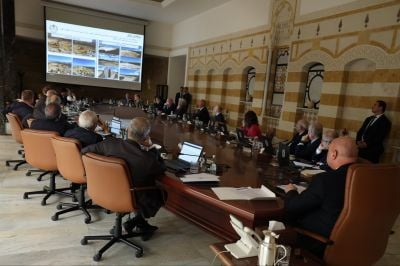
The choice of venue was symbolic. Participants gathered around the table that once served as the dining room of the Pharaon Palace, a wealthy and emblematic patrician home that belonged to one of Lebanon's independence figures, Henri Pharaon — who was a close relative of Michel Pharaon — and which was transferred after the end of the civil war (1975-1990) to the family of jeweler Robert Moawad.
In the room, guests could also observe the sketch, drawn by Henri Pharaon himself, of what would become the Lebanese flag, already inspired by the Austrian flag with its two red stripes framing a central white space.
Political figures of all faiths who had held top positions were present, alongside representatives from academia and the press, as well as the Austrian ambassador, Franziska Honsowitz-Friessnigg.
Among them was former President Michel Sleiman, whose six-year term (2008-2014) was marked by the famous Baabda Declaration, an important milestone on the path that could one day lead to Lebanon’s neutrality. Sleiman revisited the origins of this declaration, adopted in June 2012, just as Syria was plunging into a fierce civil war.
At the time, Hezbollah, which participated in the dialogue organized at the Baabda Presidential Palace to reach an agreement on a policy of distancing from the Syrian conflict, was quick to adhere to the Baabda Declaration. It should be noted that their involvement in Syria was still in its infancy, and it was mainly intended to slow the departure of many young Lebanese Sunnis, especially from Tripoli and the North, who were going to help the Syrian opposition against Bashar al-Assad's regime.
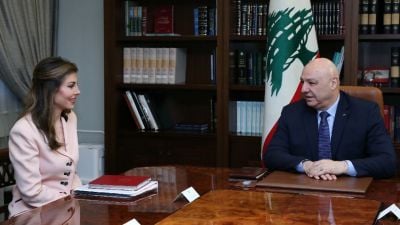
But just two months later, the context changed abruptly with Iran's decision to intervene (and thus involve Hezbollah) in the Syrian conflict. The Baabda Declaration no longer suited Hezbollah, which then withdrew and disavowed its signature. On that occasion, the head of Hezbollah’s parliamentary bloc, Mohammad Raad, famously used a rather contemptuous Lebanese expression about the text of the declaration: "Squeeze it and drink its juice..."
In addition to Sleiman, former Prime Minister Tammam Salam attended the debate, as did former ministers Khaled Qabbani, representing former Prime Minister Fouad Siniora, and Ibrahim Chamseddine, a well-known opponent of Hezbollah and the son of Imam Mohammad Mehdi Chamseddine, who chaired the Higher Shiite Council.
Representatives of President Joseph Aoun and Prime Minister Nawaf Salam were also present, as was Professor Daoud Sayegh, a leading specialist in religious affairs and former advisor to Rafic and Saad Hariri, notably for relations with Bkirki.
While, overall, there was consensus on the idea of establishing some form of neutrality, disagreements emerged on certain points of detail, such as the relevance of the Austrian model, which was imposed from outside following an agreement between the Western powers and the USSR in the 1950s; or whether neutrality should be included in the Constitution, as proposed a few weeks ago by Kataeb leader Samy Gemayel.


 Evening recap: Netanyahu announces West Bank offensive; 7 killed in Jordan church shooting; tents burned in south Lebanon
 US strike on Iran this weekend? ‘Absolutely,’ says Barrack; ‘I have no idea,’ says Trump