






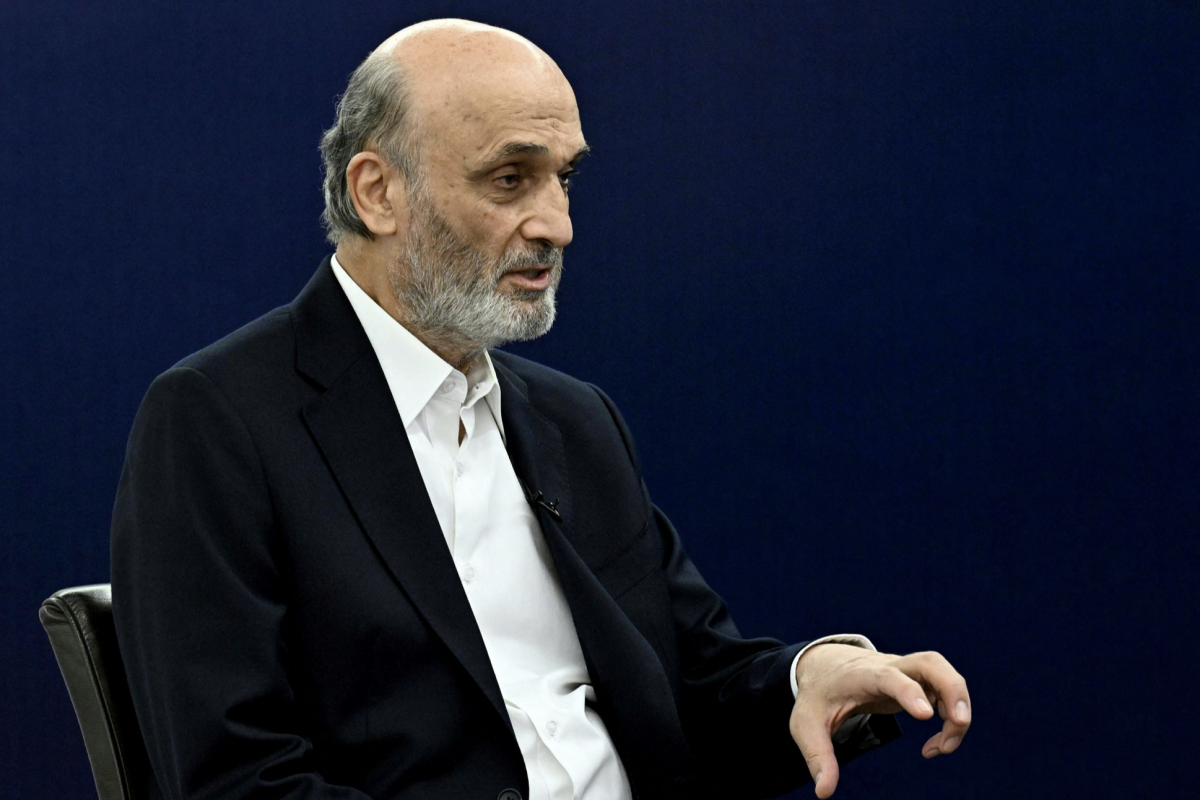
Samir Geagea, leader of the Lebanese Forces (LF), during an interview with AFP at his residence in Maarab, north of Beirut, on Oct. 7, 2025. (Credit: Joseph Eid / AFP)






The leader of the Lebanese Forces (LF), Samir Geagea, says the risk of a new Israeli airstrike campaign in Lebanon is “very high,” according to an interview he gave to the French daily Le Figaro from his residence in Meerab (Kesrouan). He also said Lebanon must “revisit the institutional and political structure of the Lebanese state,” while stressing that this should not become “a subject of negotiation with Hezbollah over its disarmament.”
“Yes, the risk is very high,” the LF leader said when asked whether a new campaign of Israeli strikes could occur “as soon as [the pope] leaves.” Pope Leo XIV will visit Lebanon from Sunday to Tuesday. On Wednesday, Israeli Defense Minister Israel Katz warned that Israel will “intervene forcefully” in Lebanon if Hezbollah is not disarmed “by the end of the year.” On Sunday, the Israeli army killed the Hezbollah military chief of staff, Haytham Tabatabai, in a strike on a building in Beirut’s southern suburbs.
‘Hezbollah is not fulfilling its commitment’
In the interview published Friday, Geagea said the cease-fire agreement that took effect on Nov. 27, 2024, ending open war between Israel and Hezbollah, “was concluded because Hezbollah wanted to put an end to the war, and Israel, for its part, wanted to achieve disarmament.” But, he added, “Hezbollah opted for a Lebanese-style approach and is not fulfilling its commitment.”
Israel and the United States accuse Hezbollah of rebuilding its military forces and the Lebanese army of dragging its feet on disarming the party. Hezbollah, for its part, refuses to hand over its arsenal north of the Litani River to the state.
“The most regrettable thing is that even Lebanon’s traditional friends — France, the United States, Saudi Arabia and the Arab countries — tell us they cannot pressure Israel as long as Hezbollah does not fulfill its side,” Geagea added.
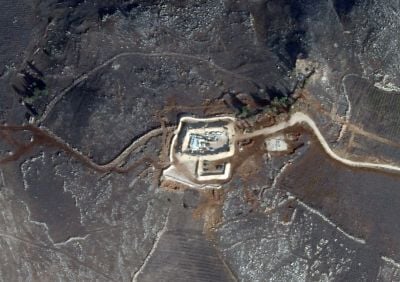
“If Israel still occupies these five positions, it’s to obtain Hezbollah’s disarmament. Because, historically, we have no border problem with Israel,” he said. According to satellite images analyzed by AFP, the Israeli army is strengthening fortifications and expanding access routes to the five positions it occupies in southern Lebanon, in violation of the cease-fire agreement.
In February 2025, Israel justified its continued presence “until it is clear that there is no more Hezbollah activity in southern Lebanon,” and assigned a company to each post. The Israeli army has also systematically demolished buildings and infrastructure in the villages nearest the border.
The Christian leader also criticized what he called the Lebanese state’s mere “literature” on Hezbollah’s disarmament. “The government’s decision to disarm militias, made on Aug. 5, is not enough. It must be accompanied by political resolve. The problem is not military, operational or logistical. So far, I see no practical will to initiate a solution — just political ‘literature’ that leads nowhere,” Geagea said.
“In the face of dogmatic players, you have to act and not fear confrontation; I’m not talking about a military confrontation, but a political one,” he added, warning that without such action, “Lebanon faces an even greater risk, with the threat of a new war” with Israel.
‘Decentralization’
On the domestic political front, Geagea said it is “absolutely necessary to revisit the institutional and political structure of the Lebanese state.” Stabilizing the country, he argued, also depends on implementing broader decentralization. “It’s also one of the conditions for reassuring Lebanese Christians, who are emigrating in large numbers,” he said.
The demand for some degree of local administrative and financial autonomy has gained traction amid a rise of federalist ideas in Christian circles over the past two years.
However, Geagea said he “categorically refuses to make this a subject of negotiation with Hezbollah over its disarmament.” He added: “Disarmament is a prerequisite for keeping our heads above water. The state’s inability, due to the persistence of a mini-state within it, affects every sector. It’s obvious in the inability to resolve Lebanon’s financial crisis since 2019.”