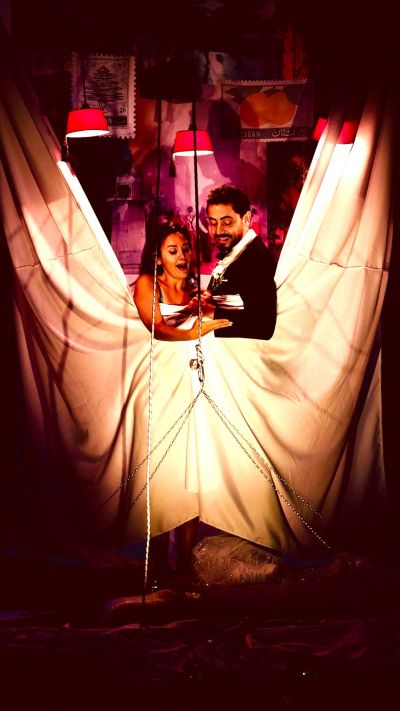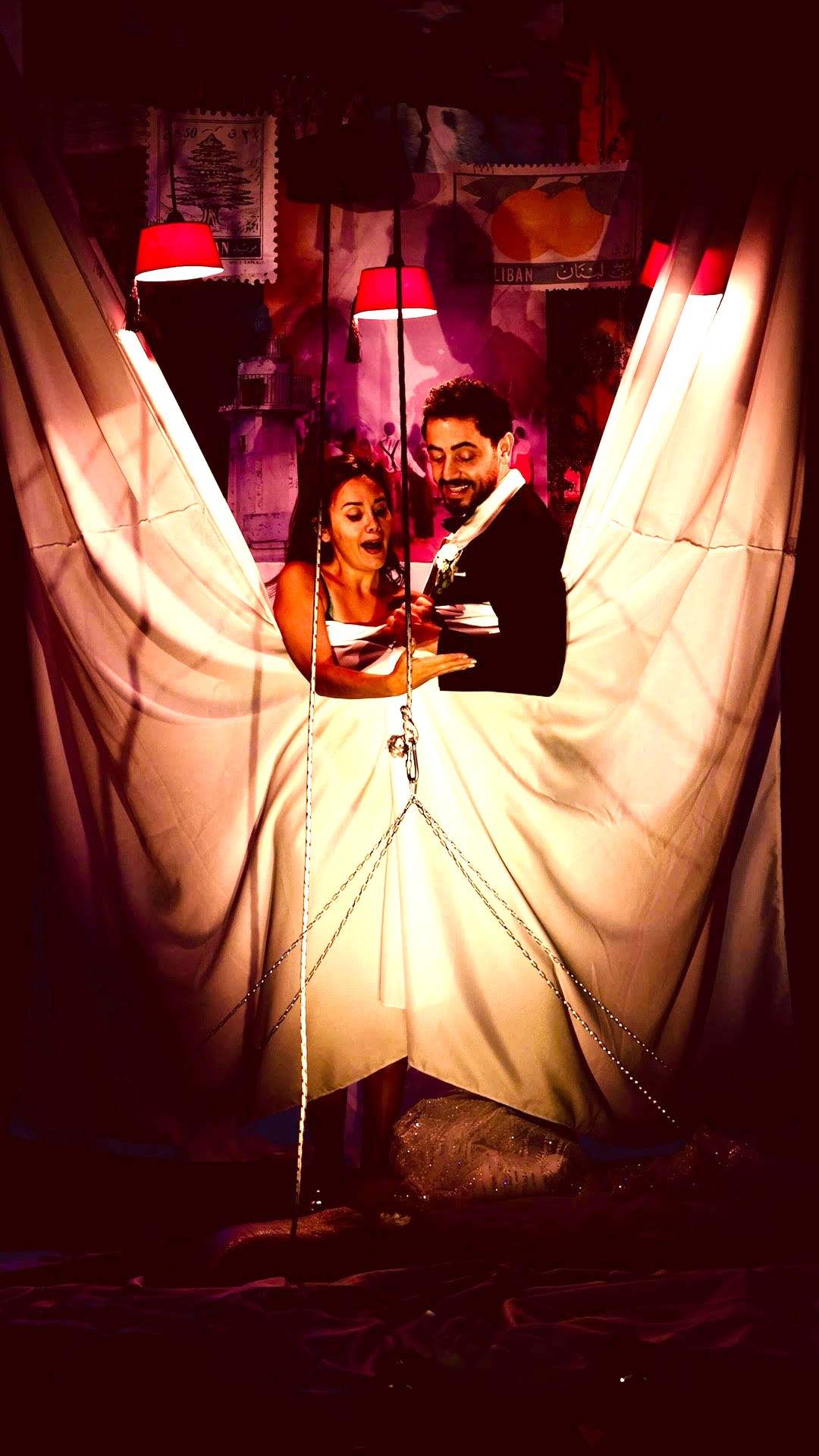
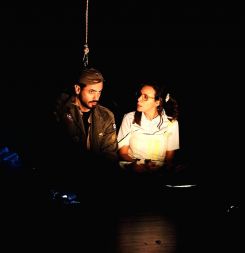
Under the tarboush lanterns, two actors play two versions of Lebanese, one abroad and one at home. (Photo provided by Marwa Khalil)






Hala and Ibrahim met in a shelter, collecting empty sniper shells as children. They learned from an early age how to tell the difference between shells that were fired and those that landed. Together, they confronted fear and nurtured their survival instinct. Until the day she left to seek refuge abroad and became an “expatriate,” a “binational,” while he became irreversibly rooted to this land.
This is a love story striving to endure in a Lebanon perpetually tested by war and its consequences: separation, exile, traumatic memory, cultural differences and that attachment to the homeland experienced so differently by the one who left versus the one who stayed.
In Tarboush jeddeh ma'allak, showing at Monnot Theater on Nov. 26, 27, 28 and 29*, Marwa Khalil and Junaid Zeineldine skillfully bring this romantic duo to life, embodying two versions of Lebanese identity caught between the desire to put down roots and the need to emigrate.
From departures to impossible reunions
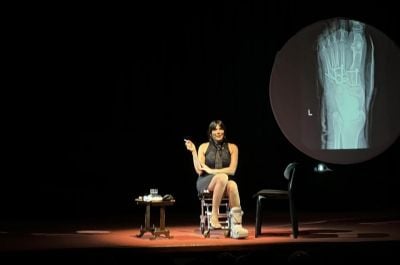
From an anxious little girl to a modern young woman, eternally searching for a stability that she finds neither in Paris, nor Montreal, nor Dubai, Hala is the stereotype of the Lebanese woman living abroad. Always chased by a country she carries within her everywhere and returns to at every lull, every truce, hoping to restore a lost connection represented, in her eyes, by Ibrahim, her childhood partner-in-crime. He too is a stereotype, the archetypal “couldn’t care less, resourceful, resilient” figure, typical of the Lebanese “survivor” he became in adulthood.
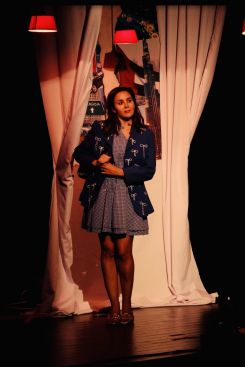
Romantic, the young woman wants to believe their love can overcome everything, even when each of them has grown in a different direction. She will try to overlook their differences, the chronic instability of a society plagued by wars, crises, and tragedies, to adapt to the changes... But each hopeful return will end up tinged by disenchantment.
Humor, rather than pathos
A metaphor for impossible reunions between Lebanese? Between Lebanese abroad and Lebanon itself? A country that seems to constantly slip away from its children. Tarboush jeddeh ma'allak is “dedicated to all Lebanese who have been torn from their country,” says Marwa, the actress, producer, and co-author (with Riad Shirazi) of this romantic comedy that, beneath abundant laughter, offers a subtle reflection on the fractures in our Lebanese identity.
Written with each co-author contributing their perspective as both a Lebanese abroad and a Lebanese at home, the play cleverly avoids falling into tearful melodrama. While Hala’s repeated departures sadly mirror the ongoing list of tragedies facing our fellow citizens, from the early years of the 1975 war to the latest upheavals, explosions and conflicts, the authors choose to address all of this through intensely funny scenes.
Synergy of actors and meaningful set design
The acting duo operates with real chemistry. While Marwa’s performance feels genuinely lived, it is also tinged with healthy self-deprecation that matches well with the sarcastic tone that emerges from Junaid’s act. An actor and impressionist used to stand-up, Junaid seamlessly shifts from the main role to a colorful cast of comic characters with various local accents and backgrounds.
And then there’s Riad’s direction, perfectly serving the piece with a light and creative set design where every element is meaningful. Take, for example, those ghostly white curtains hanging from the ceiling, reminiscent of the white cloths Lebanese would use to cover their furniture before fleeing their homes. Here, they symbolize the different episodes of turmoil and their fluctuating memories that haunt minds.
There is also a string of little red tarboushes (fezzes) constantly swaying above the actors’ heads. As a quintessential symbol of identity, this traditional Levantine hat refers to the famous jibe thrown at Lebanese considered too Westernized: “Shu, tarboush jeddik ou jeddak ma'allak bel tour Eiffel?” (Did your grandfather hang his tarboush on the Eiffel Tower, by any chance?) A question that encapsulates the play’s core issue: where does Lebanese pride lie when identity is split between here and elsewhere?
Within the realm of contemporary Lebanese theater exploring collective memory, rarely has a play evoked the open wounds of a fragmented people and country with such precision in balancing apparent lightness and underlying gravity. You leave both delighted and entertained, with a big smile, and yet, a pinch in your heart — the kind that’s hard to avoid when faced with this comedic inventory of five decades of turmoil and violence, attachment, loss and dashed hopes.
Beneath the veneer of romantic comedy, this is a vibrant meditation on that impossible, visceral, tormented love every Lebanese harbors for the country of the Cedars. Tarboush jeddeh ma'allak returns, after playing at Theatre Tournesol and Casino du Liban, to the stage at Monnot Theater (where it premiered last September) for four performances only. Four opportunities to catch up for those who haven’t seen it yet.
*Nov. 26–29, 8:30 p.m. Tickets available via Antoine Ticketing, at Antoine bookstores and the Monnot Theater box office. Reservations: 70-62 62 00.
This article originally appeared in French on L'Orient-Le Jour.