


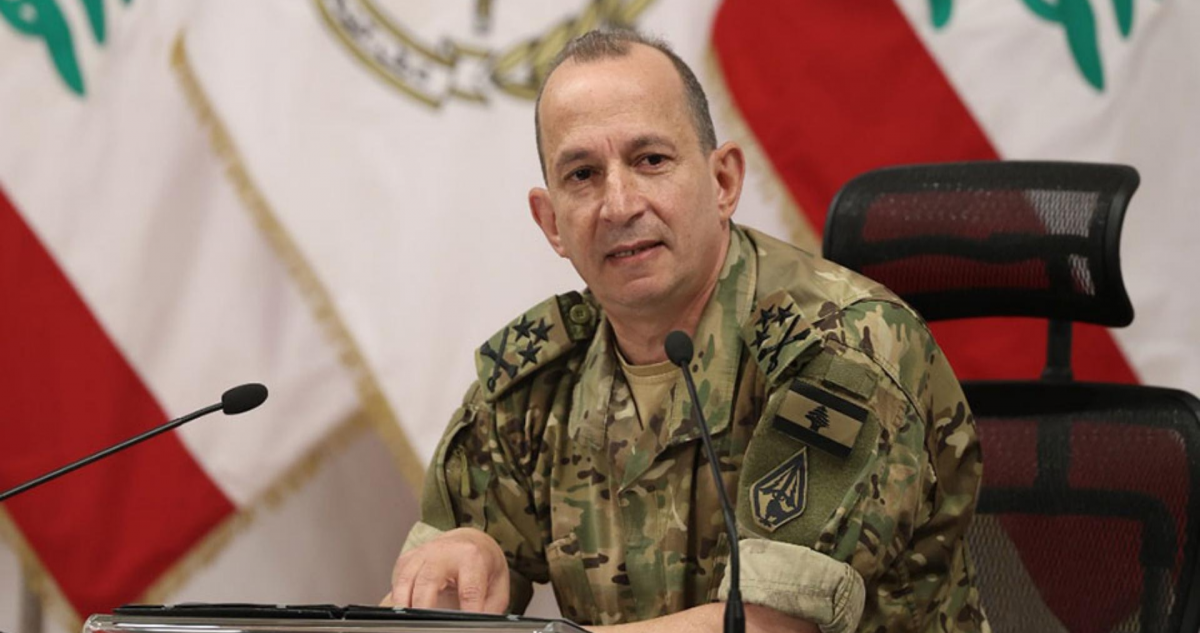
Lebanese Army Commander-in-Chief Rodolph Haykal. (Credit: NNA)






BEIRUT — Lebanese Army Commander Rodolph Haykal's meetings with American officials, scheduled for Wednesday in Washington, were canceled, according to a military source who spoke to L'Orient-Le Jour.
According to several senators' posts on X, the U.S. administration is dissatisfied with the Lebanese Army's handling of Hezbollah's disarmament.
These meetings were canceled while General Haykal was still in Beirut, the army confirmed to our newspaper.
Trump administration 'exasperated' by Beirut
“The Trump administration is frustrated with the Lebanese government and army," wrote Lebanese American businessman Tom Harb on X on Tuesday. "They have canceled all scheduled meetings in Washington, D.C., for Lebanese Army Commander Rodolphe Haykal tomorrow [Wednesday], and the Lebanese embassy in D.C. had to cancel a planned reception in his honor.”
Contacted by L’OLJ, another high-ranking military source declined to comment on the reasons behind the cancellation.
“It is clear that the Lebanese Chief Head of Defense [Haykal] — because of a reference to Israel as the enemy and his weak, almost non-existent effort to disarm Hezbollah — is a giant setback for efforts to move Lebanon forward," wrote Republican Senator Lindsey Graham on X. "This combination makes the Lebanese Army not a very good investment for America.”
Graham is a staunch supporter of Israel and has, in recent months, warned Lebanese authorities that delaying Hezbollah's disarmament could have harmful consequences.
In a statement issued Sunday, the Lebanese Army addressed the Israeli attack on the United Nations Interim Force in Lebanon (UNIFIL) last week, accusing “the Israeli enemy of continuing to violate Lebanese sovereignty and hindering the redeployment of the army in the South.”
Republican Senator Joni Ernst wrote on X on Monday that she was “disappointed by this statement” from the army.
“The Lebanese Army is a strategic partner, and — as I discussed with the CHOD [chairman of the Joint Chiefs of Staff] in August — Israel has given Lebanon a real opportunity to free itself from Iran-backed Hezbollah terrorists," she continued. "Instead of seizing that opportunity and working together to disarm Hezbollah, the CHOD is shamefully directing blame at Israel.”
The United States is the largest donor to the Lebanese Army.
Since the Cabinet decision on Aug. 5 for the army to establish the state’s monopoly on arms, Hezbollah has refused to hand over its arsenal as long as Israeli attacks and occupation continue in the South.
Tasked by the government in September with outlining and implementing a plan to disarm Hezbollah, the army says it has completed most of the first phase of operations in the area south of the Litani River, set to continue through the end of the year.
Detractors in Lebanon and the United States are pushing for its rapid disarmament. Israel continues to attack Lebanon daily, despite the cease-fire that came into effect on Nov. 27, 2024.
On Nov. 6, Haykal suggested during his monthly progress report to the Cabinet that the army would suspend its plan if Israeli attacks continue.
The 'moumanaa' welcomes Haykal's positions
The cancellation of Haykal's visit sparked numerous reactions, particularly among supporters of the 'moumanaa' (the name given to those who support the pro-Iranian axis), who welcomed the positions taken by the army commander-in-chief.
"The Israelis have recently been demanding that the Lebanese Army act as a military police force under their control... It is unacceptable for the army to be subject to the whims of Netanyahu and others!" said Deputy Speaker Elias Bou Saab, a former Aounist who has become close to Nabih Berri. Amal Movement MP Mohammad Khawaja, for his part, "welcomed General Haykal's courageous stance on matters related to preserving peace, sovereignty and defending the country."
"The military institution is not an instrument at the service of anyone; on the contrary, it is the pillar of national stability. It exclusively implements the decisions of the state," insisted former minister Elias Murr. He also denounced "the direct or indirect external pressure exerted by some to drag the army into an internal conflict." "Let us be clear: maintaining civil peace is the red line, and the army is its true guarantor," he added.
 2 Israeli soldiers injured in 'operational accident,' as army continues attacks in the South