






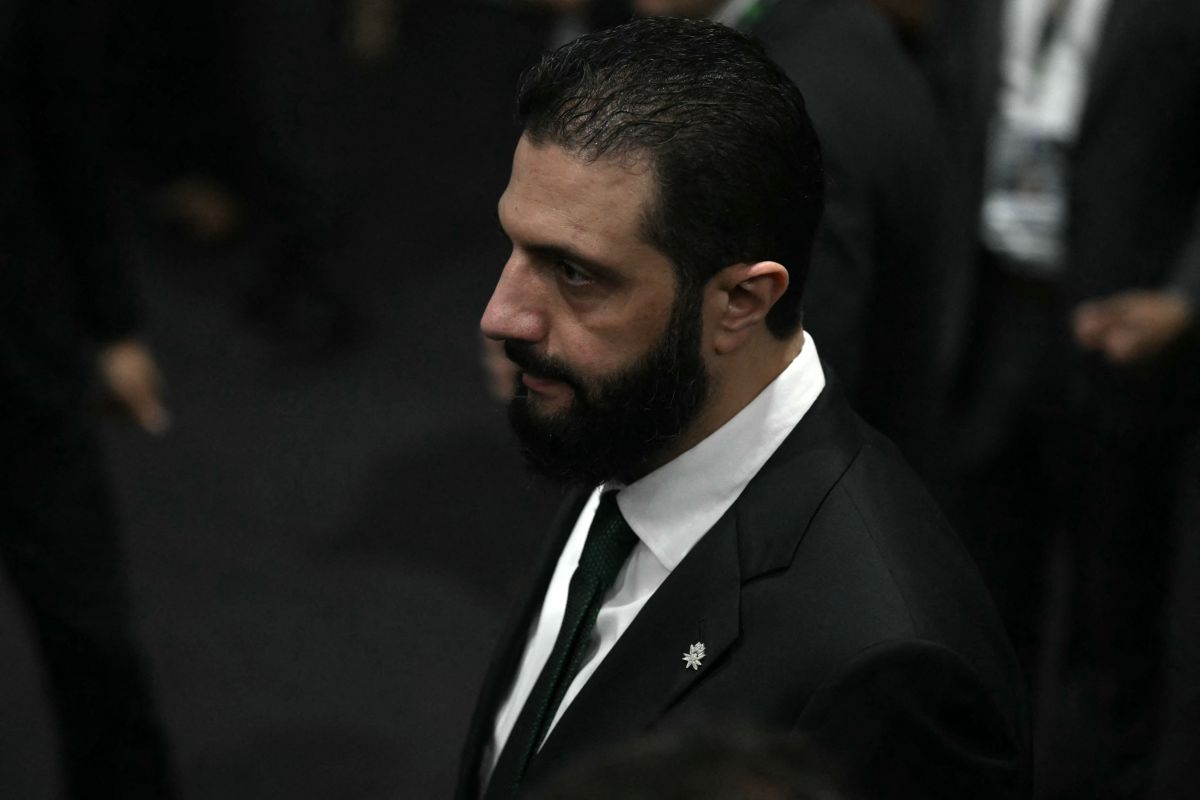
Syrian President Ahmad al-Sharaa arriving at the general plenary session of leaders as part of COP30, in Belém, in the state of Pará, Brazil, on Nov. 6, 2025. (Credit: Mauro Pimentel/AFP)






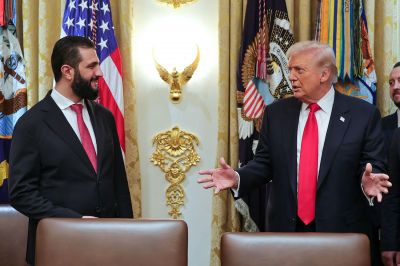
On the sidelines of his historic visit to the White House on Nov. 10, a first for a Syrian president, Ahmad al-Sharaa gave an interview Monday to the Washington Post, in which he spoke about ongoing negotiations, under U.S. supervision, between Syria and Israel regarding a security agreement.
"We are engaged in direct negotiations with Israel, and we have made significant progress towards reaching an agreement. But to reach a final agreement, Israel must withdraw to the borders as they were before Dec. 8, 2024," said Sharaa, referring to the territories seized by the Israeli army following the fall of the Assad regime, beyond the boundary of the Syrian Golan occupied in 1967 and then annexed in 1981.
"Many international actors support our position. President Donald Trump also shares this perspective and wants to reach a solution quickly," he continued.
'We are the ones who expelled' Iranian militias from Syria
Sharaa also denounced what he called "expansionist ambitions" by Israel and voiced concerns over the possibility of a demilitarized zone in southern Syria, demanded by Tel Aviv.
"Israel's advances are not about security concerns but about expansionist ambitions. Israel has always claimed to be worried about Syria because of the threat from Iranian militias and Hezbollah. But we are the ones who expelled those forces from Syria," he stated, recalling that Israel has carried out "more than 1,000 strikes" against his country since Assad's fall.
"Talking about a totally demilitarized zone is difficult: in a case of chaos, who would protect it? In the end, it's Syrian territory, and Syria has to be free to manage it. Israel occupied the Golan for protection, then imposes conditions in the south to protect the Golan. In a few years, they will soon occupy the center of the country to protect the south. They will eventually reach Munich," the Syrian president added with irony.
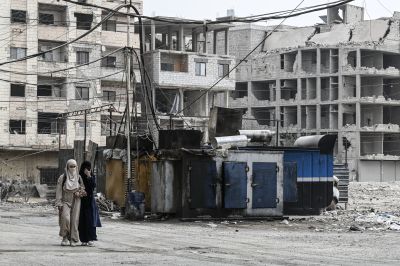
In addition, Sharaa addressed a wide range of topics over the course of the interview, including the issue of lifting American sanctions against his country. "The most important goal is to begin building a relationship between Syria and the United States, because over the past hundred years, this relationship has never been good. We have found many common interests, particularly in security and economics," he said.
On Monday, Secretary of State Marco Rubio announced he had suspended for another 180 days the "Caesar Act," adopted in 2019 during President Trump's first term, "in order to support Syria's economic reconstruction efforts."
This package of sanctions, has stifled the Syrian economy and was already temporarily lifted in late May by the U.S. Treasury and Commerce Departments, following the first meeting between Trump and Sharaa in Riyadh, while its complete removal still needs to be approved by Congress.
"Syria's instability impacts the whole region, and stability is linked to the economy, and economic development depends on lifting the sanctions. This discussion has been going on for months, and I believe we have achieved good results. But we are still waiting for the final decision," the leader emphasized.
On Thursday, the U.N. Security Council also lifted sanctions against Sharaa, at the initiative of the United States.
'Syria can handle the fight against Daesh alone'
The Syrian president also defended his pragmatic approach toward Russia, former ally of Bashar al-Assad, as a Syrian delegation visited Moscow last month.
He highlighted in this context "the existing strategic interests" between Damascus and the Kremlin.
"We fought a difficult war against Russia for ten years, they announced my death several times. But we need Russia: it is a permanent member of the Security Council, and its vote is crucial," he explained.
The Syrian leader also recalled that the hypothetical extradition of the deposed dictator back to Syria is part of these negotiations, while Moscow has granted asylum to Assad after his flight from Syria.
"The Assad file remains a sensitive subject for Moscow. Our relationship with Russia is still at the beginning, but we will maintain our right, as Syrians, to demand that he be tried for his crimes," he added.
While discussing his past as a jihadist fighter, he insisted that Syria is "now able to handle alone" the fight against the Islamic State (IS).
He suggested that its resurgence was due to the fact that northeastern Syria, still controlled by the Kurdish Autonomous Administration, had yet to return to Damascus's fold. "Maintaining areas outside of state control encourages the resurgence of Daesh. The best solution would be for American troops to supervise the integration of the Syrian Democratic Forces (SDF) into the state security forces," he said.
Asked about episodes of communal violence against Alawite and Druze religious minorities, notably on the Syrian coast and in the Sweida region, which have bloodied Syria since he came to power, he drew a parallel with the situation in the United States after the "Civil War" in the 19th century.
"Syria is emerging from a fierce war and 60 years of dictatorship. Was the United States stable one year after the Civil War? No, it took years. We are rebuilding the state and the rule of law, but that does not mean there are no more problems."

