






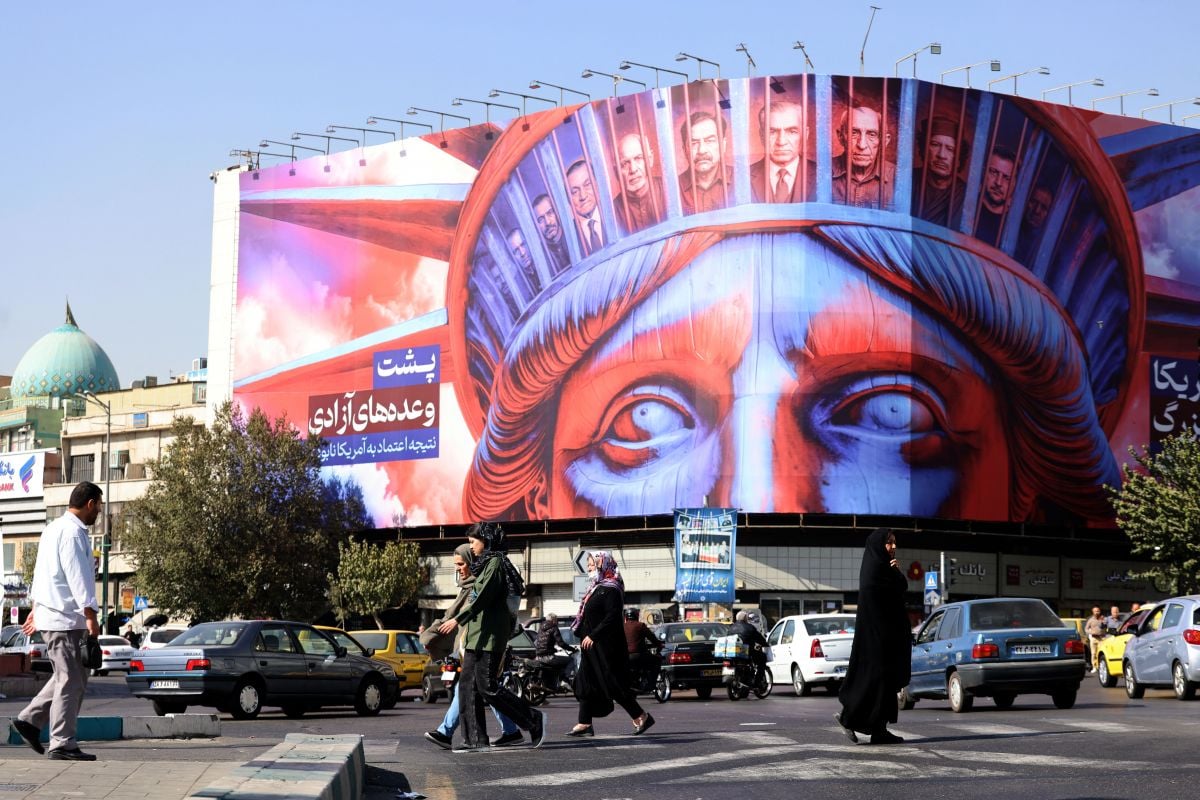
A giant poster depicts leaders behind the bars of the crown of the Statue of Liberty, with the slogan "The promise of American freedom," in Tehran, on the occasion of the 46th anniversary of the start of the hostage crisis, Nov. 4, 2025. (Credit: Atta Kenare/AFP)






On previous visits, Kamran Hekmati had never encountered any trouble for traveling to Israel for his son's bar mitzvah, which happened between seven and 13 years ago, according to various media reports.
But last May, as tensions between Iran and Israel were high and nuclear negotiations looked tenuous following their resumption the previous month, this Iranian American was forced to extend his stay for interrogation.
Banned from leaving the country after being stopped at the airport before his departure, his passport was confiscated, while security forces demanded access to his phone and social media accounts, according to his family.
From there, intelligence agents visited him multiple times for questioning while he stayed at a relative's home in Tehran.
In early July, shortly after the cease-fire announced by President Donald Trump to end the war launched by Israel against Iran, the 70-year-old jeweler was arrested and has since been held in the infamous Evin prison, according to family members who spoke to the media on condition of anonymity.
Hostage diplomacy
At the end of August, Kamran Hekmati was sentenced to four years in prison under a law that forbids Iranian citizens from traveling to Israel.
His family says he was not allowed legal representation before the verdict. In September, however, his sentence was reduced to two years in prison, and a family lawyer filed an appeal, hoping he would be released on humanitarian grounds, as he is believed to be suffering from aggressive bladder cancer.
His relatives stress that the man, born in Iran but who emigrated to the United States at age 13, is not involved in politics, having gone to Israel for personal reasons.
Identified by some media as Yehuda Hekmati, the septuagenarian is said to be an active member of the Great Neck synagogue in Long Island, where he resides, as do a large number of Iranian Jews.
The owner of a jewelry business in Midtown Manhattan, he reportedly entered Tehran with his Iranian passport, knowing that the Islamic Republic does not recognize dual nationality.
The organization Human Rights Activists News Agency (HRANA), which identified him on July 28 as "one of two recently detained American Jews in Iran," noted at the time that the other dual national, from Los Angeles, had been released on bail.
At least four American citizens — Kamran Hekmati, journalist Reza Valizadeh and two women whose identities have not been revealed — are currently being held by the Islamic Republic as part of a "hostage diplomacy" strategy using people with Western passports as bargaining chips on various issues.
The French nationals Cécile Kohler and Jacques Paris were similarly released under conditions last week, after more than three years in prison, following the release of Iranian student Mahdieh Esfandiari under judicial supervision in France.
As sanctions against Iran have tightened, notably with the activation of the "snapback," and nuclear talks appear stalled, American efforts to reach a solution by year’s end could shift the lines for American prisoners.

 8 p.m. recap: Israel again threatens Beirut’s south suburbs; 2 ships hit near Hormuz; Riyadh football matches canceled